Almost every article on WordPress vs custom website hands you two columns of pros and cons and leaves you exactly where you started. That is not a decision, it is a menu. The choice is not really about which technology is better, because neither is. It is about which set of operating costs you are willing to carry for the next five years, and that is a question about your team rather than about code.
So this page skips the columns. It names the five circumstances that actually settle the question, tells you which way each one points, and is equally blunt about when WordPress is the wrong answer and when a custom build is an expensive mistake. You should be able to reach a defensible answer before you talk to anybody, including us.
One thing to get out of the way first. We build both. Redefine Web sells WordPress development and custom web development as separate services, with separate pricing and separate delivery teams. That is a conflict of interest in one direction and a useful position in the other. We do not need you to land on a particular side to make the quarter, which is why the sections below can afford to say plainly when each one is wrong. Weigh that however you like.
What the WordPress vs custom website decision actually turns on
Strip out the marketing and there are five questions. Who maintains the site after launch. Whether your content model is standard or strange. How often the layout changes, as opposed to the content. Whether you have engineering capability in house. And what is supposed to happen the day the person who built it stops answering email.
Notice what is missing. Speed is not on the list, because both approaches can be fast and both are routinely shipped slow. Security is not on the list either, because the attack surface follows what you install and how you patch it, not the logo on the admin screen. Cost is not on the list because cost is an output of the other five, not an input. If you start from a budget you will pick a technology that fits the budget and inherit whichever operating problem comes attached to it.
Work through the five in order. Most businesses find that three point the same way and the decision makes itself. When they split evenly, that is a real signal too, and it usually means the honest answer is a hybrid rather than a compromise on either side.
Who maintains the site after launch
This is the single most predictive question, and it is the one buyers think about last. A website is not a purchase, it is a liability you have agreed to keep current. Somebody has to apply updates, watch for breakage, renew certificates, and fix the thing that stops working on a Sunday.
WordPress externalizes that work. Core, themes and plugins ship their own updates and a competent generalist can apply them. The platform publishes what it recommends a host support, PHP 8.3 or greater and either MariaDB 10.11 or greater or MySQL 8.0 or greater, with HTTPS support, and any mainstream host clears that. A custom application externalizes nothing. Your framework, your dependencies and your deployment pipeline are yours to keep alive, and there is no update button that a marketing coordinator can press.
So ask the question in its operational form. If your site broke at 9 p.m. on a Friday, who would fix it, and do they already exist? If the honest answer is a retainer with an agency, either approach works and the retainer is the real product. If the honest answer is your office manager, WordPress. If the honest answer is a named engineer on your payroll who already runs other systems, custom becomes viable.
Do not let the answer be nobody. That is the outcome the two approaches differ on most sharply, and it is where a custom build punishes you hardest. An unmaintained WordPress site degrades noisily and publicly, which at least gets noticed. An unmaintained custom application usually keeps serving pages while its dependencies quietly age out of support, and you find out during an incident.
Price the answer before you pick the platform, not after. Whatever you decide to build, the ongoing cost of keeping it alive is a real line item rather than a rounding error, and comparing what different maintenance tiers actually cover tells you more about the five-year number than the build quote does. A build quote is a one-time figure you will forget. The maintenance arrangement is the one you live inside.
Whether your content model is standard or strange
A content model is the shape of the things you publish. Pages, posts, services, locations, team members, case studies. If you can describe everything your site holds using those words, your model is standard, and standard is what a content management system is built to do well.
Strange models are the ones with real behavior attached. A product configurator where choosing one option removes three others. A member area where what you see depends on your plan and your renewal date. Inventory that has to agree with a warehouse system minute by minute. Pricing that is calculated rather than typed. These are not content, they are software wearing content’s clothes, and the moment you try to express them as custom fields you start writing an application inside a CMS with none of an application’s tools.
Our own custom development page states the threshold we use internally and publishes the examples, saying WordPress “hits a wall at role-based dashboards, multi-tenant billing, or 200+ SKUs with real-time inventory” and that “If the workload needs 4+ plugins bolted together, the right call is Laravel or Next.js picked to the workload.” That plugin count is a useful proxy in either direction. Three plugins to add capability is a CMS doing its job. Seven plugins wired together to imitate one feature is a warning that the model has outgrown the tool.
Test your own model before anybody quotes you. List every type of thing your site will hold and write one sentence describing it. If a sentence contains the words depending on, calculated from, or in sync with, you have found application behavior, and that item belongs in a scope conversation about what custom development actually costs by band rather than in a list of custom fields. One such item does not decide the build. Four of them do.
How often the layout changes
Content changing is normal and both approaches handle it. The question is how often the structure changes. How often somebody needs a page that does not look like any existing page, arranged in a way no template anticipated, without waiting for a developer.
If that happens weekly, because you run campaigns and every campaign wants its own landing page, you need composition in the hands of the marketing team. That is a CMS with a real block editor, and it is the strongest argument for WordPress that exists. If it happens twice a year, paying for editable layout is paying for flexibility you will not use, and you are better served by a small set of tight templates that a developer changes when the brand changes.
There is a trap on the WordPress side of this, and it is worth naming because it is the most common way these builds go wrong. Reaching for layout freedom usually means reaching for a page builder, and page builders are close to universal. W3Techs measured Elementor on 31.6 percent of WordPress sites, WPBakery on 7.4 percent, in figures dated 16 September 2026. They deliver the freedom and they charge for it in page weight, in lock-in, and in a site that nobody can rebuild without the builder. Editable layout and page-builder sprawl are not the same purchase, even though they are usually sold as one.
The same trap has a milder version further down the budget, where the real choice is between a theme you configure and a layout somebody draws for you. Our breakdown of responsive templates measured against custom site builds covers that end, and the deciding question is the same one. How many genuinely new page shapes do you need in a year, and who is allowed to make them.
Whether you have engineering capability in house
Capability here means something narrower than it sounds. It is not whether somebody on staff can code. It is whether your organization can review a pull request, run a deploy, read a stack trace, and decide when to upgrade a dependency. That is a process, and most businesses under a certain size do not have one, which is a perfectly reasonable thing to be.
It also matters that the two halves of the job are different skills. A person who can arrange a page well is not automatically a person who can maintain a deployment, and the line between web design and web development is where a lot of staffing plans quietly break. Teams hire for the visible half, then discover the invisible half was the part that needed an owner.
Without that process, a custom build makes you permanently dependent on whoever wrote it. That is not automatically bad. Plenty of companies run happily on a vendor relationship for a decade. It becomes bad when it is unintentional, because a dependency you chose is a contract and a dependency you stumbled into is a hostage situation.
WordPress changes the math because the skill is commodity. The platform is on 58.8 percent of sites whose content management system is known and 40.2 percent of all websites, per W3Techs on 19 September 2026, and its plugin directory carries tens of thousands of free plugins. You may not love what that ubiquity does to quality, but it means the pool of people who can pick your site up is enormous, and enormous pools price competitively. The pool of engineers who can pick up an undocumented bespoke application is small, expensive, and correctly suspicious of the job.
What happens when the developer leaves
Ask the question before you sign, because after launch it is not a question, it is an incident. Every build eventually outlives the relationship that produced it. Agencies get acquired, freelancers change careers, and the in-house developer who built the thing takes a better offer.
The thing that determines whether that is an inconvenience or a crisis is not WordPress or custom. It is whether the handoff artifacts exist. Code in a repository you own rather than the builder’s. Hosting and domain registrar accounts in your name. A written architecture document. A runbook for the failure modes that actually occur. Somewhere a new engineer can read why a decision was made rather than guessing.
Custom builds are more exposed to this failure because there is more knowledge that exists nowhere except in one person’s head, and a bespoke architecture has no community to ask. But a WordPress site assembled out of licensed plugins under the agency’s accounts, on the agency’s hosting, with a page builder whose license is the agency’s, fails the same test just as badly. The difference is that the WordPress version is recoverable at a price, and the undocumented custom version sometimes is not recoverable at all.
Make it contractual rather than cultural. Ownership of code, accounts, design files and content is a clause, and any builder who resists writing it down has told you what the arrangement really is. It is worth reading a checklist for choosing a web design and development company before you shortlist, because the handoff terms are usually decided in the selection stage and almost never renegotiated afterward.
When WordPress is the wrong answer
WordPress is wrong when the site is mostly application and incidentally content. If the pages your users spend their time on are dashboards, account areas, configurators or anything where the screen changes according to who is looking at it and what they have done, you are building software. The CMS becomes overhead you carry on every request for the sake of a marketing site bolted to the side.
It is wrong when the data has to be right rather than merely current. Real-time inventory, financial balances, availability that governs whether somebody can book. WordPress can hold that data. What it does not give you is the transactional discipline, the test coverage and the deployment control you want around data that has consequences when it is stale.
It is wrong when your compliance posture demands things that are phase-two thinking in most WordPress work. If procurement will ask for enterprise single sign-on, a security questionnaire and a staging environment that mirrors production before your buyer is allowed to run a trial, build for that on day one. Retrofitting it is where these projects die.
And it is wrong when the plugin count has already told you. If the honest specification needs several plugins bolted together to fake one coherent feature, you are paying for a workaround forever, plus the maintenance of every plugin in the chain, plus the risk that any one of them is abandoned.
When custom is an expensive mistake
Custom is a mistake when the actual requirement is a brochure. A services business with a dozen pages, a contact form and a blog is describing the exact workload a content management system was invented for. Building that bespoke buys you a slower first launch, a smaller pool of people who can maintain it, and no capability you could not have had for less.
It is a mistake when it is bought for performance. Custom code can be fast and frequently is not, because speed comes from the size of what you ship, the images, the fonts and the scripts, and a bespoke build can carry all the same weight. If speed is the goal, buy a speed budget as a launch criterion with a number attached to it, on either platform. Do not buy an architecture and hope.
It is a mistake when it is bought for security. Bespoke code is not audited by anyone but you, has no community reporting vulnerabilities into it, and inherits the same dependency risk through its own package manager. What you are buying is a smaller target, not a safer one, and you are buying it with the obligation to find your own bugs.
Most expensively, it is a mistake when it is bought to escape a bad build rather than a bad platform. A slow, unmaintainable WordPress site is usually the result of a page-builder stack and thirty plugins, and rebuilding it properly on the same platform solves the problem at a fraction of the cost. Replatforming to punish the last vendor is the most common way a business spends five figures to arrive somewhere it could have reached for less.
Before you accept that a rebuild on the same platform is a downgrade, put the two quotes side by side. Look at what a WordPress build costs by package and at what a custom engagement includes for a growth team, and check whether the custom quote is buying capability you named or reassurance you are feeling. A specification written before either quote arrives is the only thing that answers that honestly.
What we build, and what that costs us to admit
We said at the top that we sell both, so here is the specific shape of it, taken from our own service pages rather than described generously. Our WordPress work is a custom Gutenberg theme with typed fields, and the page states a starting fixed price of $18,000 and a typical build timeline of 8 to 12 weeks, with fewer than 15 plugins and a 95 or better mobile Lighthouse score written in as a launch criterion rather than a hope. Our custom work is built on the stack a client’s team already runs, listed as Next.js, Laravel, Node, headless WordPress or Shopify Hydrogen, with a stated median of 9 weeks from build to launch.
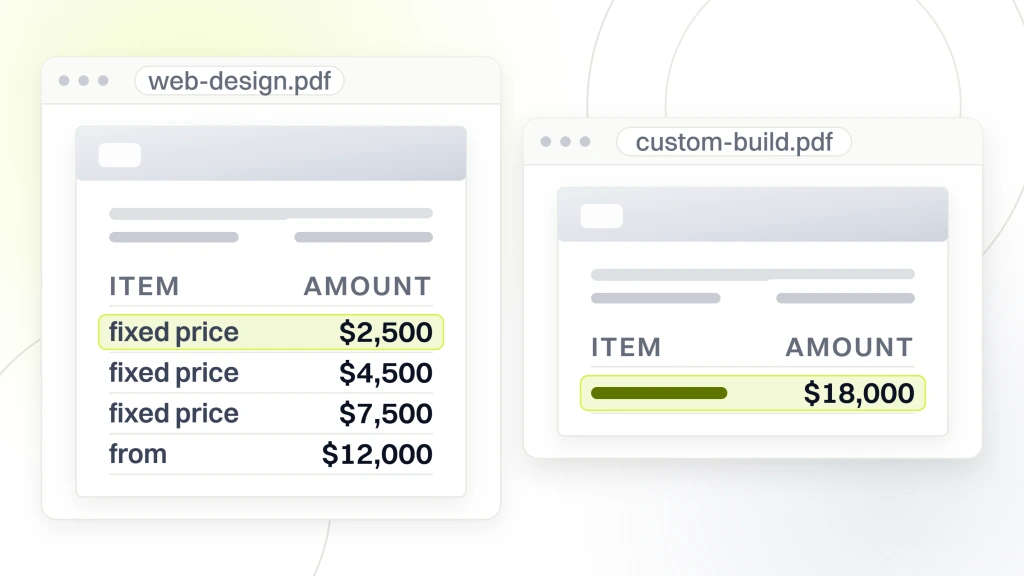
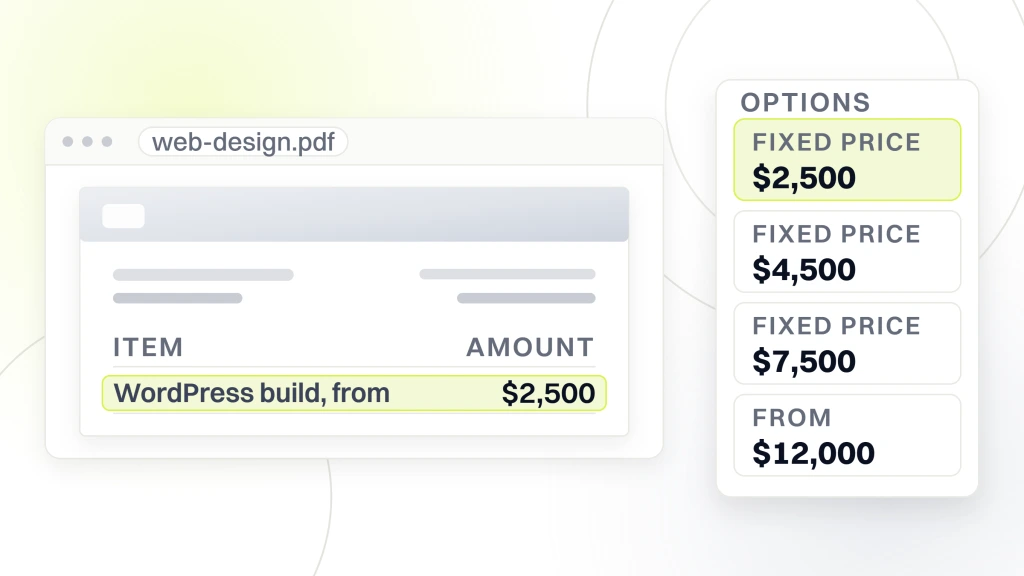
Two things follow that are not in our interest to say. The first is that a large share of the businesses who ask us for a custom build do not need one, and the five questions above are how we tell. The second is that the same WordPress page also carries our fixed-price web design ladder, which starts at $2,500 and runs through $4,500 and $7,500 to an Enterprise tier that starts at $12,000. So a buyer reads a $2,500 entry price on the same screen as an $18,000 starting price. Those are two different products, a templated web design build and a bespoke WordPress development engagement, and our own page does a poor job of saying so. We are telling you rather than quietly quoting whichever number suits the argument, and the gap between the two is wide enough that some buyers should be at the bottom of that ladder and not talking to us about architecture at all.
There is also a middle road we would rather you knew about than discovered late. Headless WordPress keeps the editing experience your marketing team already knows and puts a custom front end in front of it. It is the correct answer more often than either pure position, and it is worth pricing before you commit to a side.
What does not change between the two is the process. Discovery, a signed scope, design against real content, weekly staging and a monitored cutover look the same whether the output is a custom WordPress theme or an application, and a builder whose development process gets vaguer as the technology gets fancier is telling you something about the technology choice too.
How to settle it in an afternoon
Write the five questions down and answer them in writing, because a verbal answer will drift to whatever you already wanted. Who fixes it on a Sunday. Can you describe every content type in ordinary nouns. How many genuinely new layouts do you need in a year. Can your organization review a deploy. What is the written handoff, and is it a clause or a promise.
Count the answers. Three or more pointing at a CMS means build on WordPress and spend the saved budget on content and distribution. Three or more pointing at software means build custom and staff it properly rather than hoping a retainer covers it. An even split means look hard at headless before you flip a coin, because an even split is usually describing a site with a real front end problem and an ordinary content problem behind it.
Then do one more thing. Take your answers to two builders who sell different things and see whether either changes their recommendation when they read them. On the question of WordPress vs custom website, the builder whose advice moves with your circumstances is the one worth hiring, and the one whose recommendation was fixed before you opened your mouth has told you which product they need to sell this quarter.