B2B SaaS Go to Market Strategy for Modern Product Launches
February 18, 2026·17 min read·By omorsarif
Key takeaways
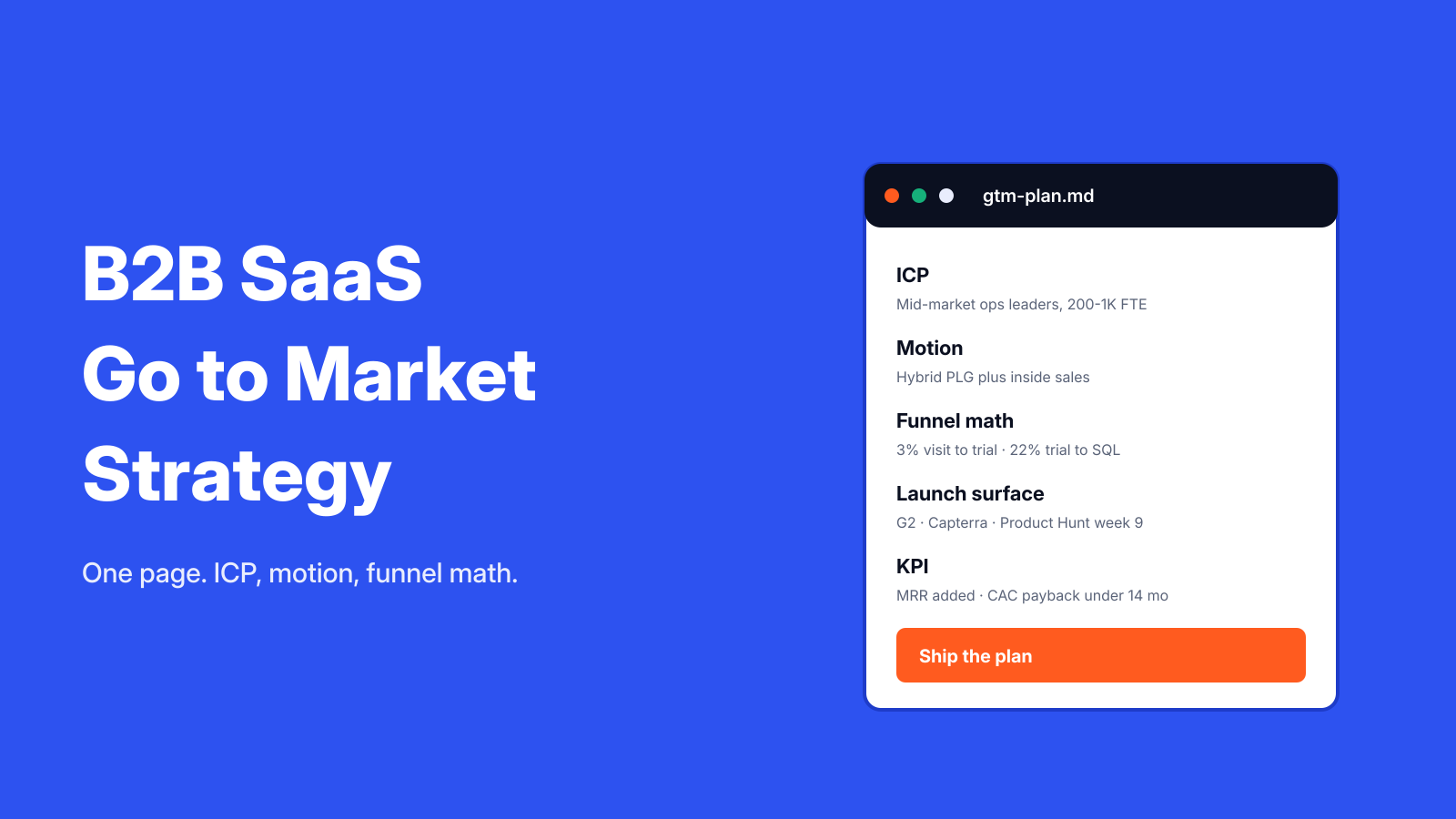
A B2B SaaS go to market strategy names the ICP, the motion, the pricing model, the launch surface, the funnel math, and the KPI on one page.
The ACV band picks the motion. Under $5K goes product-led. $5K to $30K runs hybrid. $30K and up goes sales-led with ABM.
The funnel math from visit to closed ARR is what tells the plan whether the top of funnel actually feeds the revenue target.
Attribution wired into HubSpot, Salesforce, or Marketo on day one is the difference between grading channels on data and arguing about them.
The plan grades on MRR added, ARR run rate, logo churn versus revenue churn, and CAC payback in months. MQL count is a vanity number.
A B2B SaaS go to market strategy is the written plan for how a product reaches its first thousand paying accounts and every cohort after. It names the ICP, the motion, the launch surface, the funnel math, and the metric that says the plan is working. This piece walks through the framework we run for SaaS clients, the numbers we grade against, and the mistakes that show up when a team skips a step.
What a B2B SaaS go to market strategy actually covers
A B2B SaaS go to market strategy is not a slide deck of positioning statements. It is the operating file that connects the product, the buyer, the channel mix, the sales motion, and the revenue target. Every serious plan we have seen fits on one page and reads like a checklist. The vague ones read like a manifesto and never survive the first quarter. The same shape shows up when founders vet the best B2B SaaS marketing agencies and find only two or three of ten can screen-share a real CRM pipeline chart.
The six pieces every plan must name are the ICP with a firmographic definition, the primary motion (product-led, sales-led, or hybrid), the pricing model with a free-to-paid path, the launch surface (Product Hunt, G2, LinkedIn, or an ABM list), the funnel math from visit to closed ARR, and the KPI that says the plan is working this quarter. Miss one and the team ends up guessing at the daily stand-up.
68%
of B2B SaaS launches under $10M ARR miss their first-year revenue target when the go to market plan is longer than one page.— Redefine Web internal data, 34 SaaS engagements 2022-2025
Define the ICP before the launch date is set
The single biggest reason a B2B SaaS go to market strategy misses is a soft ICP. Teams write “mid-market operations leaders” and start spending. Six weeks later the CAC is triple the plan and no one can point to a repeatable win. Naming the firmographic (employee count, revenue band, tech stack, geography) and the persona (title, seniority, buying trigger) forces the channel and message choice for you.
Our SaaS engagements start with a 40-point ICP scorecard. Twenty points on firmographic (industry code, employee count, revenue band, geography, funding stage, tech stack signal). Twenty points on behavioral (site visit depth, content downloaded, competitor comparison viewed, demo scheduled, hand-raise timing). Accounts that score above 28 go into the active pipeline. Accounts below 28 stay in nurture. That one filter cuts wasted SDR time roughly in half and pulls CAC payback in by 3 to 5 months on the average deal.
When Camu Digital Campus came to us in 2023, their EdTech SaaS was running broad Google and LinkedIn campaigns across every school administrator title. We rewrote the go to market plan around three named personas: K-12 IT decision-makers, higher-ed academic leaders, and multi-campus procurement heads. Persona-driven Google and LinkedIn campaigns grew qualified leads 70%, dropped CPA 28%, and moved LinkedIn engagement from 0.2% to 1.2%. Same product. Sharper ICP.
Choose the motion before the channel plan gets written
The motion is the single choice that shapes every downstream decision in the go to market plan. Product-led (PLG) sells through a free tier or trial and lets the product do the selling. Sales-led sells through named reps and closes six-figure contracts on a call cycle. Hybrid runs a PLG top-of-funnel that hands warm signups to a sales team once they cross a usage threshold. The wrong motion for the ACV band burns cash for six to nine months before anyone catches it.
How ACV picks the motion for you
Annual Contract Value
Primary motion
Sales team shape
Common launch surface
Under $5K
Product-led (PLG)
No SDRs. Growth PMM + lifecycle
Product Hunt, SEO, community
$5K to $30K
Hybrid (PLG + inside sales)
SDR + AE pod
G2, Capterra, paid search, review sites
$30K to $100K
Sales-led with content assist
Full SDR to AE to CS handoff
ABM lists, LinkedIn ABM, events
$100K plus
Enterprise sales-led
Named accounts, field AE, SE
Analyst reports, executive dinners, ABM
The ACV band picks the motion, not the founder’s preference.
The ACV threshold that pushes a plan into ABM is $30K. Under that number, ABM tooling like 6sense, Clearbit, or Demandbase costs more than the pipeline it produces. Above it, the account-level intent signal pays for itself inside two quarters. That one call determines whether the SDR team spends their day cold-calling from a list or working inbound signups that opened three product pages last night.
$30K
ACV threshold where ABM tooling starts to pay back inside two quarters for a B2B SaaS go to market plan.— Redefine Web internal benchmark
Build the funnel math from visit to closed ARR
The funnel math is the row of conversion rates the go to market plan lives or dies on. A B2B SaaS funnel typically reads: unique visit to signup, signup to activated user, activated to sales-qualified lead (SQL), SQL to opportunity, opportunity to closed-won, closed-won to expansion. Every stage has a benchmark and a lever. If the plan does not name the target rate at each stage, it is not a plan.
The rates that hold up across the SaaS engagements we run are roughly: 2 to 4% visit to trial signup on a well-optimized product page, 25 to 40% signup to activated (defined as one meaningful product action inside 7 days), 15 to 25% activated to SQL, 20 to 30% SQL to opportunity, 20 to 35% opportunity to closed-won for mid-market. Multiply those and a well-targeted 100,000 monthly visitors delivers roughly 15 to 40 closed accounts a month. That math tells you whether the top-of-funnel plan feeds the revenue target or whether it is short by a factor of three.
Simply.Coach, a coaching SaaS platform, came to us in 2024 with a new domain, sparse organic traffic, and inefficient paid spend. Their funnel math showed the ceiling was at the top: not enough qualified visits to feed the trial. We rebuilt the site architecture around user intent, added keyword-gap content, and restructured Google, LinkedIn, and Facebook campaigns with lead-gen forms and single-image conversion ads. Inside 48 days, organic leads grew 80% and paid leads grew 120% at a lower ad budget. Same product, tighter funnel math, better mix.
Freemium versus 14-day trial and the conversion math that decides
The choice between freemium and a 14-day trial is not a preference. It is a math problem. Freemium converts 2 to 5% of active users to paid over time and requires a product that delivers standalone value on the free tier without giving away the paid one. Trial converts 15 to 25% of activated trials but requires a fast time-to-value inside two weeks and often needs a credit card up front to filter tire kickers.
Model
Typical paid conversion
Time to first value
Best fit
Freemium (no card)
2 to 5%
Days to weeks
Wide TAM, viral loops, low ACV
14-day trial (no card)
10 to 18%
Under 24 hours
Mid-ACV, clear job-to-be-done
14-day trial (card)
18 to 30%
Under 24 hours
High-intent buyers, less noise
Demo-then-trial
25 to 45%
Sales-scheduled
$30K+ ACV, complex setup
Pick the model that matches the ACV band, not the founder’s preference. A $99/month product on a demo-then-trial funnel loses to a $20K/year product on the same funnel every time, because the sales cost eats the margin. Run the LTV to CAC math on both models before the launch date is locked. A 3:1 LTV to CAC is the floor. Below that, the plan is buying revenue, not building it.
Wire attribution into HubSpot, Salesforce, or Marketo before launch
The go to market plan is a story about what worked. Attribution is what tells that story with numbers. If the CRM is not capturing gclid, li_fat_id, msclkid, and the UTM set at first-touch and at opportunity creation, the marketing team is guessing which channel drove the pipeline. Every SaaS launch we have joined mid-flight has had at least one broken attribution field, and every one of them has been arguing over which channel to cut.
The setup that holds up across HubSpot, Salesforce, and Marketo is: capture gclid, li_fat_id, msclkid, and utm_source, utm_medium, utm_campaign, utm_content, utm_term on every form submission and store them as custom fields on the contact record. Roll them up to the account. Stamp the opportunity with first-touch, last-touch, and multi-touch on creation. That is what lets the plan grade Google Ads against LinkedIn ABM against Product Hunt six months in.
Rapyd Financial Network, a fintech SaaS out of the UK, illustrates what a fixed attribution stack changes. They came to us with a fragmented Salesforce plus Zapier setup, roughly 5 leads a month, and no view of which spend was working. We rebuilt the site, moved the CRM to HubSpot, restructured Google Ads around high-intent SaaS keywords, layered in LinkedIn Ads for decision-maker targeting, and added gated content downloads for SEO. The result was 3x monthly inbound leads, £1.8 million in pipeline added, and 5x organic traffic growth. None of that shows up on a dashboard without attribution wired in on day one.
Sequence the launch surface across Product Hunt, G2, and Capterra
The launch surface is where the go to market plan meets the buyer for the first time. A B2B SaaS launch that hits only the company blog and a LinkedIn post from the founder is a launch in name only. The three surfaces that move the needle are Product Hunt for the developer and early-adopter audience, G2 for the mid-market evaluator, and Capterra for the SMB buyer running a comparison shortlist.
The sequencing we run is a 12-week launch calendar. Weeks 1 to 4 seed the review base on G2 and Capterra with 15 to 25 verified reviews. Weeks 5 to 8 open a Product Hunt hunter conversation and prep the launch assets. Week 9 or 10 runs the Product Hunt launch on a Tuesday or Wednesday. Weeks 11 to 12 push the paid layer on Google Ads and LinkedIn against the review base and the Product Hunt badge. Skipping the review seed phase is why most launches show a spike day and a flat week.
Grade the plan on MRR, ARR, and CAC payback every 30 days
The metric a B2B SaaS go to market strategy grades against is not MQL count. It is MRR added, ARR run rate, logo churn versus revenue churn, and CAC payback in months. MQL is a lagging vanity number in a SaaS motion. The three questions the plan needs to answer every 30 days are: how much new ARR closed this month, what is the CAC payback on the last cohort, and is logo churn tracking above or below revenue churn.
The one distinction worth calling out is logo churn versus revenue churn. Logo churn counts accounts lost. Revenue churn counts dollars lost. If logo churn runs high but revenue churn stays flat, small accounts are leaving and big ones are expanding, and the plan is working on the segments that matter. If revenue churn outpaces logo churn, the biggest accounts are leaving and the segment fit is wrong. The plan needs a rewrite on ICP, not on channel.
14 mo
median CAC payback for a healthy B2B SaaS motion. Anything past 24 months signals the go to market plan is buying growth, not compounding it.— OpenView 2024 SaaS Benchmarks
Publish the plan as one page the whole company can quote
The last step in a B2B SaaS go to market strategy is the one most teams skip. Write it up as one page. Name the ICP in a sentence. Name the motion in a sentence. Name the ACV band, the funnel math, the launch surface, and the KPI that says the plan is working. Print it. Pin it to the top of the internal wiki. When a new AE joins in month four, they should be able to quote the plan on day one.
The one-page format also forces the honest conversation. Teams that cannot fit their plan on a page are usually hiding a soft ICP, a mismatched motion, or a funnel math they have not run yet. Writing it short exposes the gap. Fix the gap before the launch date, not six weeks after.
Frequently asked questions about B2B SaaS go to market strategy
What does a B2B SaaS go to market strategy include
A B2B SaaS go to market strategy names the ICP with a firmographic and behavioral definition, the primary motion (PLG, sales-led, or hybrid), the pricing model, the launch surface, the funnel math from visit to closed ARR, and the KPI that grades the plan every 30 days. It fits on one page. Anything longer is execution detail.
The plan reads as a working file, not a slide deck. Every SaaS engagement we run starts with the six-line summary and a 40-point ICP scorecard. Teams that skip the one-page discipline end up with a 60-slide deck that no one on the sales team can quote at the daily stand-up, and the KPI drift shows up by the second quarter.
How is a B2B SaaS go to market strategy different from a marketing plan
A B2B SaaS go to market strategy covers the entire path from product to closed ARR. A marketing plan covers the top of that funnel: awareness, demand generation, and lead capture. The go to market plan owns the motion (PLG, sales-led, hybrid), the pricing model, the sales team shape, the launch surface, and the CAC payback target. Marketing owns the demand engine that feeds it.
Most SaaS teams under $10M ARR run a go to market plan and a marketing plan as one file. Above $10M, they split. The go to market plan sits with the CRO or founder, and the marketing plan sits with the CMO. Confusing the two is what drives the classic argument between sales and marketing about lead quality. The plans need to name who owns what before the launch date is set.
When does ABM belong in a B2B SaaS go to market strategy
ABM belongs in a B2B SaaS go to market strategy once the ACV crosses $30K. Below that, ABM tooling like 6sense, Clearbit, or Demandbase costs more per opportunity than the pipeline it produces. Above $30K, the account-level intent signal pays for itself inside two quarters and the SDR team can prioritize accounts that opened three product pages last night over a cold list.
The other trigger is deal complexity. A $15K ACV product with a 90-day sales cycle and a five-person buying committee benefits from ABM even under the dollar threshold, because the intent signal shortens the cycle. A $50K ACV product with a fast one-buyer close does not need it. The plan needs to grade both dollar and cycle, not just ACV alone.
How long does a B2B SaaS go to market strategy take to show results
A well-built B2B SaaS go to market strategy shows movement on top-of-funnel metrics inside 30 to 60 days and on pipeline inside 90 to 120 days. Closed ARR at plan levels typically takes two to three quarters. Anything faster is usually the launch spike rather than the compounding engine.
The 48-day result on Simply.Coach (80% organic lead growth, 120% paid lead growth) is unusually fast because the funnel math ceiling was already at the top and the fix was mostly technical. Most SaaS launches sit closer to the 90-day pipeline window and the 6-month closed-ARR window. Plans that promise faster are almost always spending against pipeline they have not built yet.
What is the biggest reason a B2B SaaS go to market strategy fails
The biggest reason a B2B SaaS go to market strategy fails is a soft ICP. Teams write a wide ICP so nothing is off the table, then spend across channels without a filter, and the CAC runs 2 to 3x the plan for six months before anyone catches it. Sharpening the ICP fixes the plan faster than any channel swap.
The second reason is a mismatched motion. Running a PLG plan on a $50K ACV product wastes the free tier and shorts the sales team. Running a sales-led plan on a $99/month product buries the margin in SDR cost. The ACV band picks the motion. The plan needs to respect the math.
Do I need a go to market strategy for a product update or only a full launch
A B2B SaaS go to market strategy is required for a full launch and for any major update that moves the ACV band, opens a new persona, or unlocks a new price tier. Minor feature updates run on the standard launch calendar, not on a new plan. The test is whether the update changes the ICP, the motion, or the funnel math. If yes, the plan needs a rewrite.
An enterprise tier launch on a mid-market product is a full plan rewrite. A UI redesign is not. Confusing the two is how SaaS teams end up with three overlapping plans and no clear owner. Keep the launch calendar tight and reserve the go to market plan for the launches that actually reset the target.
{
“@context”: “https://schema.org”,
“@type”: “FAQPage”,
“mainEntity”: [
{
“@type”: “Question”,
“name”: “What does a B2B SaaS go to market strategy include”,
“acceptedAnswer”: {
“@type”: “Answer”,
“text”: “A B2B SaaS go to market strategy names the ICP with a firmographic and behavioral definition, the primary motion (PLG, sales-led, or hybrid), the pricing model, the launch surface, the funnel math from visit to closed ARR, and the KPI that grades the plan every 30 days. It fits on one page. Anything longer is execution detail. The plan reads as a working file, not a slide deck. Every SaaS engagement we run starts with the six-line summary and a 40-point ICP scorecard. Teams that skip the one-page discipline end up with a 60-slide deck that no one on the sales team can quote at the daily stand-up, and the KPI drift shows up by the second quarter.”
}
},
{
“@type”: “Question”,
“name”: “How is a B2B SaaS go to market strategy different from a marketing plan”,
“acceptedAnswer”: {
“@type”: “Answer”,
“text”: “A B2B SaaS go to market strategy covers the entire path from product to closed ARR. A marketing plan covers the top of that funnel: awareness, demand generation, and lead capture. The go to market plan owns the motion (PLG, sales-led, hybrid), the pricing model, the sales team shape, the launch surface, and the CAC payback target. Marketing owns the demand engine that feeds it. Most SaaS teams under $10M ARR run a go to market plan and a marketing plan as one file. Above $10M, they split. The go to market plan sits with the CRO or founder, and the marketing plan sits with the CMO.”
}
},
{
“@type”: “Question”,
“name”: “When does ABM belong in a B2B SaaS go to market strategy”,
“acceptedAnswer”: {
“@type”: “Answer”,
“text”: “ABM belongs in a B2B SaaS go to market strategy once the ACV crosses $30K. Below that, ABM tooling like 6sense, Clearbit, or Demandbase costs more per opportunity than the pipeline it produces. Above $30K, the account-level intent signal pays for itself inside two quarters. The other trigger is deal complexity. A $15K ACV product with a 90-day sales cycle and a five-person buying committee benefits from ABM even under the dollar threshold, because the intent signal shortens the cycle.”
}
},
{
“@type”: “Question”,
“name”: “How long does a B2B SaaS go to market strategy take to show results”,
“acceptedAnswer”: {
“@type”: “Answer”,
“text”: “A well-built B2B SaaS go to market strategy shows movement on top-of-funnel metrics inside 30 to 60 days and on pipeline inside 90 to 120 days. Closed ARR at plan levels typically takes two to three quarters. Anything faster is usually the launch spike rather than the compounding engine. Most SaaS launches sit closer to the 90-day pipeline window and the 6-month closed-ARR window. Plans that promise faster are almost always spending against pipeline they have not built yet.”
}
},
{
“@type”: “Question”,
“name”: “What is the biggest reason a B2B SaaS go to market strategy fails”,
“acceptedAnswer”: {
“@type”: “Answer”,
“text”: “The biggest reason a B2B SaaS go to market strategy fails is a soft ICP. Teams write a wide ICP so nothing is off the table, then spend across channels without a filter, and the CAC runs 2 to 3x the plan for six months before anyone catches it. Sharpening the ICP fixes the plan faster than any channel swap. The second reason is a mismatched motion. Running a PLG plan on a $50K ACV product wastes the free tier and shorts the sales team. Running a sales-led plan on a $99/month product buries the margin in SDR cost. The ACV band picks the motion.”
}
},
{
“@type”: “Question”,
“name”: “Do I need a go to market strategy for a product update or only a full launch”,
“acceptedAnswer”: {
“@type”: “Answer”,
“text”: “A B2B SaaS go to market strategy is required for a full launch and for any major update that moves the ACV band, opens a new persona, or unlocks a new price tier. Minor feature updates run on the standard launch calendar, not on a new plan. The test is whether the update changes the ICP, the motion, or the funnel math. If yes, the plan needs a rewrite. An enterprise tier launch on a mid-market product is a full plan rewrite. A UI redesign is not.”
}
}
]
}