
Build a B2B SaaS Marketing Strategy That Compounds Pipeline
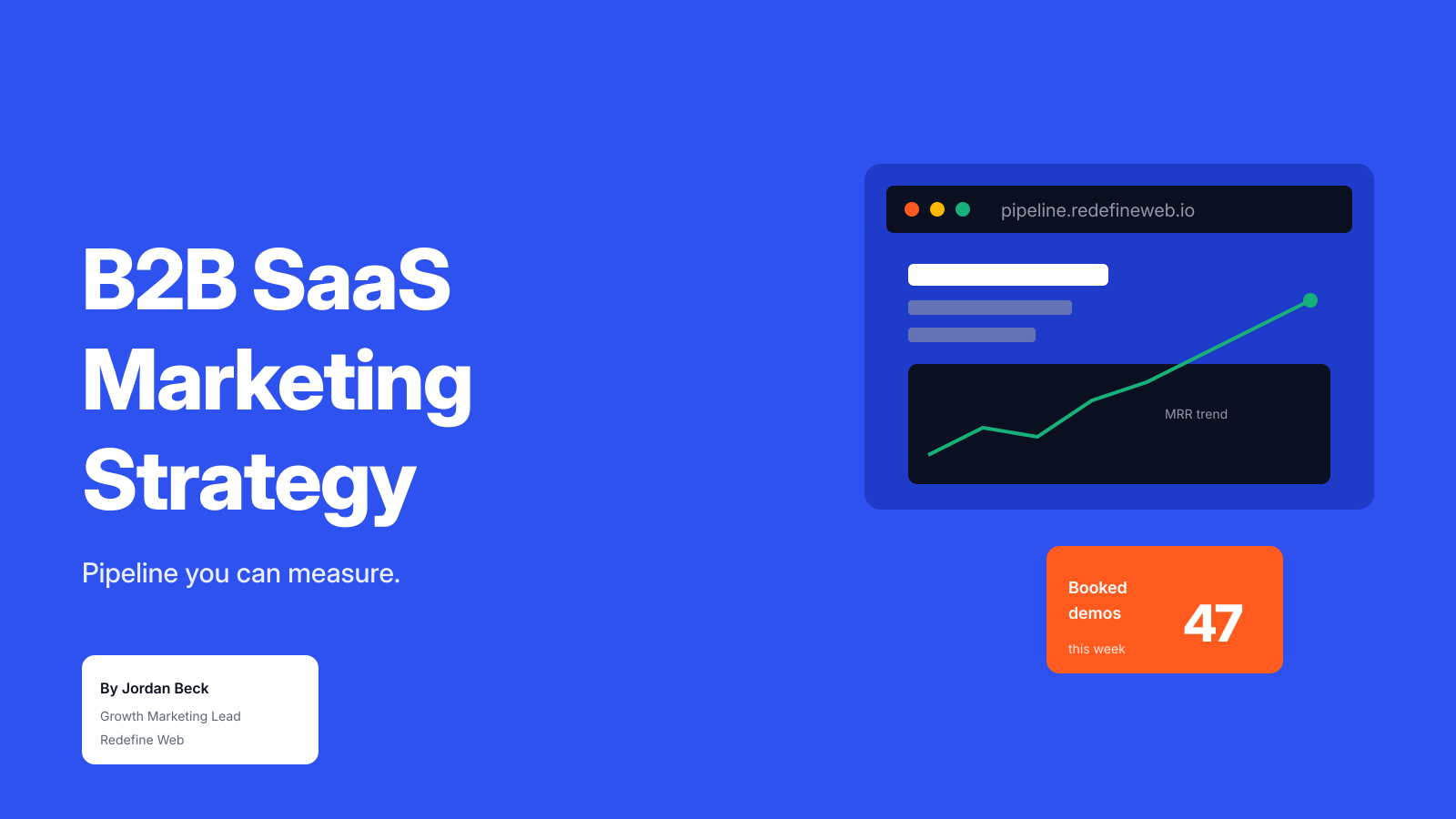
- A B2B SaaS marketing strategy is a single working document that names the ICP, the pipeline target, the channel mix, and the payback window everyone on the team can read in five minutes.
- SaaS motions split into product-led, sales-led, and hybrid, and each one loads the channel mix differently. Naming the motion first stops half the channel debates before they start.
- Attribution has to run in the CRM, not the ad platform. Pass gclid, li_fat_id, and msclkid into HubSpot or Salesforce and grade channels on pipeline, not clicks.
- Budget bands scale with ARR and stage. Early-stage SaaS spends 15 to 25% of ARR on marketing, growth-stage 12 to 15%, and mature 8 to 10%. Missing the band means either starving pipeline or overspending on brand.
- The strategy is only real once the CFO, the head of sales, and the head of marketing agree on the same number the plan is meant to hit.
A B2B SaaS marketing strategy is a single working document that names the ideal customer profile, the pipeline number the plan has to hit, the channel mix by motion, and the payback window the CFO signs off on. It is not a deck. It is a live file the head of marketing updates every Friday and the head of sales reads every Monday. SaaS companies with a written strategy tied to pipeline close 2 to 3x more qualified opportunities per dollar than SaaS companies running channel-by-channel with no shared plan. That gap has almost nothing to do with brand and almost everything to do with sequencing, ICP tightness, and honest CRM attribution. It also tracks with why the best B2B SaaS marketing agencies filter their shortlist on pipeline, not on brand. The vetting frame we run when founders ask how to choose a B2B SaaS marketing agency uses the same pipeline-first filter.
This guide gives you the exact B2B SaaS marketing strategy framework we run for our SaaS clients, the budget bands that hold at each ARR stage, the pipeline math the plan needs to survive board review, and the CRM plumbing that makes channel decisions honest. Everything below is from live client work with real numbers, not a generic playbook.

Why a B2B SaaS marketing strategy fails without a written motion
Most SaaS teams do not have a marketing strategy. They have a channel list. Google Ads runs. LinkedIn ABM runs. Content runs when the writer has time. Product Hunt gets one launch a year. Nothing owns MRR. Every dashboard shows a different number, and the board deck averages them out. The B2B SaaS marketing strategy that actually moves ARR collapses that mess into one file that answers four questions in writing: who the target buyer is, which motion the company sells on, what pipeline each channel has to produce, and how many months each channel has before it gets cut or scaled.
SaaS splits into three motions, and the strategy loads each one differently. Product-led growth spends most of the budget on the trial-to-paid conversion path, self-serve pricing, and content that ranks for feature-comparison queries. Sales-led motions load the budget on ABM, outbound support content, and demo-book paid media. Hybrid runs a self-serve tier under a sales-assisted enterprise tier and needs both loaded at the same time. Choosing the wrong motion for the pricing and ACV is the single most common cause of a SaaS marketing plan that reads well and produces nothing. Our B2B SaaS marketing agency page covers how we split those three motions on the first call.
The seven inputs every B2B SaaS marketing strategy starts with
Before the channel mix gets planned, seven inputs go into the strategy doc. Skip any of them and the plan reads as a wishlist. Fill them in with real numbers pulled from the CRM, the billing system, and last quarter’s ad spend. Guesses are worse than blanks. If a founder does not know the last-90-day CAC number, the answer is not to make one up. The answer is to pull it from Stripe and HubSpot today and write the real one down.
| Strategy input | What goes in the box | Where the number comes from |
|---|---|---|
| ICP | One tight buyer archetype with firmographic + technographic filters | Last 12 months of closed-won in the CRM, filtered by NRR > 100% |
| Motion | Product-led, sales-led, or hybrid, one choice | ACV band plus median sales cycle from HubSpot or Salesforce |
| ARR target | The next 4-quarter ARR number the plan feeds | Board deck or founder-CFO commit |
| Pipeline coverage | 3 to 5x of the quarterly bookings goal | Sales close-rate on SQLs times the ARR gap |
| CAC payback | Months to recover CAC from gross margin on new ARR | CAC divided by (ACV times gross margin percentage divided by 12) |
| Channel spend baseline | Last-90-day spend by channel with pipeline attribution | Ad platforms plus CRM attribution report |
| Logo vs revenue churn | Both, separately, last 12 months | Billing system by cohort, not blended |
These seven inputs decide the strategy’s shape. A SaaS company with 8% monthly logo churn has a product problem, not a marketing problem, and no channel mix fixes that. A SaaS company with a 26-month CAC payback has a pricing problem or a channel-fit problem, and pouring more into the same paid mix makes it worse. Writing the numbers down forces the honest read. If the ICP is still fuzzy after the first pull, the SaaS SEO agency work we run starts with a topic-cluster audit that surfaces where the real ICP is already searching.
Pick the motion before the channel mix
Motion selection drives every other line in the plan. Product-led growth needs a self-serve product with a real free tier or 14-day trial, transparent pricing, and content that ranks on high-intent long-tail queries like “SaaS name vs competitor” or “how to do task X in tool Y.” Sales-led motion needs ABM infrastructure, an SDR team, and paid media that books demos, not signups. Hybrid runs both, and the mistake is trying to run both from one budget line without splitting owners.
The ACV threshold is the fastest way to pick. Under $5K ACV, product-led wins on unit economics. Between $5K and $30K, hybrid is honest. Above $30K, sales-led with ABM is almost always the right call because the sales cycle is too long for a self-serve funnel to close. This is where Automation Anywhere found the biggest gain. They were running a sales-led enterprise motion but pushing generic contact-form CTAs against paid search terms that competitors matched with white papers and free trials. The result was a $1,936 cost per lead. After restructuring their campaigns around gated analyst reports and vertical-specific offers, lead cost dropped from $1,936 to $63 and qualified lead volume scaled 100x. The change was not in the ad budget. The change was in the motion match between paid demand and sales-ready offer.
Set the budget band by ARR stage, not by category benchmark
SaaS marketing spend is often quoted as a flat percentage of revenue, which produces bad plans. Early-stage SaaS at pre-Series-A ARR needs to spend 15 to 25% of ARR on marketing to compound at all. Growth-stage SaaS between Series A and Series C runs at 12 to 15%. Mature SaaS above $100M ARR runs at 8 to 10%. Below those bands, pipeline starves. Above them, the CAC payback stretches past what the board tolerates.
| Stage | ARR band | Marketing spend as % of ARR | CAC payback target | Primary channel load |
|---|---|---|---|---|
| Early | Under $2M ARR | 15 to 25% | Under 18 months | Content plus one paid channel |
| Growth | $2M to $30M ARR | 12 to 15% | 12 to 15 months | Full mix, ABM enters if ACV supports |
| Mature | $30M to $100M ARR | 10 to 12% | 10 to 12 months | Brand plus category creation added |
| Public / scale | Over $100M ARR | 8 to 10% | Under 12 months | Efficiency plus category defense |
Those bands are what actually holds up under board review. A pre-Series-A SaaS spending 8% of ARR on marketing is under-investing and the plan will miss ARR targets by 40 to 60%. A $5M-ARR company spending 30% is either running a brand play that will not compound or wasting money on the wrong channels. Sizing the band first, then loading the channel mix, keeps the conversation honest. The SaaS PPC services we run always start with the CAC payback math, then work backward into the channel budget.
Load the channel mix against the SaaS marketing funnel
The channel mix in a B2B SaaS marketing strategy should look different at every stage of the funnel, not the same channel doing every job. Top-of-funnel needs SEO content on category and use-case queries, plus paid social for demand creation. Middle-of-funnel needs comparison content, G2 buyer-intent signals, and retargeting into demo-book. Bottom-of-funnel needs demo-book paid search on branded and near-branded queries, plus sales-enablement content the SDR team can drop into outbound sequences.
ABM is the multiplier when the ACV supports it, roughly $30K and up. Layer G2 Buyer Intent data on top of a LinkedIn ABM audience filtered by 6sense or Clearbit intent signals, and the CTR on cold display doubles because the accounts are already in-market. Forward Networks ran this play for their network infrastructure SaaS and grew revenue 300% year over year with a combined SEO plus PPC engine, because their sales cycle needed both organic authority for the technical evaluator and paid demand for the buying committee. The channel picks were downstream of the motion, not upstream.
Wire attribution into the CRM before the strategy goes live
The single reason SaaS marketing strategies fail on execution is that channel decisions get made from the ad platform dashboards instead of the CRM pipeline report. Google Ads shows conversions. LinkedIn shows conversions. Meta shows conversions. Add them up and the SaaS company has 3x the conversions they actually got, because the platforms all claim the same buyer. The strategy has to name the CRM as the source of truth on day one.
Concrete plumbing: pass the gclid, li_fat_id, and msclkid parameters from every landing page form into hidden HubSpot or Salesforce fields, then join those parameters back to the ad platform report for closed-loop attribution. Add UTM source, medium, campaign, and content on every paid link, and a first-touch plus last-touch model in the CRM. The strategy grades every channel on pipeline generated and closed revenue, not clicks. Running paid without this plumbing is like running a P&L with no bank statement to reconcile against. Our SaaS website design services build every landing page with these hidden fields already wired.
Sequence the launch calendar around Product Hunt, G2, and Capterra
Product launches are their own line in a B2B SaaS marketing strategy. A launch is a demand-creation event, not a press release. The 3 platforms that move real signups on a launch are Product Hunt (top-of-funnel awareness), G2 (buyer-intent), and Capterra (comparison-shopper). Each has its own review flywheel and content cadence that has to be maintained across the year, not spun up in launch week.
The launch cadence we run for growth-stage SaaS clients: two major launches per year timed around end of Q1 and Q3, one Product Hunt hunt tied to each, a rolling G2 review push that averages 8 to 12 new reviews per month, and a Capterra category push once a quarter with paid placement in the top 3 comparison spots. Between launches, the calendar runs 4 to 6 minor feature announcements per quarter through in-product tours, email, and a changelog page that ranks for the feature name. Apex Fintech Solutions ran a version of this cadence on their inbound-led marketing reset and cut media spend 65% while holding pipeline flat, because the launch calendar picked up the demand slack the paid budget cut.
Grade the strategy on ARR, NRR, and CAC payback every quarter
The strategy is only real once it has three quarterly gates: net-new ARR, net revenue retention, and CAC payback in months. Marketing owns pipeline generation into net-new ARR. Sales and CS own NRR. Finance and marketing jointly own CAC payback. Any strategy that grades marketing on MQLs alone is running a metric marketing can juice by lowering the MQL threshold, and the board will figure that out by quarter three.
Concrete quarterly review: pipeline generated by marketing sourced (channels marketing ran) plus marketing influenced (channels that touched the buying committee), split logo churn from revenue churn (revenue churn is the honest number for expansion-heavy accounts), and re-run the CAC payback math on the last 90 days of closed-won deals. If any of the three trends the wrong direction two quarters in a row, the strategy gets rewritten, not tweaked. That is the difference between a real B2B SaaS marketing strategy and a channel list dressed up in a Notion doc.
Publish the strategy as one page the whole team can quote
The finished B2B SaaS marketing strategy fits on one page. If it does not fit on one page, no one on the team will read it after the first week and no one on the board will remember it after the meeting. The one-page format forces the discipline of naming the ICP in one sentence, the motion in one word, the pipeline number in one figure, and the channel mix in a table. Everything else lives in the appendix.
Template the whole team can copy: line 1 is the ICP one-sentence description, line 2 is the motion and ACV band, line 3 is the ARR target and CAC payback ceiling, then a five-row channel table with owner, quarterly spend, quarterly pipeline target, and month-over-month grade. That is the doc. Everything under it is execution. Everything above it is board narrative. Our SaaS marketing retainer engagements deliver this one-page doc in week two so the team stops arguing about tactics before the numbers get named.
Frequently asked questions about B2B SaaS marketing strategy
What does a B2B SaaS marketing strategy actually include
A B2B SaaS marketing strategy includes the ICP definition, the motion choice (product-led, sales-led, or hybrid), the ARR target and CAC payback ceiling, the channel mix by funnel stage, the launch calendar, and the CRM attribution model. It fits on one page. Anything longer is execution or appendix material.
The deeper appendix carries the channel-by-channel spend tables, the ABM account tiering, the launch cadence with Product Hunt and G2 dates, and the quarterly review gates on ARR, NRR, and CAC payback. But the top-page strategy stays short so every team member can quote it in a hallway conversation. That is the actual test of a working strategy.
How is SaaS marketing different from general B2B marketing
SaaS marketing is different from general B2B marketing on three axes. First, revenue is subscription, so NRR and logo churn matter as much as new bookings. Second, product experience is a marketing surface (self-serve trial, onboarding, activation), which pulls product marketing and lifecycle emails into the strategy. Third, the buying committee spans a technical evaluator, an economic buyer, and often an end user, so the content has to serve all three.
General B2B marketing (consulting, services, industrial) rarely needs product-led motion, in-product tours, or G2 review flywheels. That is why a SaaS marketing strategy borrows from consumer growth (activation loops, freemium math) more than from traditional B2B (long-form lead gen, trade shows). Trying to run a SaaS company on a generic B2B plan is the fastest way to burn 18 months of runway.
What channels work best for B2B SaaS
For product-led SaaS, the best channels are SEO on high-intent long-tail queries, content marketing tied to the free tier, paid search on branded plus feature-comparison keywords, and community-driven distribution (Slack groups, Reddit, LinkedIn organic). For sales-led SaaS, the top channels are LinkedIn ABM layered with 6sense or Clearbit intent, G2 Buyer Intent, gated analyst reports and free trials, and outbound SDR sequences supported by paid demand.
Hybrid SaaS runs a smaller version of both stacks. What does not work for most SaaS: broad awareness display, generic industry trade shows, and untargeted content SEO. The pattern is that channels that create in-market demand (SEO, ABM, review sites) outperform channels that spray awareness (display, sponsored newsletters) at nearly every ARR stage.
How much should a B2B SaaS company spend on marketing
Early-stage SaaS at pre-Series-A ARR spends 15 to 25% of ARR on marketing. Growth-stage between $2M and $30M ARR runs at 12 to 15%. Mature SaaS above $30M ARR runs at 8 to 12%. Below those bands, pipeline starves. Above them, the CAC payback stretches past what a board tolerates for the ARR stage.
Those bands assume the CAC payback target is under 18 months for early-stage and under 12 months for mature. If the payback runs longer, either the ACV is too low for the channel mix or the funnel is leaking at activation. The strategy sizes the band first, then the mix. Never the other way around.
Should a SaaS company invest in SEO, PPC, or content first
SEO and content go first for product-led SaaS because organic search on category and use-case queries is where the self-serve buyer starts. PPC on branded and near-branded queries goes on next to defend brand traffic against competitor conquest campaigns. Broader PPC on non-branded high-intent queries comes after the site converts, not before.
For sales-led SaaS with $30K+ ACV, the sequence flips. ABM plus paid demand book demos while SEO content builds authority over 6 to 9 months. Running non-branded paid search to a broken demo-book funnel is the most common way to burn $50K in a quarter and get no meetings. The answer is not more spend. The answer is fixing the demo-book flow, then adding spend.
How long before a B2B SaaS marketing strategy shows results
Paid channels show pipeline signal in 30 to 60 days. Content and SEO show ranking signal in 3 to 4 months and compounding pipeline in 6 to 9 months. Category creation and brand plays show measurable ARR impact in 12 to 18 months. Any agency or consultant promising ARR impact from SEO in month one is either lying or grading on the wrong number.
The right time horizon to grade a B2B SaaS marketing strategy is two full quarters. One quarter is not enough to see the CAC payback moves. Three quarters is where compounding starts on SEO and content, and where the launch calendar shows its second cycle. Cutting a channel before two quarters is almost always a mistake if the CPL is not running well above target.
Where to take this next
See how we build B2B SaaS marketing strategies that compound pipeline for our SaaS clients, and what the retainer includes at each ARR stage.
{ “@context”: “https://schema.org”, “@type”: “FAQPage”, “mainEntity”: [ { “@type”: “Question”, “name”: “What does a B2B SaaS marketing strategy actually include”, “acceptedAnswer”: { “@type”: “Answer”, “text”: “A B2B SaaS marketing strategy includes the ICP definition, the motion choice (product-led, sales-led, or hybrid), the ARR target and CAC payback ceiling, the channel mix by funnel stage, the launch calendar, and the CRM attribution model. It fits on one page. Anything longer is execution or appendix material. The deeper appendix carries the channel-by-channel spend tables, the ABM account tiering, the launch cadence with Product Hunt and G2 dates, and the quarterly review gates on ARR, NRR, and CAC payback. But the top-page strategy stays short so every team member can quote it in a hallway conversation.” } }, { “@type”: “Question”, “name”: “How is SaaS marketing different from general B2B marketing”, “acceptedAnswer”: { “@type”: “Answer”, “text”: “SaaS marketing is different from general B2B marketing on three axes. First, revenue is subscription, so NRR and logo churn matter as much as new bookings. Second, product experience is a marketing surface (self-serve trial, onboarding, activation), which pulls product marketing and lifecycle emails into the strategy. Third, the buying committee spans a technical evaluator, an economic buyer, and often an end user, so the content has to serve all three. General B2B marketing rarely needs product-led motion, in-product tours, or G2 review flywheels.” } }, { “@type”: “Question”, “name”: “What channels work best for B2B SaaS”, “acceptedAnswer”: { “@type”: “Answer”, “text”: “For product-led SaaS, the best channels are SEO on high-intent long-tail queries, content marketing tied to the free tier, paid search on branded plus feature-comparison keywords, and community-driven distribution. For sales-led SaaS, the top channels are LinkedIn ABM layered with 6sense or Clearbit intent, G2 Buyer Intent, gated analyst reports and free trials, and outbound SDR sequences supported by paid demand. Hybrid SaaS runs a smaller version of both stacks.” } }, { “@type”: “Question”, “name”: “How much should a B2B SaaS company spend on marketing”, “acceptedAnswer”: { “@type”: “Answer”, “text”: “Early-stage SaaS at pre-Series-A ARR spends 15 to 25% of ARR on marketing. Growth-stage between $2M and $30M ARR runs at 12 to 15%. Mature SaaS above $30M ARR runs at 8 to 12%. Below those bands, pipeline starves. Above them, the CAC payback stretches past what a board tolerates. The bands assume the CAC payback target is under 18 months for early-stage and under 12 months for mature.” } }, { “@type”: “Question”, “name”: “Should a SaaS company invest in SEO, PPC, or content first”, “acceptedAnswer”: { “@type”: “Answer”, “text”: “SEO and content go first for product-led SaaS because organic search on category and use-case queries is where the self-serve buyer starts. PPC on branded and near-branded queries goes on next to defend brand traffic against competitor conquest campaigns. For sales-led SaaS with $30K+ ACV, the sequence flips. ABM plus paid demand book demos while SEO content builds authority over 6 to 9 months.” } }, { “@type”: “Question”, “name”: “How long before a B2B SaaS marketing strategy shows results”, “acceptedAnswer”: { “@type”: “Answer”, “text”: “Paid channels show pipeline signal in 30 to 60 days. Content and SEO show ranking signal in 3 to 4 months and compounding pipeline in 6 to 9 months. Category creation and brand plays show measurable ARR impact in 12 to 18 months. The right time horizon to grade a B2B SaaS marketing strategy is two full quarters. One quarter is not enough to see the CAC payback moves.” } } ] }Book your free 30-minute strategy call.
No spam, no sales rep. We use your email to schedule your call with a senior strategist. That is it.
More from the blog
View all articles → Marketing Strategy
 How Dental DSOs Grow Through Marketing. Tactics That Scale
Read article Marketing Strategy
 Dental DSO Marketing Services. What to Expect From an Agency Partner
Read article Marketing Strategy