
Beauty and Skincare Digital Marketing Agency vs General Agency
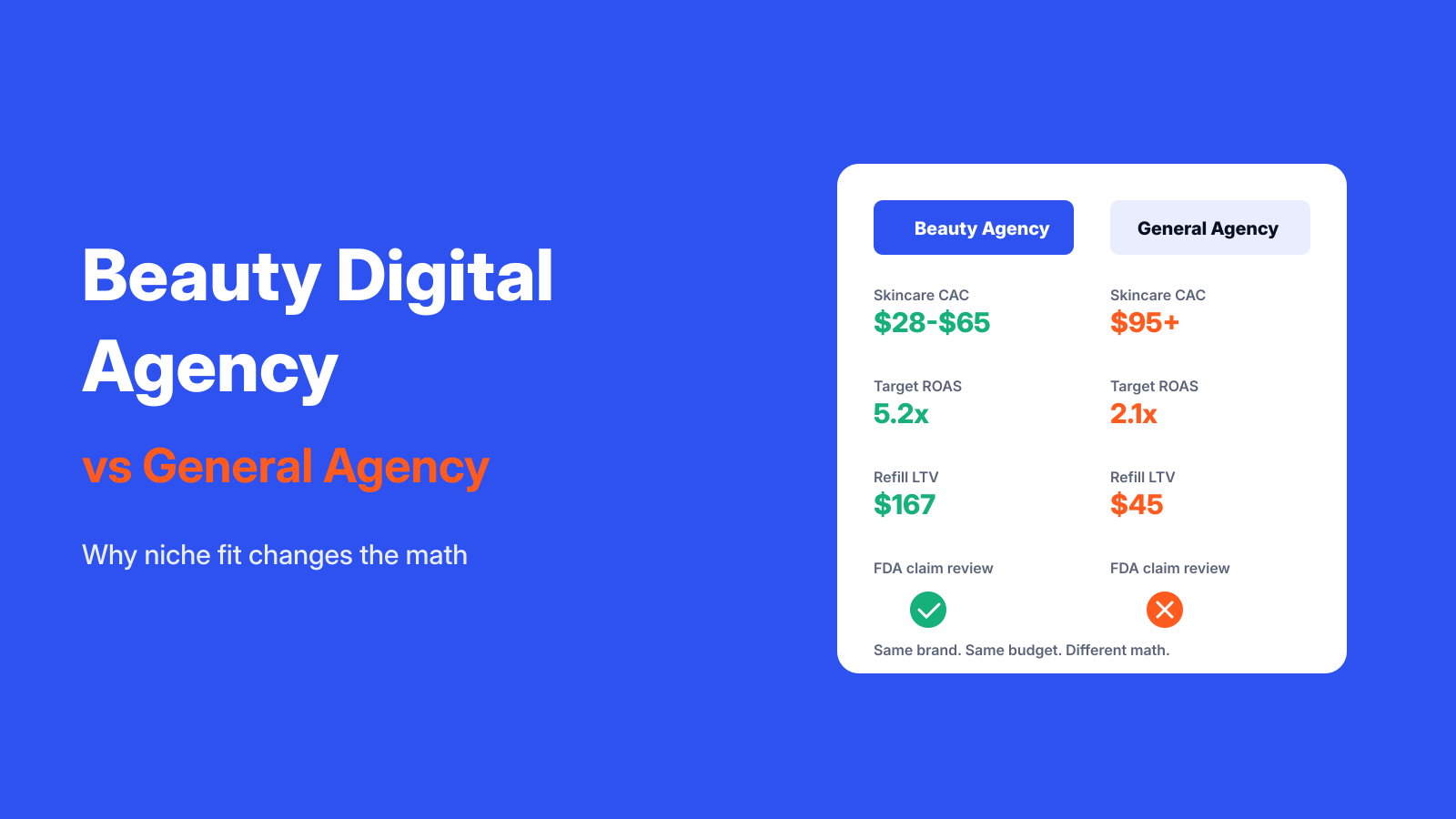
- A beauty and skincare digital marketing agency defaults to the channel mix, PDP rules, compliance handling, refill math, and retail readiness patterns that pay in this category, and a generalist does not.
- Blended skincare CAC on a specialist retainer typically settles between 34 and 52 dollars, versus 85 to 110 dollars on a generalist first quarter, which is the specialist premium made real.
- The Klaviyo refill flow tuned to 30 percent of remaining supply is where beauty specialists move repeat-purchase rate 16 points inside six months.
- Retail readiness for Sephora Accelerate and Ulta MUSE requires a founder-story surface plus hero-SKU review generation that generalist playbooks do not build.
- The 90 day proof pattern is the same either way. If day 90 does not show movement on sales, CAC, ROAS, repeat rate, and refill LTV, escalate. If day 180 still is not moving, shortlist again.
A beauty and skincare digital marketing agency runs the specific plays that make skincare, makeup, haircare, and fragrance brands profitable online. A general digital marketing agency runs the same tactical stack across every vertical, which is why so many beauty brands quietly bleed budget for their first six months with one. This is the honest comparison brands should read before signing either. What actually differs between the two, when the specialist premium is worth paying, and when a strong generalist can carry the work.
Below we walk the channel mix, the CAC math, the compliance rules, the retention curve, and the retail readiness gap. Every number is drawn from real skincare accounts we run or benchmark against, and where a case study makes the point cleaner than prose we drop the client name and the exact figures. If you want the scorecard we run on every intake call, our beauty marketing agency team keeps it live.
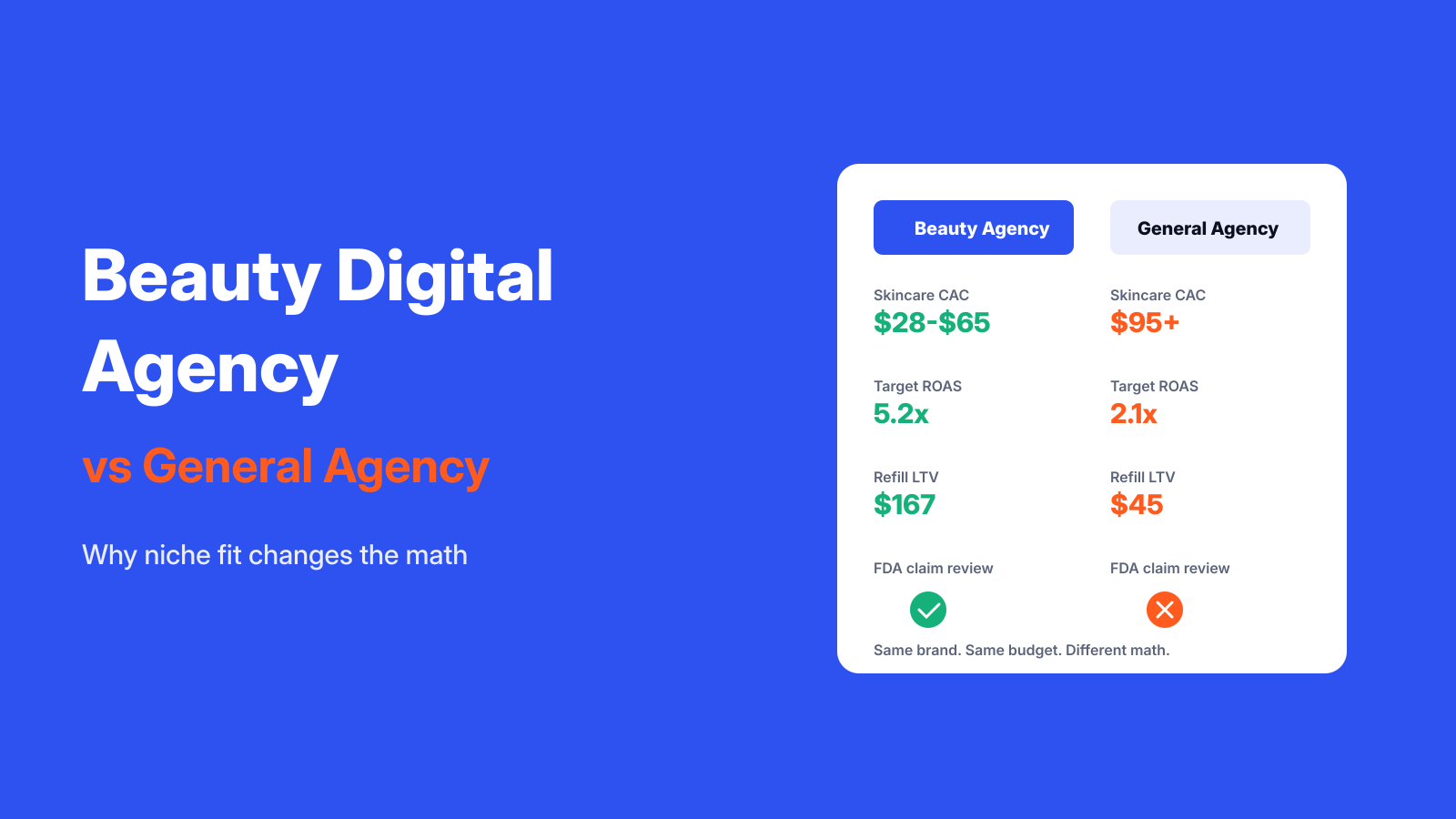
What a beauty and skincare digital marketing agency actually does differently
A beauty and skincare digital marketing agency structures the paid, organic, email, influencer, and web work around skincare category math. That means a channel mix weighted to Meta and TikTok Shop rather than search-heavy, PDPs built around ingredient stories with FDA-safe structure-function claims, review widgets that survive Meta prestige-cosmetics ad review, and Klaviyo flows that hit refill windows at 30 percent of remaining supply. A generalist team can technically build all of those pieces. The difference is what they default to when the brief is vague. Beauty specialists default to the plays that pay in this category. Generalists default to whatever paid last month for a chiropractor or a plumber.
Skincare CAC on cold Meta prospecting runs 28 to 65 dollars for prestige tier brands, and blended CAC across the full channel mix usually settles between 34 and 52 dollars once a refill flywheel kicks in. A general agency that treats skincare like any other ecommerce vertical will often land above 90 dollars blended CAC in the first quarter, because the ad account is not being segmented around margin tiers and the PDP is not built to convert first-time skincare buyers. That gap between 42 dollars and 92 dollars is the specialist premium made real, and it usually pays back inside one billing cycle.
Where beauty channel mix diverges from generalist defaults
Generalist digital marketing agencies tend to build a Google-heavy channel mix by default. Search is legible, keyword intent is measurable, and it works well for services and B2B. Beauty and skincare buyers do not shop that way. They discover on TikTok and Reels, add to consideration through creator seeds and UGC, price-check on Google, and buy either from the D2C site or a marketplace shelf. A beauty and skincare digital marketing agency reads that funnel correctly and weights the budget to match. Meta prospecting and retargeting take the biggest share, TikTok Shop and creator seeding follow, Google Shopping and Performance Max cover intent capture, Klaviyo and Attentive run retention, and SEO compounds underneath.
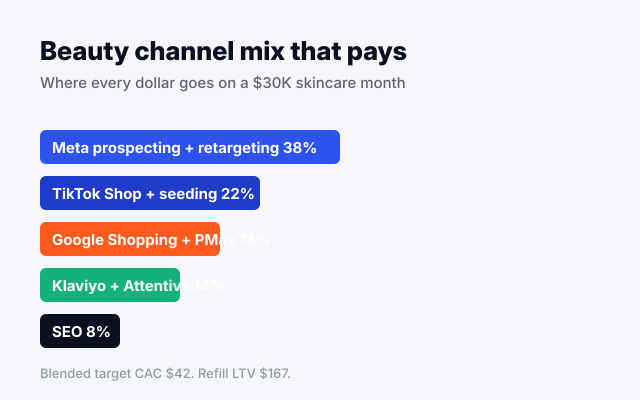
Cutting Meta share below 30 percent on a scaling skincare brand is a red flag on a proposal. So is cutting TikTok Shop share to zero on a brand whose buyer is 18 to 34. So is 60 percent Google share on a brand whose category has weak search demand relative to social demand. If a general agency shows up with a channel mix that reads like a plumbing account, ask them to walk the math on why skincare buys the same way. Most will not have an answer that survives the second follow-up question. Our beauty PPC service holds the mix above to reference benchmarks and adjusts by SKU margin, launch stage, and refill window.
FDA and FTC compliance is where general agencies quietly cost you money
Clean beauty, cruelty-free, dermatologist-tested, and anti-aging language is regulated. The FDA polices structure-function claims that cross into drug claims, the FTC polices influencer endorsement disclosures on TikTok and Instagram, and Meta’s ad review layer polices prestige cosmetics language with its own inconsistent bar. A beauty and skincare digital marketing agency writes ad copy and PDP text with those rules baked in, flags risk language on intake, and quietly cleans up product pages that would otherwise draw a Meta ad rejection or a warning letter. A general agency almost never reads the warning letter database, and the copy they push live will trip claim review often enough to burn ad-account velocity every quarter.
The cost of a general agency getting clean beauty compliance wrong compounds. Ads get rejected, the account trust score falls, prospecting spend caps out early, retargeting sequences break, and the fix cycle costs a week of momentum every time. Over a six month window that is easily three weeks of lost paid velocity, which on a $30,000 monthly spend account is about $17,500 of misfired budget. A specialist charges 800 to 1,500 dollars more per month than a generalist. The math on that trade is not close.
When a 10-year Ukraine natural cosmetics manufacturer came to us, their Google Ads account had drifted from a healthy 500 percent ROAS down to 230 percent after three months of unattended in-house management. Auto-recommendations had been silently accepted, broad-match keywords had crept in, and Shopping and Performance Max were not segmented around margin tiers. A general agency looking at that account often reads it as needing more budget. We read it as needing surgical cleanup. We disabled auto-recommendations, dropped broad-match on search, regrouped Shopping and PMax around margin tiers, and shut down the unprofitable campaigns rather than optimizing them. Target ROAS of 400 percent hit by month two. ROAS reached 800 percent by month four. Leads scaled 247 percent on a stable budget. Every paid dollar was tied to attributable return across the omnichannel mix, which included offline stores, retail chains, and aggregator platforms.
The retention curve is where beauty specialists earn their premium
Skincare and haircare live on refill economics. A $45 first-order shampoo with a 42 day refill window and a stable subscription retention rate hits $167 in year-one LTV, which changes what you can pay for the first order. A beauty and skincare digital marketing agency builds the Klaviyo refill logic to hit that curve. Generalists rarely tune the flow that tightly. The default subscription setup lets first-order buyers churn at day 45, and the win-back sequence fires too late to catch the wallet.
The refill-reminder rule of thumb across the category is 30 percent of remaining supply. A 40 day cadence gets its first refill reminder around day 28, a second nudge around day 34, and a stronger offer around day 40 if the first two do not convert. A general agency running a default 30-day flow will miss the wallet moment on longer refills and burn margin on faster ones. A subscription category with a 42 percent baseline repeat-purchase rate can typically move to 58 percent inside six months when the refill flow is tuned to the actual SKU cadence, and that 16 point delta is worth more than every other channel combined. Beauty brands with a physical salon or spa footprint layer on the ranking playbook in our beauty salon SEO guide plus local SEO strategies for beauty professionals so the map pack feeds first-time bookings into the same refill flywheel.
Retail readiness is the play generalists cannot even see
Sephora Accelerate, Ulta MUSE, Target Made-by-Us, and the entry paths into wholesale beauty retail require a specific readiness pattern. Named founder story, a category-defining hero SKU with 200+ verified reviews, D2C velocity that proves product-market fit, and a retail deck that reads the way a Sephora buyer expects. A beauty and skincare digital marketing agency structures the six months before a retail pitch around that readiness. Founder-story creative, D2C velocity build, hero-SKU review generation, and buyer-meeting rehearsal. Generalists tend not to know the readiness pattern exists, and by the time the brand shows up to a Sephora buyer meeting the deck reads like generic ecommerce and the buyer passes.
The retail play matters even for brands that do not sign wholesale on the first attempt. The D2C surface built for a retail pitch converts D2C buyers better anyway, because founder story plus reviews plus hero SKU is what wins on the shelf and what wins on a first-time buyer landing page. A general agency running a default ecommerce playbook does not build the founder-story surface, and the brand loses on both fronts.
Reporting and dashboards where generalists hide behind vanity metrics
The single fastest way to tell a beauty and skincare digital marketing agency from a generalist is the monthly report. A specialist report opens with sales, orders, CAC, blended CAC, contribution margin post-fee, repeat-purchase rate, and refill LTV. A generalist report opens with clicks, impressions, click-through rate, and engagement. Both reports run 15 pages. Only one of them tells you whether the retainer is profitable.
Ask any agency on your shortlist to send an anonymized sample of a beauty client dashboard from month three. If the top-line metrics are all top-of-funnel, the firm is not measuring what beauty brands actually care about. Marketing performance benchmarks published by industry associations put the top decile of beauty brands at 5x+ blended ROAS and 55 to 65 percent repeat-purchase rate. Any dashboard that does not report against those two numbers is not a beauty dashboard.
When a general agency is actually the right pick
There are cases where a general digital marketing agency is the right pick for a beauty brand. Very early stage brands under $10,000 monthly revenue often cannot afford the specialist premium, and a strong generalist with real ecommerce chops can carry the work for the first two quarters. Brands with an in-house head of ecommerce who wants to own the beauty-specific plays and hire out the technical execution can pair with a generalist and drive the specialist decisions themselves. Established beauty brands with in-house paid, SEO, and email teams often use a generalist for adjacent work like PR, offline attribution, or CRM implementation where beauty specialization does not add value.
Outside of those three cases, the specialist premium usually pays back inside the first billing cycle. A brand spending $25,000 to $80,000 a month across paid, email, and retainer typically recovers the 800 to 1,500 dollar specialist premium in the first month of tighter CAC alone, and the compounding gains across LTV, repeat rate, and retail readiness pay for years. If you want the plan our team runs against every skincare and cosmetics intake, our beauty marketing retainer page lists the exact monthly deliverables that map to each brand stage.
A side by side comparison of the two agency models
| Dimension | Beauty and skincare digital marketing agency | General digital marketing agency |
|---|---|---|
| Default channel mix | Meta + TikTok Shop weighted, Google and SEO underneath | Google-weighted, Meta second, TikTok Shop optional |
| Skincare CAC first quarter | $34 to $52 blended | $85 to $110 blended |
| Target ROAS by month three | 4.5x to 5.2x | 2.1x to 3.0x |
| FDA and FTC compliance | Built into copy on intake | Retrofitted after first ad rejection |
| Klaviyo refill flow | Tuned to SKU cadence at 30 percent remaining supply | Default 30 day cadence, single reminder |
| Retail readiness (Sephora, Ulta) | Six month prep with founder-story creative | Not part of the playbook |
| Monthly reporting focus | Sales, CAC, contribution margin, repeat rate | Clicks, impressions, CTR, engagement |
| Retainer premium vs generalist | +$800 to $1,500 per month | Baseline |
| Typical payback window | First billing cycle | N/A |
The 90 day proof pattern brands should demand from either firm
Whether you sign a beauty and skincare digital marketing agency or a strong generalist, the 90 day proof pattern should be the same. Month one is foundation. Ad account audit, PDP rebuild, Klaviyo flow reset, review widget integration, dashboard setup, and channel mix rebalance. Month two is execution. New creative into Meta and TikTok, Shopping and PMax segmented around margin tiers, first refill flow live, hero SKU review generation running. Month three is measurement. Sales, blended CAC, ROAS, repeat-purchase rate, and refill LTV against target, with a written escalation plan for anything that is not moving.
If day 90 reporting does not show measurable movement on at least three of those five metrics, escalate with the strategy lead. If day 180 still does not show it, the fit is wrong and it is time to shortlist again. When an NZ-formulated vegan skincare brand entering the Indian market came to us needing both awareness and revenue growth without inflating acquisition cost, we ran relevant-audience targeting rather than broad reach, sequenced awareness creative alongside conversion campaigns, and integrated Amazon India, Myntra, and Flipkart alongside D2C so buyers were met wherever they preferred to purchase. Result. 1.65 million relevant accounts impacted. 4x revenue inside 90 days. CPA held flat across the entire scale window. That is the 90 day proof pattern applied to a market entry brief, and it is the same pattern any brand should demand on their own retainer.
What to ask on the first call to separate specialists from generalists
Ask five questions on the discovery call and score the answers. First, name three beauty or skincare clients in the last 24 months and walk me through what the retainer delivered month by month. Second, what is your default channel mix for a scaling skincare brand and why. Third, what is the FDA structure-function line on anti-aging claims and how do you handle it in PDP copy. Fourth, show me a sample month three dashboard from a real client with names redacted. Fifth, what would you not take on for a beauty brand.
A beauty and skincare digital marketing agency will answer four of those five questions on the call. A generalist will hedge on at least three. The fifth question is the one that separates the honest firms from the polished ones. A firm that names the work it will not do is a firm that knows its bar. A firm that says yes to every scope is a firm that will run every play the same way for every brand, and beauty brands are the ones who quietly pay for that in month six. Our beauty SEO service and beauty web design service pages spell out exactly what our team will and will not take on across the funnel, and that clarity is what brands should demand on every shortlist call.
Frequently asked questions
What does a beauty and skincare digital marketing agency actually do
A beauty and skincare digital marketing agency runs the specific plays that make skincare, makeup, haircare, and fragrance brands profitable online. That covers paid media on Meta and TikTok Shop and Google, PDPs built with FDA-safe structure-function language and review widgets that survive Meta prestige ad review, Klaviyo and SMS retention flows tuned to the refill cadence, hero-SKU review generation for D2C velocity and retail readiness, and monthly reporting against sales, CAC, contribution margin, and repeat-purchase rate. The difference from a general agency is defaults. Beauty specialists default to the plays that pay in this category. Generalists default to whatever paid last month for a different vertical.
How much does a beauty and skincare digital marketing agency cost per month
A beauty and skincare digital marketing agency typically charges between $599 and $15,000 per month depending on scope and brand stage. Entry retainers at $599 cover foundational SEO and content on a single brand. Mid-band retainers at $2,500 to $6,000 cover paid media, email retention, or SEO as a single-lever engagement. Full-service retainers running $6,000 to $15,000 per month cover strategy, paid, SEO, web, creative, and email under one roof with a named strategy lead. Ecommerce web-design rebuilds are typically project fees between $25,000 and $95,000. Ad spend is separate from retainer on any honest proposal.
How is a beauty and skincare digital marketing agency different from a general agency
A beauty and skincare digital marketing agency defaults to the channel mix, PDP defaults, compliance rules, refill flow math, retail readiness pattern, and reporting metrics that pay in the beauty category. A general digital marketing agency defaults to whatever paid last month across their portfolio, which for most generalists is a Google-heavy service or B2B mix that does not fit skincare buying behavior. The specialist premium runs $800 to $1,500 per month and typically pays back inside the first billing cycle on tighter CAC alone, with compounding gains across LTV, repeat rate, and retail readiness.
When should a beauty brand hire a specialist agency instead of a generalist
A beauty brand should hire a beauty and skincare digital marketing agency the moment monthly revenue clears $10,000 and paid media becomes a real line on the P&L. Below $10,000 monthly revenue a strong generalist ecommerce agency can carry the work. Between $10,000 and $80,000 monthly revenue the specialist premium usually pays back inside one billing cycle. Above $80,000 monthly revenue the specialist premium is table stakes because the compounding CAC, LTV, and retail readiness gains dwarf the retainer delta. Any brand planning a Sephora Accelerate or Ulta MUSE application should hire a specialist at least six months before the pitch.
How long does a beauty and skincare digital marketing agency take to move the numbers
A beauty and skincare digital marketing agency should show measurable movement on at least three of five metrics by day 90. Sales, blended CAC, ROAS, repeat-purchase rate, and refill LTV. Month one is foundation work. Month two is execution. Month three is the first honest measurement window. If day 90 reporting is not moving on three of five, escalate with the strategy lead. If day 180 still is not moving, the fit is wrong and it is time to shortlist again. The 90 day pattern is the same one we ran on the 10-year Ukraine cosmetics manufacturer that went from 230 percent ROAS to 800 percent by month four.
Should a beauty brand hire an agency or build the marketing in house
Most beauty brands under $500,000 in annual revenue should hire a beauty and skincare digital marketing agency rather than build in house. A single in-house marketing hire at $85,000 to $140,000 fully loaded covers one channel at most, and beauty needs at least three channels running well at once. An agency retainer at $2,500 to $8,000 per month buys named specialists across paid, email, SEO, and creative for less than the fully loaded cost of one senior hire. Above $2 million in annual revenue the math flips and hybrid in-house plus specialist agency is usually the right structure.
See how our beauty and skincare digital marketing agency team runs the same channel mix and compliance rules from the inside, and where the numbers land after 90 days.
Book your free 30-minute strategy call.
No spam, no sales rep. We use your email to schedule your call with a senior strategist. That is it.
More from the blog
View all articles → Marketing Strategy
 How Dental DSOs Grow Through Marketing. Tactics That Scale
Read article Marketing Strategy
 Dental DSO Marketing Services. What to Expect From an Agency Partner
Read article Marketing Strategy