A working pet website maintenance checklist separates the DTC pet brand losing 3% to 8% of monthly revenue to preventable site issues from the one that compounds through every seasonal peak. When a WooCommerce checkout drops for 45 minutes on a Saturday in November, a competing pet brand can lose 4 figures in orders overnight. Every pet brand founder knows the risk. Almost nobody runs the maintenance calendar that would have prevented it.
This pet website maintenance checklist walks the monthly, quarterly, pre-peak, and annual tasks that keep a WooCommerce or Shopify pet brand fast, safe, and buyable through Black Friday, back-to-school, and the January flea-and-tick surge. A pet brand doing $2 million to $30 million in annual revenue lives on the same operating profile. High-frequency small baskets, tight checkout margins, and 3 hard seasonal peaks that punish any site running on a stale plugin stack. See our pet products website hosting and maintenance page for the retainer that packages this checklist end to end.
What’s in this guide
- Monthly tasks
- Quarterly tasks that catch what monthly misses
- Annual tasks
- Pre-peak audits every checklist should include
- Security tasks
- Performance tasks that keep pet ecommerce sites fast
- Cost tiers for the retainer
- Pet case patterns behind a real maintenance calendar
- Picking a partner
- How month one looks on a new retainer
Monthly tasks on the pet maintenance calendar
Monthly tasks on this checklist run on a fixed calendar the whole team follows. Plugin, theme, and WordPress core updates on a staging-first schedule. A full backup with an integrity check. Uptime and page-speed monitoring with alerting under 5-minute detection. A malware scan through Wordfence, Sucuri, or Patchstack. Broken-link and 404 sweeps across the top 200 URLs by traffic. A checkout smoke test across Stripe, Shop Pay, PayPal, and Apple Pay. Each item takes 10 to 40 minutes on a mid-size WooCommerce pet catalog and 2 to 4 hours across the full monthly pass.
Plugin updates cause the largest share of self-inflicted site incidents on pet WooCommerce sites. A specialist runs updates on staging, tests the checkout with 3 real transactions, verifies the cart preserves subscription line items, and confirms tax and shipping calculate correctly. Only then does the update promote to production. The staging-first pattern catches 70% of plugin-update incidents before they reach a paying customer. Every incident it prevents saves an average of 90 minutes of emergency response and any lost orders inside the outage window.
Monthly uptime monitoring belongs on 2 independent tools not 1. Pingdom or UptimeRobot against the homepage every 60 seconds, and a synthetic checkout monitor from a different provider running a full add-to-cart transaction every 15 minutes. Single-provider monitoring misses the 3% of outages that live inside checkout while the homepage stays green. That 3% is where the revenue actually lives. A quarterly review of monitoring coverage keeps the alert stack honest against the current site behavior instead of the site as it looked 18 months ago.
- Plugin, theme, core updates on staging first, then production, with checkout smoke test in between.
- Full backup and integrity check. Backup runs automatically. Integrity check confirms the file is not silently corrupt.
- Uptime and page-speed monitoring review. Both homepage and checkout, on 2 independent providers.
- Malware scan and admin account audit. Wordfence, Sucuri, or Patchstack. Remove dormant editor accounts.
- Broken-link and 404 sweep across top 200 URLs by traffic. Redirect or fix within 7 days.
- Checkout smoke test across Stripe, Shop Pay, PayPal, Apple Pay. 1 test per gateway per month.
- Analytics and tracking review. Verify GA4, Meta pixel, and Klaviyo events still fire on add-to-cart and purchase.
Analytics and tracking review is the monthly task most pet brands skip. Every Klaviyo flow, Meta remarketing pool, and TikTok Advantage+ audience depends on the pixel firing correctly on add-to-cart and purchase events. A single deploy that breaks the pixel silently kills remarketing performance for weeks before anybody notices. A monthly 15-minute event verification on the debug view of each ad platform catches this drift before it costs 4 to 6 weeks of retargeting spend. See Kinsta’s WordPress operations blog for the underlying platform patterns most pet brands should benchmark against, and cross-reference our ecommerce website maintenance checklist for the broader ecommerce cadence, or the pet website maintenance retainer for DTC brands and salons for the packaged retainer.
Quarterly tasks that catch what monthly misses
Quarterly tasks on the pet maintenance calendar run every 90 days and catch the drift that monthly scans cannot. A backup restore test to staging. A full third-party script audit with removal of unused pixels and trackers. A checkout flow QA with 8 to 12 test transactions across payment methods, device classes, and browsers. A page-speed audit against Core Web Vitals benchmarks on the homepage and top 10 product pages. A search console review for crawl errors, indexing gaps, and manual actions. A permissions audit removing dormant accounts. Each quarterly pass takes 8 to 14 hours of skilled time and closes 20% to 35% of the maintenance risk monthly work cannot see.
The Passion Built case pattern shows why quarterly rigor beats reactive fixes. A Sydney home-renovation specialist replaced 2 underperforming websites with a single SEO-driven site and generated more than $60,000 in bookings in 12 months. Behind that number sits a quarterly cadence. Every 90 days their site got a full third-party script audit, a Core Web Vitals pass, and a checkout QA that kept the booking form firing under real traffic. Pet DTC brands running the same quarterly rigor keep the checkout live through peak weekends when the reactive-only crowd is patching outages after the fact.
Backup restore verification is the quarterly task most pet brands skip. Backups run automatically, but almost nobody tests the restore. A quarterly restore test to a staging environment verifies the backup is complete and usable. Untested backups are theoretical protection, and a working restore procedure takes 45 to 90 minutes. It is the most reassuring hour a brand founder spends on the site every quarter. Skip it, and you find out on the day of the outage that the backup was silently corrupt for 6 months.
Annual tasks on the pet maintenance calendar
Annual tasks on the pet maintenance calendar cover the deep-work items that need a real audit window. A full accessibility audit against WCAG 2.1 AA. A site architecture review. Deprecated content pruning. A server-side performance audit. An SSL certificate renewal check. A domain registration renewal. A privacy policy and terms of service refresh against current data protection standards. And a plugin ecosystem review with sunset plans for any plugin whose developer has stopped pushing updates.
The accessibility audit carries the highest liability of any annual task for a pet brand. ADA lawsuits against ecommerce sites grew 34% in 2024 and kept climbing through 2025. Pet brands get named in these suits because the category skews toward older customers who often rely on screen readers and assistive tech. An annual WCAG 2.1 AA audit runs $2,400 to $8,500 through a specialist and catches 80% to 95% of the risk before it becomes a demand letter. Every pet brand doing over $5 million in annual revenue should treat this as non-optional.
Deprecated content pruning removes low-value or outdated pages that drag domain authority and confuse the internal link map. A mature pet brand typically carries 40 to 180 pages that should have been archived years ago. Annual pruning improves crawl efficiency, tightens the internal link map, and produces a 4% to 11% gain in organic traffic to the pages that survive. Read the WordPress.org documentation library for the exact redirect and 410 patterns to use when pruning, and reference our dental website maintenance checklist for a parallel view of what an annual pass looks like in a services vertical.
Pre-peak audits every seasonal peak needs
Pre-peak audits on this checklist run 2 to 3 weeks before each seasonal peak. The pass covers load testing against a traffic curve at 2x the site’s normal daily peak, a cache purge and warm-up, a payment gateway retest under load, a checkout flow QA with 8 to 12 test transactions, an ad landing page performance check, a cart abandonment flow verification, and a coupon code stress test against high-volume promo codes. Each audit takes 6 to 10 hours of skilled time and covers the 3 highest-risk peaks. Black Friday, the January flea-and-tick surge, and back-to-school.
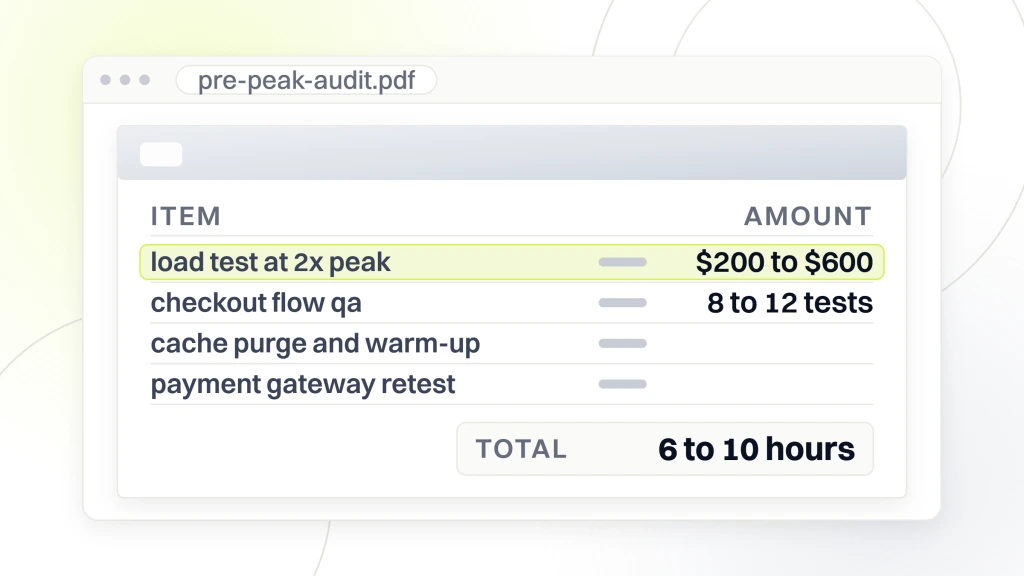
Load testing is the most-skipped pre-peak task in pet ecommerce maintenance. Most brands wait for the peak to see whether the site holds. A synthetic load test through Loader.io or K6 at 2x the projected peak load costs $200 to $600 and catches most scale issues before they turn into live-site outages. Every unmanaged pet site that crashed on Black Friday could have spent less than $600 to prevent it. The math is not close.
Cart abandonment flow verification catches the second-biggest revenue drag during peaks. Misfiring abandonment emails, wrong product images in the recovery email, or broken tracking pixels cost 8% to 22% of the recovery revenue during peak season. A solid pre-peak audit runs 3 test abandonment flows across 3 email clients to verify the recovery email renders correctly and tracks the eventual purchase. Our pet business web design page covers the storefront rebuild that reduces abandonment structurally, and our pet business web design for subscription DTC brands page walks the subscription-specific pattern.
Security tasks inside a pet ecommerce maintenance stack
Security tasks on this checklist run continuously through Wordfence, Sucuri, or Patchstack. The stack includes a monthly full scan, a weekly changed-files alert, a real-time firewall against known attack signatures, two-factor authentication on every admin account, and an IP allowlist for the wp-admin backend where feasible. These controls run $25 to $95 per month and close 90% to 96% of the attack surface a typical WooCommerce pet site exposes to the public web.
Magecart-style card-skimming attacks hit ecommerce checkout scripts and route stolen card data to attacker-controlled endpoints. Pet brands get hit often because the category runs high-frequency small-basket transactions that attackers use to test stolen cards. Content Security Policy headers, subresource integrity checks, and quarterly checkout-script audits catch these attacks before they cost $100,000 or more in chargebacks and reputation damage. The Pet Insurance Australia account is a good pattern for what happens when the security discipline is right. That team runs a full Google Ads engine with 455 qualified conversions in 5 months and a 1132% return on investment, and none of that math holds if a Magecart injection quietly drains the checkout for 6 weeks.
Admin account hygiene deserves the same attention. Every dormant editor account or old developer credential stays a live attack surface until you remove it or downgrade it to read-only. A quarterly permissions audit takes 20 to 40 minutes and removes 30% to 60% of the account risk on a mature pet WooCommerce install. See WP Rocket’s operations blog for the caching and backup pattern most pet WooCommerce sites should run alongside the security stack.
Performance tasks that keep pet ecommerce sites fast
Performance tasks on this checklist keep the storefront under 2.5 seconds largest contentful paint on 4G mobile. The recurring work includes image compression on every new upload, WebP or AVIF format for product images, lazy loading below the fold, a CDN with proper cache headers on static assets, critical CSS inlined on the homepage and top 10 product pages, deferred JavaScript for anything non-critical, and fewer third-party scripts on product and checkout pages.
Third-party script bloat is the biggest performance drag on mature pet brand sites. Every Meta pixel, TikTok pixel, Klaviyo tracker, Loox review widget, and analytics tag adds 40 to 220 milliseconds to page load. Most pet brands stack 12 to 25 third-party scripts over 2 to 3 years and never audit which ones still earn their spot. Quarterly script audits remove 4 to 9 scripts and produce a 400 to 900 millisecond page-load gain with no other work.
Product page performance matters most for pet ecommerce because the browsing pattern runs 8 to 22 product page views per session on average. Every 500 millisecond gain in product page load time moves add-to-cart rate 3% to 6% across the pet accounts we run. That gain compounds through every product view in the session, so a 1-second product page improvement produces a 6% to 12% revenue gain over 90 days. Mission Pet Health is the pattern for what happens when performance and paid media scale together. That vet-owned 400+ clinic network beat their 12-month return-on-ad-spend goal by 74% and grew leads 54% year over year on the back of a maintenance calendar tight enough to hold up under scaled spend.
Cost tiers for a managed pet retainer
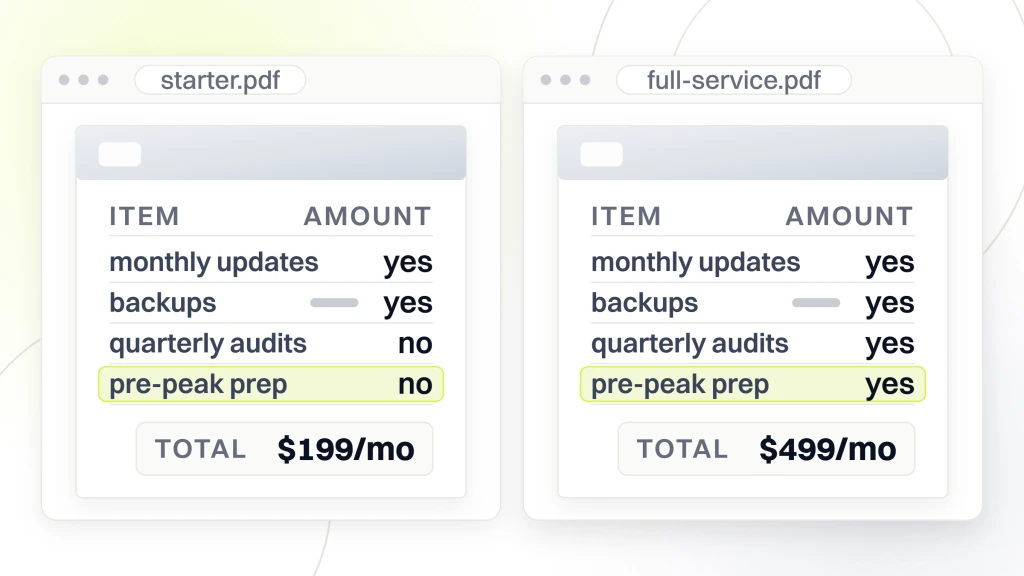
Cost tiers for a managed pet retainer sit in 3 honest bands at Redefine Web. Starter at $199 per month covers monthly updates, backups, uptime monitoring, and 1 to 2 hours of emergency response. Growth at $299 per month adds quarterly audits, checkout QA, and pre-peak prep for 2 seasonal peaks. Full-service at $499 per month adds performance optimization, security controls, accessibility audits, and dedicated response. Any retainer under $199 per month for a real pet WooCommerce site is an automated-tool wrapper or a loss leader with no human oversight behind it.
| Tier | Price | Included | Best for |
|---|---|---|---|
| Starter | $199/mo | Monthly updates, backups, uptime monitoring, 1 to 2 hours emergency response | Pet brands under $1M annual revenue on a stable stack |
| Growth | $299/mo | Starter plus quarterly audits plus checkout QA plus pre-peak prep for 2 seasonal peaks | Pet DTC brands $1M to $6M annual revenue with 2 to 3 peak seasons |
| Full-service | $499/mo | Growth plus performance optimization plus security controls plus accessibility audits plus dedicated response | Pet DTC brands over $6M annual revenue with subscription plus one-time SKUs |
| Ad-hoc hourly | $95 to $135/hr | Specific fixes outside retainer scope, billed in 15-minute increments | One-off jobs from past clients or referrals |
Real pet website maintenance needs skilled hands on the plugin updates, checkout QA, and pre-peak audits. Automated tools alone catch 30% to 50% of the maintenance risk. The remaining risk causes 6-figure outages during Black Friday when the automated tool never learned the coupon stacking rule was broken. The retainer separates the management fee from any third-party tool licensing. Wordfence, WP Rocket, Kinsta hosting, backup storage, and monitoring tools bill separately at cost. That transparency blocks the hidden markup pattern where an agency bundles $180 of tool fees into a $600 retainer that looks reasonable until the founder prices the tools directly.
Pet case patterns behind a real maintenance calendar
A typical pet DTC brand doing $6 million to $12 million in annual revenue carries the same operating profile every pet maintenance calendar has to handle. Sensitive checkout flow. Subscription and one-time SKUs on the same cart. High-frequency small baskets that make refund noise expensive. Seasonal peaks concentrating 40% to 55% of annual revenue into a 90-day window between mid-October and late December. Most brands in this range arrive after 12 to 18 months of irregular maintenance, a checkout losing 4% to 7% of orders to Apple Pay or Shop Pay timeouts, and a Black Friday plan that has never seen a real load test.
Pet Shop · Independent Retail · UK is the reference pattern for a small pet retailer running the checklist right. That long-standing independent UK pet shop was losing ground to chains and online marketplaces. The team rebuilt the site mobile-first around local conversion, tuned the Google Business Profile, and ran a daily Instagram and Facebook cadence. Local inquiries via call and WhatsApp climbed 158%, click-and-collect orders climbed 212%, and repeat-customer rate climbed 47% in a single quarter. Behind every one of those numbers sits a maintenance calendar that kept the mobile checkout live and fast on the exact peak days when a broken site would have handed the inquiry to Amazon.
The remediation pattern rebuilds the maintenance calendar around monthly, quarterly, and pre-peak tasks aligned to the site’s actual revenue rhythm. That means load testing 3 weeks before the biggest seasonal peak, checkout flow QA across 5 payment methods on 3 browsers and 2 device classes, plugin updates on a staging-first schedule, backup restore verification every 90 days, and a third-party script audit that typically removes 6 unused trackers and shaves 500 to 900 milliseconds off homepage load. Pet brands that stand up this rhythm before Q4 protect 3% to 7% of annual revenue that would otherwise vanish to preventable site issues during peaks.
Picking a partner for the pet maintenance retainer
Picking a maintenance partner runs on 4 filters. How many pet or ecommerce sites the agency currently maintains. The average response time on emergency tickets during peak season. How the retainer separates management from tools. And whether pre-peak audits sit inside the retainer or bill as add-ons. Any partner clearing all 4 filters earns a reference call. A partner clearing 3 of 4 earns a follow-up. Fewer than 3 does not earn pitch time.
Ask for 2 references from active retainers over 12 months old with matching traffic profiles, and talk to at least 1. Ask about response time on the last peak, whether backups have been restored during a real incident, and how the agency handled the most recent plugin update with a known breaking change. Every reference call catches a pattern the sales deck hides. That 45 minutes of research prevents 4 to 6 months of misfit inside a bad engagement. Cross-check our small business website maintenance packages page for a parallel pricing view.
Red flags include no case study naming an ecommerce brand, no documented incident response process, retainers bundled with hosting or tool costs, and a proposal promising 100% uptime without qualifying the service level agreement. Green flags include named case studies with real revenue outcomes, a documented incident response runbook, itemized retainer structure, and honest service-level language. Every serious pet brand should audit any shortlisted vendor against those 4 green flags before signing.
How month one looks on a new pet maintenance retainer
Month one on a new pet maintenance retainer runs a full audit of the current site state, documents the maintenance backlog, restores a test backup to a staging environment, runs the first plugin update pass on staging then production, and stands up the ongoing monitoring stack so the founder sees uptime and performance in one dashboard. The month breaks into 4 focused weeks with clear deliverables tied to each.
Week 1 audits the current site state against a 40-item checklist. Week 2 documents the backlog and ranks the top 15 items by risk and revenue impact. Week 3 runs the backup restore to staging and executes the first plugin update pass after staging QA. Week 4 sets up ongoing monitoring, the incident response playbook, and the calendar for month 2 forward. Expect the first measurable page speed movement inside 30 to 45 days after the third-party script audit and image compression pass.
Security posture moves inside 14 days after the first firewall and two-factor rollout. Full maintenance rhythm stabilizes at day 90 with all monthly, quarterly, and pre-peak calendars running. Month 4 through month 12 covers the accessibility audit window, quarterly cadence, and the annual deep-work items that keep the maintenance calendar honest against the actual site state instead of the automation report. See our pet products marketing retainer page for the marketing bundle, and the pet website hosting for DTC brands and grooming salons page for the hosting pairing.