
How DSOs Buy Dental Practices and Value Selling Dentists
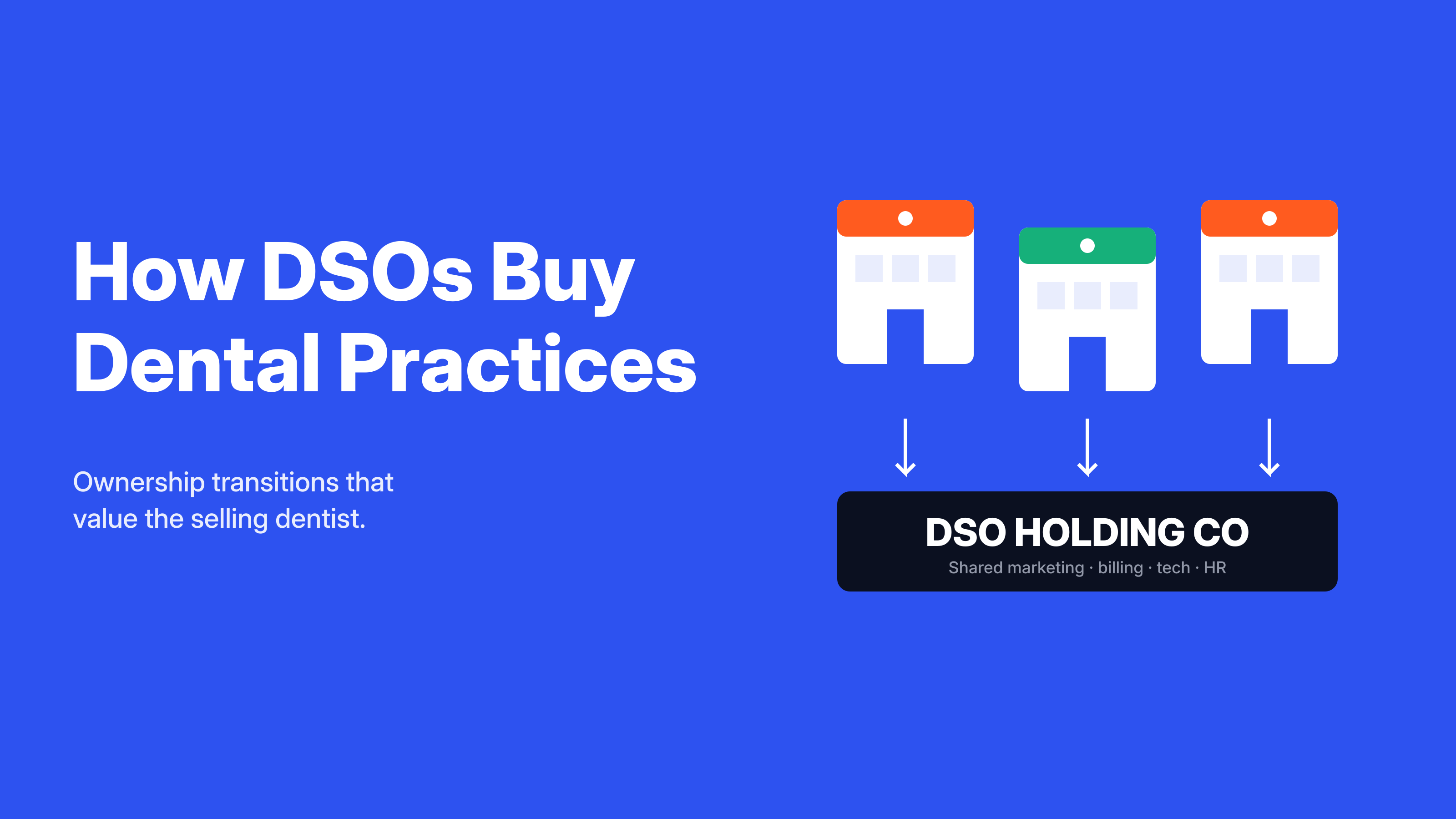
- DSOs buy dental practices for stable cash flow, patient charts, and local Google presence, not just clinical talent.
- A typical DSO acquisition runs 6 to 9 months from letter of intent to close, and the marketing data package can make or break the valuation.
- Selling dentists who prep their marketing data early, including GBP performance and CAC, tend to close 40 percent faster.
- Equity rollover deals with a strong parent DSO can outperform an all-cash sale over a 5-year horizon.
- The biggest post-close risk is losing local reputation during the transition to shared branding.
DSOs bought more dental practices in 2025 than any other buyer type in the US market, and the pace is not slowing. A dental service organization gives affiliated practices shared marketing, HR, billing, and technology, and pays the selling dentist for the operating asset. If you own a practice and a DSO is calling, or if you run a DSO and you are on the buy side, this guide covers how dso buying dental practices actually works, what each side values, and how the marketing data package moves the price.
What a DSO Actually Buys When It Buys a Dental Practice
A DSO does not buy your clinical skill. It buys the operating business around your chair. The value sits in a few places, and the biggest ones are recurring cash flow, the patient chart, the location, and the local search footprint. Heartland, Aspen, Pacific Dental Services, Smile Brands, and MB2 Dental have all built their acquisition models around these four assets.
The chart is the single most valuable line item in most deals. A well-maintained chart of 3,000 to 6,000 active patients throws off predictable hygiene revenue for years. The DSO underwrites that stream, discounts it, and puts a multiple on it. Location comes second. A practice with a 10-year lease in a growing zip code beats a rented space in a shrinking one. Local Google presence sits alongside the lease. A practice with 400 verified reviews and a top-3 Google Business Profile is worth measurably more than a clinically identical practice with 30 reviews and page-two visibility.
The DSO is buying a going concern. That means staff, systems, and reputation, not just the four operatories and the compressor. Understanding what they actually value shapes how sellers should prepare for a call from an M&A advisor.
How the Typical DSO Acquisition Runs From Outreach to Close
Most DSO deals for a single practice run 6 to 9 months from first serious outreach to close. Larger portfolio deals stretch to 12 months. The sequence looks the same across almost every buyer, whether the DSO is private-equity backed or dentist-owned.
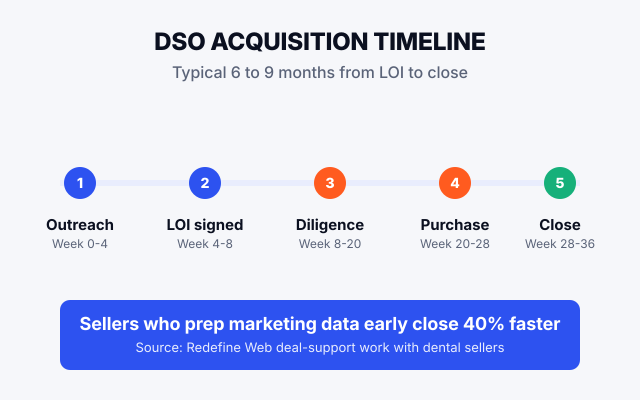
Weeks 0 to 4 are outreach and initial financials. The DSO or its M&A advisor sends a non-disclosure agreement, then asks for two to three years of P&L, patient counts, and procedure mix. Weeks 4 to 8 bring the letter of intent, which locks in the headline price range, the deal structure, and an exclusivity period. Weeks 8 to 20 are diligence. This is where the marketing data package matters most, since the DSO’s ops team is trying to model post-close revenue.
Weeks 20 to 28 draft the purchase agreement. Real estate, non-compete, employment terms for the selling dentist, and rollover equity all get negotiated here. Weeks 28 to 36 are close, funding, and staff transition. Sellers who arrive at diligence with a clean marketing data package, a complete Google Business Profile export, and a documented patient acquisition cost usually shave 4 to 6 weeks off the timeline. Our deal-support team has seen sellers close 40 percent faster when they had this material ready on day one.
What the Marketing Data Package Should Contain
A DSO buyer uses the marketing data to forecast post-close revenue. If the data is messy, the buyer discounts the price to cover uncertainty. Clean data is cash. The package should cover three years and pull from Google Analytics, Google Search Console, Google Business Profile, the practice management system, and any paid ad platforms.
At minimum, include monthly new patient counts, monthly recall counts, patient acquisition cost by channel, top 20 organic keywords with position history, GBP calls and direction requests by month, Google Ads spend and conversions, and website conversion rate. If the practice runs a review generation system, include the review velocity chart. Verifiable review growth is a signal that the DSO’s post-close reputation team can plug into shared infrastructure.
The comparison table below shows what a strong marketing data package looks like versus a weak one, and how each affects the final purchase price.
| Marketing data element | Weak package | Strong package | Price impact |
|---|---|---|---|
| New patient tracking | Estimated from PMS notes | Monthly, by source, 36 months | +3 to +5% multiple |
| Google Business Profile | Claimed but stale | Verified, top 3 in map pack | +2 to +4% multiple |
| Patient acquisition cost | Unknown | Documented by channel | +1 to +3% multiple |
| Google reviews | Under 100 | 400+ with active velocity | +2 to +5% multiple |
| Website conversion rate | No tracking | Measured, benchmarked | +1 to +2% multiple |
| Paid ads performance | Not run, or unclear | Documented ROAS | Neutral to +2% |
A weak package tells the DSO that revenue could sit anywhere in a wide band. A strong package tightens the band and pulls the multiple up. The difference on a $2M EBITDA practice can be $400K or more in enterprise value.
How Deal Structures Work in DSO Acquisitions
Most DSO deals are not straight cash-out. The buyer pays 60 to 80 percent of the purchase price in cash at close, and asks the selling dentist to roll the rest into equity in the parent DSO or a holding company. This is called a rollover, and it is how the DSO aligns the selling dentist with future performance.
The rollover is the piece most sellers underweight. If the DSO grows and eventually sells to another private equity buyer at a higher multiple, the rollover equity can be worth two to three times the cash portion. If the DSO underperforms, the rollover can be worth less than the paper it was signed on. The DSO’s track record, its debt load, and the sponsor behind it matter more than the headline price at close.
Deal structures typically fall into one of three shapes. A pure cash sale gives certainty at close but caps upside. An equity rollover with a strong parent DSO gives lower cash today and real upside on the next liquidity event. An earnout structure ties additional payment to hitting specific revenue or EBITDA numbers in years one through three post-close. The right structure depends on the selling dentist’s age, tax situation, and appetite for tied-in years.
How Canadian Orthodontic Partners Grew a 65-Clinic DSO Through Acquisition and Marketing
The rollup model works when the parent DSO runs marketing well at scale. Canadian Orthodontic Partners is Canada’s largest orthodontic network, with 65 plus clinics across 8 provinces under a house-of-brands model. When we started with them in 2023, their paid media spend was uncoordinated across the acquired clinics. Each clinic ran ads independently, competing for the same terms and matching different intake capacities.
We rebuilt the paid media stack around conversion-first, capacity-aligned, multilingual campaigns. Booked consults grew 97 percent across the network. Cost per consult dropped 58 percent. Paid media conversion rates rose 105 percent. The interesting piece for anyone selling into or running a DSO is what those numbers imply about acquisition strategy. Clinics with strong pre-acquisition marketing data plugged into the shared infrastructure faster and hit the post-close model within one quarter. Clinics with weak data took two to three quarters to stabilize.
The takeaway for sellers is direct. If your local marketing is documented and performing, you slot into a DSO’s shared systems on day one. If it is not, you add integration risk that the buyer will price into your deal.
Post-Close Marketing Integration and What Sellers Should Negotiate
The first 90 days after close are where local reputation gets protected or lost. DSOs typically move practices to a shared website platform, shared review generation, shared local SEO tooling, and centralized ads accounts. If the transition is handled badly, the practice’s Google Business Profile can drop 20 to 40 percent in map pack visibility during the switch. That drop translates directly into lost new patient volume, and it is very hard to recover.
Selling dentists should negotiate three things into the purchase agreement to protect local presence. First, the timing of the website migration should include a 30-day parallel-run period where both the old and new sites are indexed, with 301 redirects tested before the old site goes offline. Second, the Google Business Profile ownership transition should happen through Google’s built-in ownership transfer, not by creating a new listing. Creating a new listing forfeits the review history. Third, the review generation system should run continuously through the transition, not pause.
NC Dental Clinic is a 20-year Vista, California practice we worked with through a similar infrastructure rebuild. The practice replaced fragmented agencies and outdated systems with a unified site, advanced local SEO, and GBP-driven PPC. Patient volume grew 1,000 percent over the engagement, with 12 to 16 new patients monthly. The rebuild was not a DSO transition, but the playbook maps almost exactly to what a well-run DSO integration should look like. Preserve the historic assets, replace the technology stack cleanly, and never let the review generation stop.
How the Marketing Team Structure Changes After a DSO Sale
Independent practices typically use a mix of local vendors and one or two agencies. Post-close, most DSOs consolidate marketing to one internal team plus one preferred agency partner for local execution. This changes what the selling dentist can influence and how fast marketing decisions get made.
Local promotions still originate at the practice level. Brand, media buying, technology, and reporting cadence move to the DSO’s central team. The best DSOs give practice-level clinicians input on offer strategy, promotions, and community events, and pull back the technical execution to a shared team. The worst DSOs push every decision through corporate and lose local nuance.
Sellers who care about post-close marketing autonomy should ask two questions during diligence. Who owns the marketing budget after close, and what is the process for a practice-level manager to request a local promotion? The answers reveal the DSO’s operating model in a single conversation. See our overview of DSO marketing rollout for what a well-structured shared services team should look like.
Common Mistakes Sellers Make Before and During a DSO Deal
The five mistakes we see most often destroy value on both sides of the close. Sellers who avoid them keep more of the deal on their side of the table.
The first mistake is signing a letter of intent before the practice has a real valuation. Sellers who take the first offer without a competitive process leave 10 to 20 percent of value on the table. Getting two or three DSOs into an active bid is the single highest-return move for a seller. The second mistake is treating the exclusivity period as low-pressure. A signed LOI with exclusivity means the DSO can drag diligence and negotiate down the price without competition. Cap exclusivity at 90 days.
The third mistake is showing up to diligence with unclear marketing data. This forces the DSO to discount its offer to cover forecasting risk. The fourth is signing an aggressive non-compete without measuring the local market. A 5-year, 10-mile non-compete effectively removes the seller from the local dentistry market. And the fifth is under-negotiating the transition support agreement, which defines how much time the selling dentist commits post-close. Most DSOs want 2 to 5 years of continued clinical work. That commitment should be priced explicitly.
For sellers who want the buy-side view before entering conversations, our guide to dental DSO marketing at scale and what a DSO actually means for practice ownership both cover the operator side in more depth.
How DSOs Compare Practices During the Buy Process
DSO buy-side teams score every target practice on the same rough grid. Understanding the grid helps sellers see what the buyer is really evaluating.
| Scoring dimension | Weight | What the DSO looks at |
|---|---|---|
| EBITDA and cash flow | Highest | Trailing 12 months, 24 months, add-backs |
| Patient chart quality | High | Active patient count, recall rate, hygiene retention |
| Real estate and lease | High | Remaining term, option to renew, rent as % of revenue |
| Local search presence | Medium-high | GBP position, review count, review velocity |
| Staff continuity | Medium | Tenure of hygienists and front desk |
| Payer mix | Medium | PPO vs fee-for-service vs Medicaid split |
| Selling dentist commitment | Medium | Years agreed to continue clinical work |
| Technology stack | Low-medium | PMS platform, cloud vs on-prem |
Local search presence has climbed the list over the last five years as DSOs have gotten better at valuing digital assets. A practice with a strong GBP and 500-plus reviews is worth more than a clinically identical practice with a stale profile, since the DSO does not have to spend the first year rebuilding local presence. This is where the marketing data package pays off directly. Our breakdown of DSO versus independent practice trade-offs covers the operator-side view of these dimensions.
Frequently Asked Questions
How much do DSOs pay for a dental practice
Most DSOs pay between 6 and 9 times trailing 12-month EBITDA for a general dental practice, with specialty practices like ortho or endo trading at 8 to 12 times. The exact multiple depends on practice size, growth trajectory, payer mix, real estate, and marketing data quality. A practice generating $1M in EBITDA typically transacts at $6M to $9M enterprise value, with 60 to 80 percent paid in cash at close and the rest as rollover equity in the DSO parent.
The headline multiple is not the whole story. Deal structure, earnout language, non-compete scope, and transition support commitments all move the effective price the selling dentist actually receives. Two offers at the same headline multiple can produce very different outcomes over a 5-year horizon depending on how the equity rollover and earnout are structured. Sellers should model both the cash portion and the risk-adjusted rollover value before signing an LOI.
How long does dso buying dental practices actually take from first call to close
A DSO acquiring a single dental practice typically closes in 6 to 9 months from serious first outreach. Portfolio deals covering multiple practices stretch to 9 to 15 months. The bottleneck is almost always the diligence phase, which runs 8 to 12 weeks and touches financials, patient records, real estate, staff, and marketing data.
Sellers who arrive at diligence with a clean, three-year marketing data package cut 4 to 6 weeks off the timeline. Sellers who arrive with disorganized data add 6 to 10 weeks and often see the headline price get renegotiated down as the DSO uncovers surprises. The clearer the data going in, the faster and cleaner the close.
Should I sell my dental practice to a DSO
Selling to a DSO makes sense for dentists who want to reduce operational overhead, capture a valuation multiple on a lifetime of practice building, and stay clinical without running the business. It is less right for dentists who value full clinical and operational autonomy or who plan to retire cleanly within 12 months of close, since most DSOs require 2 to 5 years of continued clinical work post-close.
The best way to decide is to run a real valuation, get two or three DSOs into a competitive bid, and compare the total 5-year economics of each offer against continuing independent. The valuation exercise alone often surfaces useful operating information regardless of whether the sale happens.
What documents does a DSO ask for during diligence
Standard DSO diligence covers financial, clinical, operational, and marketing documents. On financial, expect requests for three years of P&L, tax returns, bank statements, accounts receivable aging, and a working capital schedule. On clinical, the buyer wants active patient counts, procedure mix by CDT code, hygiene retention rates, and case acceptance ratios. Operational documents cover staff rosters with tenure, equipment inventory, lease and real estate documents, and vendor contracts.
Marketing diligence is where most sellers under-prepare. Buyers want monthly new patient counts by source, patient acquisition cost, Google Business Profile performance, Google Analytics access, Google Ads history, review velocity data, and any agency contracts. A clean marketing data package cuts diligence time and pulls the offer up.
Can I keep my practice name after a DSO sale
Most DSOs preserve the practice name for at least the first two to three years after close, particularly if the local reputation is strong. Some DSOs run a house-of-brands model permanently, which keeps each acquired practice on its original name. Others eventually rebrand under a shared name, which is more common with private-equity backed roll-ups building a regional or national brand.
Selling dentists who want name preservation should get the commitment in writing during LOI negotiation. Ask directly about the brand transition timeline, the shared marketing platform rollout, and the review generation continuity plan. A vague answer to any of these is a signal that reputation continuity is not a priority for the buyer.
What happens to the practice staff after a DSO acquisition
Most DSOs retain the existing staff after close, particularly hygienists and long-tenured front desk employees, since staff continuity directly protects patient retention. Compensation structures usually shift to align with the DSO’s standard, which can mean small increases for hygienists and bonus restructuring for the selling dentist. Benefits packages typically improve, since DSOs have scale to negotiate better health insurance and retirement plans.
Culture change is the piece that often surprises staff. Practices that had informal decision-making shift to more structured processes, standardized software, and reporting cadences. Selling dentists who want to protect their team should negotiate an explicit staff continuity clause into the purchase agreement and stay involved through the first 90 days of integration.
If you run a dental practice and want a marketing data package that will hold up in DSO diligence, see how our dental marketing agency approaches new patient tracking and dental SEO services that hold local map pack position through practice transitions.
Book your free 30-minute strategy call.
No spam, no sales rep. We use your email to schedule your call with a senior strategist. That is it.
More from the blog
View all articles → Marketing Strategy
 How Dental DSOs Grow Through Marketing. Tactics That Scale
Read article Marketing Strategy
 Dental DSO Marketing Services. What to Expect From an Agency Partner
Read article Marketing Strategy