
E-commerce SEO Services for Online Stores That Actually Sell
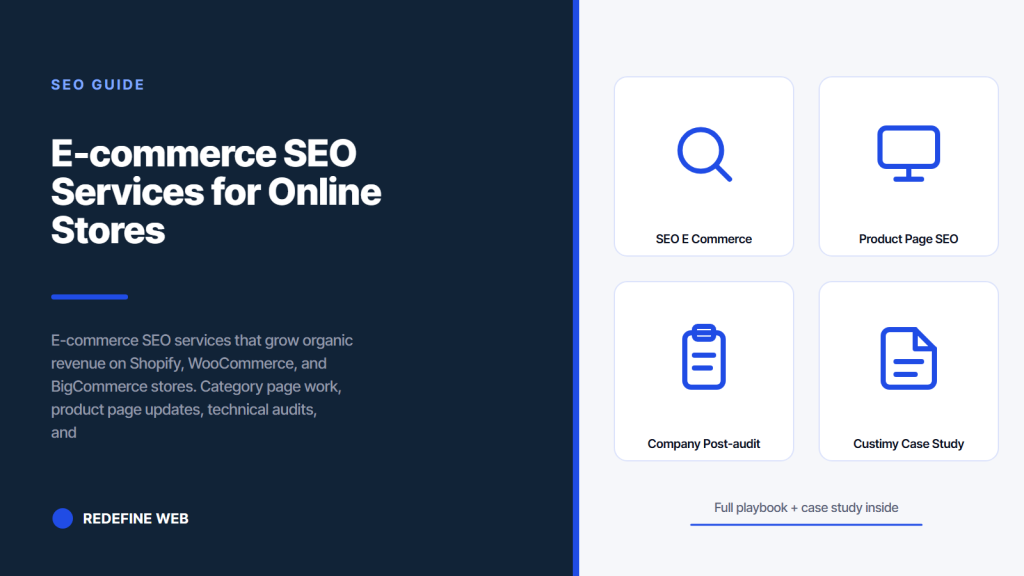
- Retainer runs $599 to $8,500 monthly by catalog size.
- Technical audit fixes open 20 to 40 percent of catalog indexation.
- Category page copy is the single biggest ranking driver.
- Rewrite top 100 revenue product pages first.
- Reporting leads with organic revenue, not keyword counts.
- SEO in e commerce category pages that actually rank
- Product page SEO that pulls long-tail buyer intent
- The e-commerce SEO company post-audit playbook
- SEO e-commerce for Shopify versus WooCommerce versus BigCommerce
- Custimy case study for the e-commerce SEO services conversation
- What e-commerce SEO service reporting should actually track
- Choosing an e-commerce SEO agency versus an in-house hire
- Red flags in every e-commerce SEO services pitch
- Wrapping the e-commerce SEO services guide
E-commerce SEO is the difference between an online store that pays for itself in organic traffic and one that lives or dies on paid ads. Most stores we audit run 5 to 12 percent of their revenue from organic search when the ceiling is 35 to 55 percent for a well-optimized site in the same category. This guide walks you through what real e-commerce SEO services look like, what they cost, and how to know which agency can actually move category page rankings versus which one will hand you a monthly report with green arrows and no revenue growth.
You’re probably reading this because your store’s organic traffic went flat six months ago and paid ROAS dropped from 4x to 2.3x. The fix isn’t more ad spend. It’s a working SEO program that pulls buyers from Google directly onto category pages that convert. Below you’ll find the scope, the pricing bands, the technical audit checklist we run on every new account, and a Custimy case study that hit 500 plus first-page rankings and 25K monthly organic visits inside 12 months. Read straight through in about ten minutes.
SEO in e commerce category pages that actually rank
SEO in e commerce lives and dies on category pages. Category pages target head and mid-tail keywords with the highest commercial intent on the site. “Women’s running shoes” pulls 200,000 monthly searches at $2.40 CPC on Google Ads. Ranking that page organically is worth $40,000 to $180,000 in monthly revenue depending on your conversion rate and average order value.
A ranking category page has five things going for it. A 400 to 900 word intro block above the product grid with genuine buying advice and internal links to related categories. Product cards with structured markup for price, availability, and review rating. A filter and sort UI that generates crawlable indexable URLs for high-value combinations only. A FAQ block at the bottom that answers the top 5 buyer questions pulled from real search data. And a clean canonical strategy that keeps filtered variants from cannibalizing the parent category.
The category page copy is where most stores fall short. A 40-word intro that reads like it was written by the store owner in 15 minutes doesn’t rank against category pages with 600 words of genuine buyer guidance from Wirecutter, REI, or Nordstrom. Invest 4 to 8 hours per category page in the copy pass. On a 60-category site, that’s 240 to 480 hours of writing, which is why the mid-tier retainer at $2,800 to $5,500 makes sense for a 5,000-SKU catalog. Also worth pairing this with a working Ecommerce SEO Services for DTC Brands partner who’s built this pattern on 20 plus stores in the same category.
Product page SEO that pulls long-tail buyer intent
Product page SEO pulls long-tail buyer intent that category pages don’t reach. A category page ranks for “women’s running shoes.” A product page ranks for “Nike Pegasus 41 women’s size 8 wide.” The long-tail volume per page is smaller but the intent is transactional, and 300 well-optimized product pages compound into 20 to 40 percent of the store’s organic revenue.
The product page checklist runs eight items. A unique title tag with brand, model, key attribute, and category noun. A meta description that pulls the buyer in with a specific benefit or offer. 250 to 700 words of unique product description in your voice, not the manufacturer boilerplate that also runs on 400 other retailers. Structured markup for product, offer, aggregate rating, and review. A minimum of 3 review snippets rendered server-side, not lazy-loaded JavaScript. A related-products block linked to complementary items in the same category. Breadcrumb navigation with category schema. And image alt text that describes the visible attribute of the product.
The number of stores we audit that fail the manufacturer-boilerplate check is around 8 out of 10. Copy the same description onto 400 SKUs and Google treats every one of them as duplicate content. The category page pulls the organic traffic, and the product pages get maybe 5 percent of the total organic pie. Rewrite unique descriptions on the top 100 revenue SKUs first, then work outward. This one pass usually adds 15 to 30 percent to organic revenue inside 4 months on a mid-size catalog. External data on product page ranking patterns sits at Search Engine Journal’s e-commerce SEO archive.
The e-commerce SEO company post-audit playbook
The e-commerce SEO company you sign should have a documented post-audit playbook. Weeks 1 to 3 fix critical technical blockers. Weeks 4 to 8 rewrite category page copy and internal linking. Weeks 9 to 16 rewrite top product pages and build category-level backlinks. Weeks 17 onwards move into a monthly rhythm of new category adds, product page refreshes, and content clusters around buyer questions.
The rhythm past month 4 is what separates a real SEO retainer from a monthly reporting subscription. A working retainer delivers 4 to 8 category page rewrites, 20 to 40 product page rewrites, 2 to 4 new content clusters, and 3 to 6 backlink placements per month. Reporting is the last 10 percent of the retainer, not the first 60. When the invoice shows more strategy and reporting hours than content and technical hours, you’re paying for the wrong shape.
The named account lead matters more on e-commerce than on lead-gen SEO. Product catalogs change monthly. New categories launch, old SKUs retire, and the site map shifts. An account lead who’s on your Slack sees these changes in real time and updates the SEO plan alongside them. An account lead who only shows up on a monthly review call misses 60 percent of the catalog changes and the SEO plan drifts out of sync with the store within a quarter. Ask upfront who the named lead is and whether they’re on Slack or email.
The single most common SEO deliverable we’ve seen from other agencies on stores that hired us second is a 68-slide monthly reporting deck built by an offshore analyst who has never opened the store’s admin panel. The deck arrives on the 15th of the month, contains 42 charts of ranking positions, and has zero completed changes to the actual site since the last one. The store owner reads it, feels productive, and pays another $2,800 to receive an identical deck in 30 days. If your current SEO agency’s reports look like a NASA mission briefing but your Shopify admin activity log shows no theme file edits in the last 60 days, you already know what’s happening.
Buying a blog subscription won't fix faceted URLs eating crawl budget. Run Screaming Frog on your category pages this week. Look at what's canonical to what.
SEO e-commerce for Shopify versus WooCommerce versus BigCommerce
SEO e-commerce runs on all three major platforms but the technical starting point is different on each. Shopify handles canonical tags and basic schema out of the box but restricts URL structure and .htaccess-level redirects. WooCommerce gives full control over everything but comes with default settings that generate crawl-budget waste. BigCommerce sits in the middle with cleaner defaults but a smaller plugin ecosystem for advanced SEO tasks.
The workload split by platform: Shopify is roughly 30 percent technical and 70 percent content and links because the platform handles most technical baseline items. WooCommerce inverts to 55 percent technical and 45 percent content because the default install comes with 15 to 25 URL issues that need fixing. BigCommerce splits 40 percent technical and 60 percent content. Match the retainer scope to the platform reality, not the sticker price of another store on a different platform.
The migration question matters. Stores considering a platform switch mid-retainer often lose 20 to 45 percent of organic traffic in the 90 days after migration when the dev team owns the URL mapping and redirect strategy instead of the SEO team. Never migrate an e-commerce store without a mapped URL redirect plan reviewed by the SEO lead. This one gap has cost stores we’ve audited $80,000 to $340,000 in lost organic revenue over the first 6 months post-migration. For platform-specific patterns, the sibling guides on woocommerce seo services and Shopify SEO cover the tradeoffs in more depth.
Custimy case study for the e-commerce SEO services conversation
Custimy is a SaaS customer data platform serving e-commerce brands, whose SEO engagement mirrors the compounding pattern we run on catalog stores. Over 2023 and 2024 the program ranked Custimy in Google’s top 10 for 500 plus industry-relevant keywords, drove organic monthly visits to 25,000 plus, and pushed average session duration to 165 seconds through targeted content and technical work.
The engagement started with a full technical audit that surfaced JavaScript rendering issues on 30 percent of the site’s key landing pages, canonical inconsistencies across the resource library, and a thin category structure that grouped 40 unrelated topics under 4 broad hubs. The first three months went into fixing rendering and canonicals, then restructuring the topical categories into 12 focused hubs mapped to buyer intent stages. By month 6, first-page ranks crossed 200. By month 12, they crossed 500. The pattern is the same one that works on catalog e-commerce sites: fix technical first, restructure categories second, then compound with content and links quarterly.
The takeaway for a store owner reading this: the 12-month compounding pattern is real but the first 90 days look like backlog work, not ranking work. Rankings don’t move visibly for 60 to 90 days on a mid-size store because the technical fixes need to work through Google’s crawl and indexation cycles. If your current SEO agency promises visible ranking movement in month 1, they’re either working on a store with fresh domain authority and low competition or they’re front-loading vanity keyword wins to keep the invoice paid. Real e-commerce SEO shows up in month 4 and compounds through month 12. For the retainer plan that pairs SEO with paid, email, and CRO, see our Ecommerce Marketing Retainer Plans from $599/mo.
What e-commerce SEO service reporting should actually track
An e-commerce SEO service report worth reading tracks six metrics in order. Organic revenue in GA4. Organic sessions to money pages by category. Category rankings on 20 head terms. Assisted conversions from organic. Backlinks with domain rating. And Core Web Vitals as a health check, not a headline.
What the report should NOT lead with: total keyword count on any page position, impressions on branded terms, or a wall of green arrows on ranking changes that aggregate 400 keywords into one meaningless up-arrow. These are the vanity metrics that fill 68-slide decks and tell the store owner nothing about revenue. The clean signal is: organic revenue this month versus 3 months ago versus 12 months ago, plus category-level session growth on the top 15 revenue-driving pages. Anything else is noise.
The monthly review call should take 30 minutes not 90. Fifteen minutes on the six metrics above. Ten minutes on what went live last month and what’s queued for next month. Five minutes on any strategic decisions the store owner needs to make, like a new category launch or a discontinuation. If the review call runs to 90 minutes and half of it is the agency defending ranking movements, the reporting is the product instead of the ranking work. Reference material on GA4 attribution for e-commerce sits at the Google Analytics 4 e-commerce measurement post.
Choosing an e-commerce SEO agency versus an in-house hire
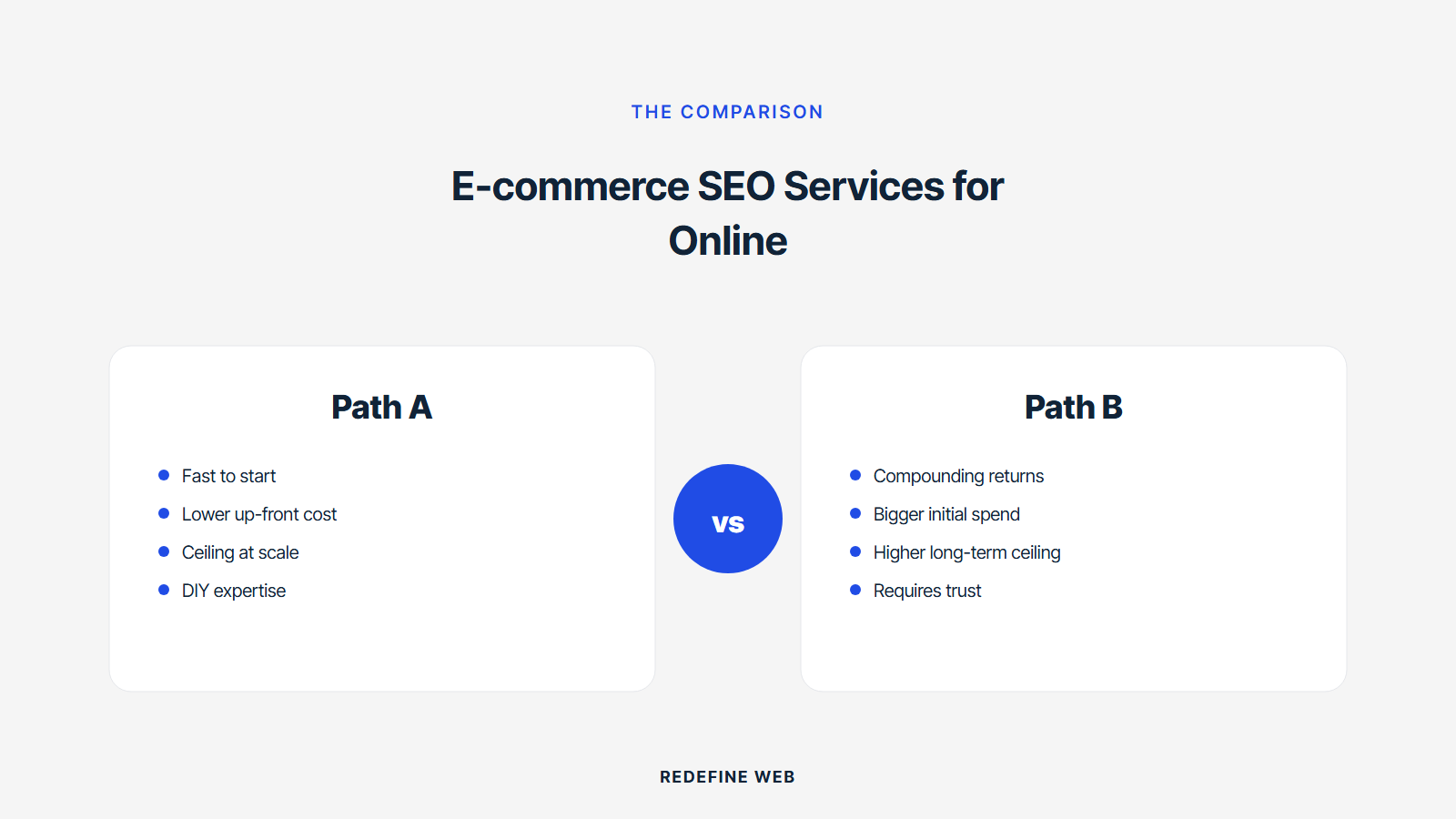
Choosing an e-commerce SEO agency versus an in-house SEO manager comes down to three variables. Catalog size. Growth stage. And whether you already have a marketing operations lead who can direct external work. Below $2M annual revenue, agencies win on flexibility and specialist depth. Above $8M with a marketing ops lead in place, an in-house SEO plus a specialist agency partner is the strongest combination.
An in-house SEO hire runs $75,000 to $135,000 fully loaded plus tools at $9,000 to $18,000 per year for Ahrefs, Screaming Frog, and a content workflow tool. That’s $84,000 to $153,000 all-in for one person who covers strategy, on-page, technical, and reporting. An agency retainer at $3,200 monthly runs $38,400 per year and touches all four capabilities through a specialist team. The math favors agencies until catalog size crosses roughly 8,000 SKUs and organic revenue crosses $2M annually, at which point the in-house hire pays back inside 18 months.
The hybrid is the strongest shape past $8M annual revenue. In-house SEO manager owns strategy, roadmap, and internal stakeholder work. Agency delivers the technical fixes, category page rewrites, and link outreach. This split runs $150,000 to $220,000 annually combined and delivers 3 to 5 times the output of either alone. Below $2M revenue skip the debate and hire an agency. Between $2M and $8M start with the agency and layer the in-house hire once organic revenue passes $2.4M annually. For the deeper agency versus in-house math, see Moz’s take on the agency versus in-house question.
Red flags in every e-commerce SEO services pitch
The red flags on any e-commerce SEO services pitch cluster around three patterns. Guarantees. Vanity metric focus. And unclear scope. Any agency that guarantees a #1 ranking on a competitive category term is either lying or planning to game the metric with branded search volume tricks that Google catches inside 6 months.
The seven-flag checklist worth running on every proposal: 1. Guaranteed rankings language anywhere in the deck. 2. Case studies that show ranking screenshots without revenue numbers. 3. Retainer with no hours breakdown by discipline. 4. No named account lead or team roster. 5. Reporting cadence more frequent than the delivery cadence. 6. A monthly link package priced separately from the retainer with no domain rating targets. 7. No termination clause under 30 days notice. Two or more of these in one proposal and the agency is a sales operation, not a delivery operation.
- Guaranteed rankings or top-page-1 language in the pitch deck
- Case studies with ranking screenshots but no revenue numbers
- Retainer with no hours breakdown by technical, content, and link work
- No named account lead or team roster attached to the proposal
- Reporting cadence more frequent than the actual delivery cadence
- Monthly link package priced separately with no domain rating targets
- Termination clause longer than 30 days notice with penalty language
- Pitch deck runs 68 slides with 42 charts and 3 live-site screenshots
Wrapping the e-commerce SEO services guide
E-commerce SEO that grows organic revenue past 30 percent of total store revenue runs on the same repeatable pattern. Fix the technical layer first. Rewrite category pages second. Rewrite the top revenue product pages third. Then compound with content clusters and category-level backlinks on a monthly rhythm through months 6 to 18.
If you take one thing from this guide, take the six-metric report shape and run it against your current agency’s monthly deck. If the deck leads with organic revenue and top-15 category sessions, keep them. If it leads with total keywords ranking and impressions on branded terms, start the vendor search this week. When you’re ready to talk through a retainer that pairs SEO with paid, email, and CRO on one account, our Search Engine Optimization Services team walks through the shape in a 30-minute call. For the site build layer that pairs with the SEO retainer, our Ecommerce Website Design Services practice runs the same pattern on Shopify and WooCommerce builds.
For the full strategy stack across feed audits, category depth, product schema, and site speed, read our deeper guide on ecommerce SEO services covering feed, content, and technical work.
For founders choosing a build partner, our deeper read on picking an ecommerce web design company covers pricing bands, platform picks, and the questions to ask before signing.
Frequently asked questions
How much do e-commerce SEO services cost per month?
E-commerce SEO services run $599 to $8,500 per month depending on catalog size and platform. A small Shopify store with 50 to 300 SKUs sits at $599 to $1,600 monthly. A growth-stage Shopify store between 300 and 1,500 SKUs runs $1,600 to $3,200. A mid-size WooCommerce catalog between 1,000 and 5,000 SKUs runs $2,800 to $5,500. Large WooCommerce catalogs past 5,000 SKUs run $4,500 to $8,500 monthly. BigCommerce enterprise sites past 20,000 SKUs cross $6,500 and run to $12,000 monthly. Below $599 you're getting monthly ranking reports, not completed optimization work.
How long does e-commerce SEO take to show results?
E-commerce SEO shows measurable ranking movement in months 3 to 5 and material organic revenue growth in months 4 to 8. The first 90 days go into technical audit fixes, category page rewrites, and internal linking work that doesn't move rankings visibly. Rankings begin moving in month 3 as Google's crawl and indexation catches up. Organic revenue starts compounding in month 4. By month 6 most working programs deliver 20 to 45 percent organic revenue growth over the pre-engagement baseline. If your current agency promises visible ranking movement in month 1, they're front-loading vanity keyword wins.
What does an e-commerce SEO agency include in the technical audit?
An e-commerce SEO agency worth signing runs a 40 to 80 hour technical audit in month one covering crawl budget, canonical tags, faceted navigation URL patterns, JavaScript rendering of product data, product and category schema, internal linking depth, XML sitemap health, HTTP status codes across the catalog, image optimization, and Core Web Vitals across mobile and desktop templates. The audit outputs a prioritized ticket list with dev estimates for your Jira or Linear, not a 90-page PDF. Below 40 hours the audit is a checklist scan, not a real diagnosis of what's blocking the store's organic performance.
Which is better for e-commerce SEO, Shopify or WooCommerce?
Shopify wins on technical baseline and speed to launch. WooCommerce wins on flexibility and URL control. For most stores under $2M annual revenue Shopify is the stronger pick because the platform handles canonical tags, XML sitemaps, and Core Web Vitals defaults that WooCommerce requires manual configuration to reach. For stores past $5M annual revenue with in-house dev capacity WooCommerce becomes competitive because the URL and template freedom pays back through custom SEO patterns Shopify restricts. BigCommerce sits in the middle with cleaner defaults than WooCommerce and more flexibility than Shopify but a smaller ecosystem for advanced SEO plugins.
How do I choose the right e-commerce SEO company?
Choose an e-commerce SEO company that shows revenue case studies not ranking screenshots, breaks down retainer hours by technical, content, and link discipline, names the account lead in the proposal, offers a termination clause under 30 days notice, and runs a monthly review call under 30 minutes focused on organic revenue not vanity metrics. Avoid agencies that guarantee rankings, run 60-plus-slide monthly decks, or price monthly link packages separately with no domain rating targets. Ask for three references from stores in your platform and rough catalog size and call them before signing anything.
Should I hire in-house SEO or use an e-commerce SEO agency?
Below $2M annual store revenue an agency retainer wins on cost and specialist depth. An in-house SEO manager runs $75,000 to $135,000 fully loaded plus $9,000 to $18,000 in annual tool costs. An agency retainer at $3,200 monthly runs $38,400 annually and covers strategy, technical, on-page, and reporting through a specialist team. Above $8M annual revenue the hybrid model wins with an in-house SEO manager plus an agency partner. In-house owns strategy and roadmap. Agency delivers technical fixes, category page rewrites, and link outreach. Combined cost $150,000 to $220,000 annually with 3 to 5 times the output of either alone.
Book your free 30-minute strategy call.
No spam, no sales rep. We use your email to schedule your call with a senior strategist. That is it.
More from the blog
View all articles → SEO
SEO Organic Search Engine Optimization Services That Grow Real Traffic
Read article SEO
SEO SEO for Pet Groomers That Fills the Appointment Book Weekly
Read article SEO
SEO