Where Healthcare Practices Waste SEO Budget
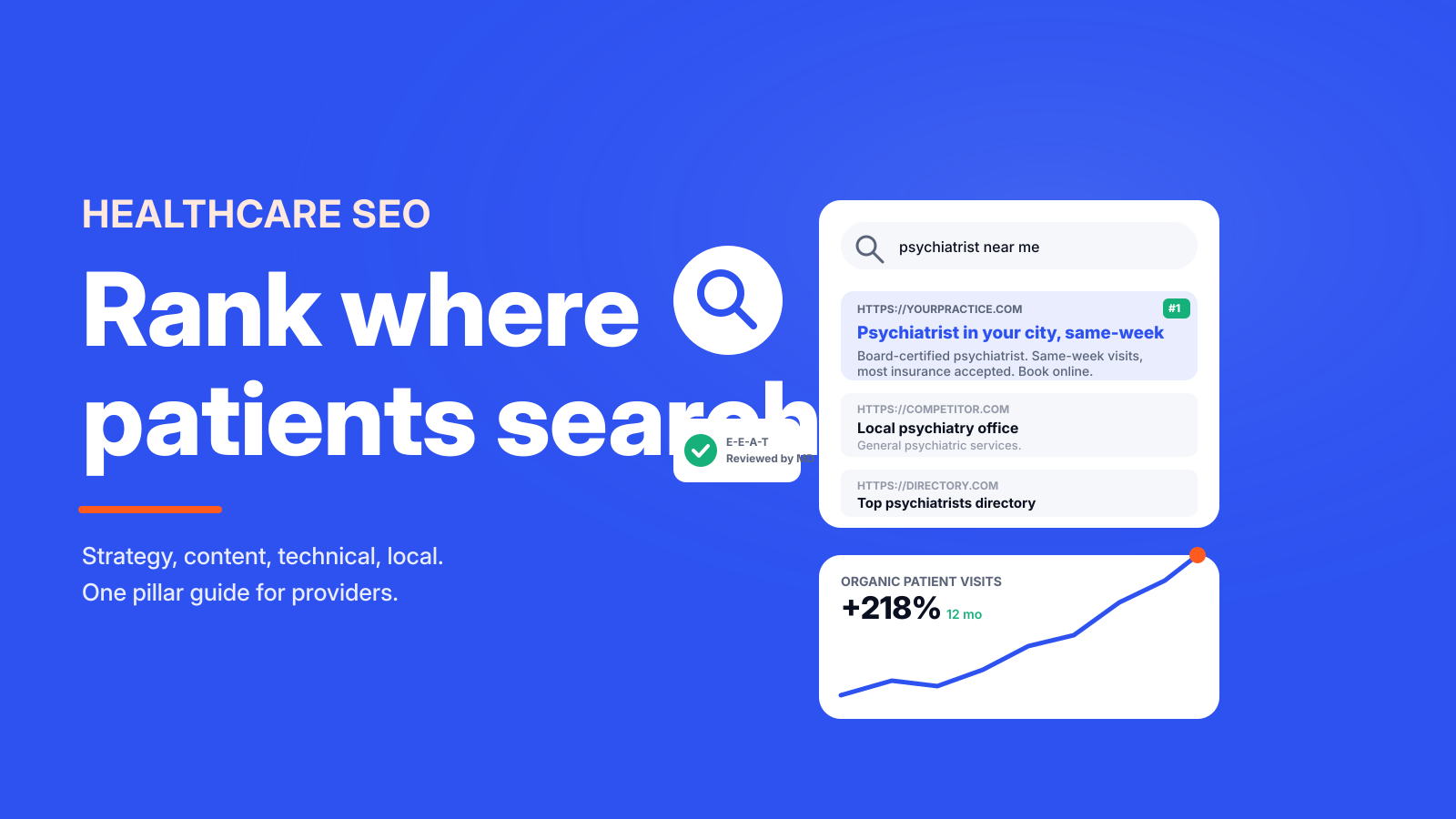
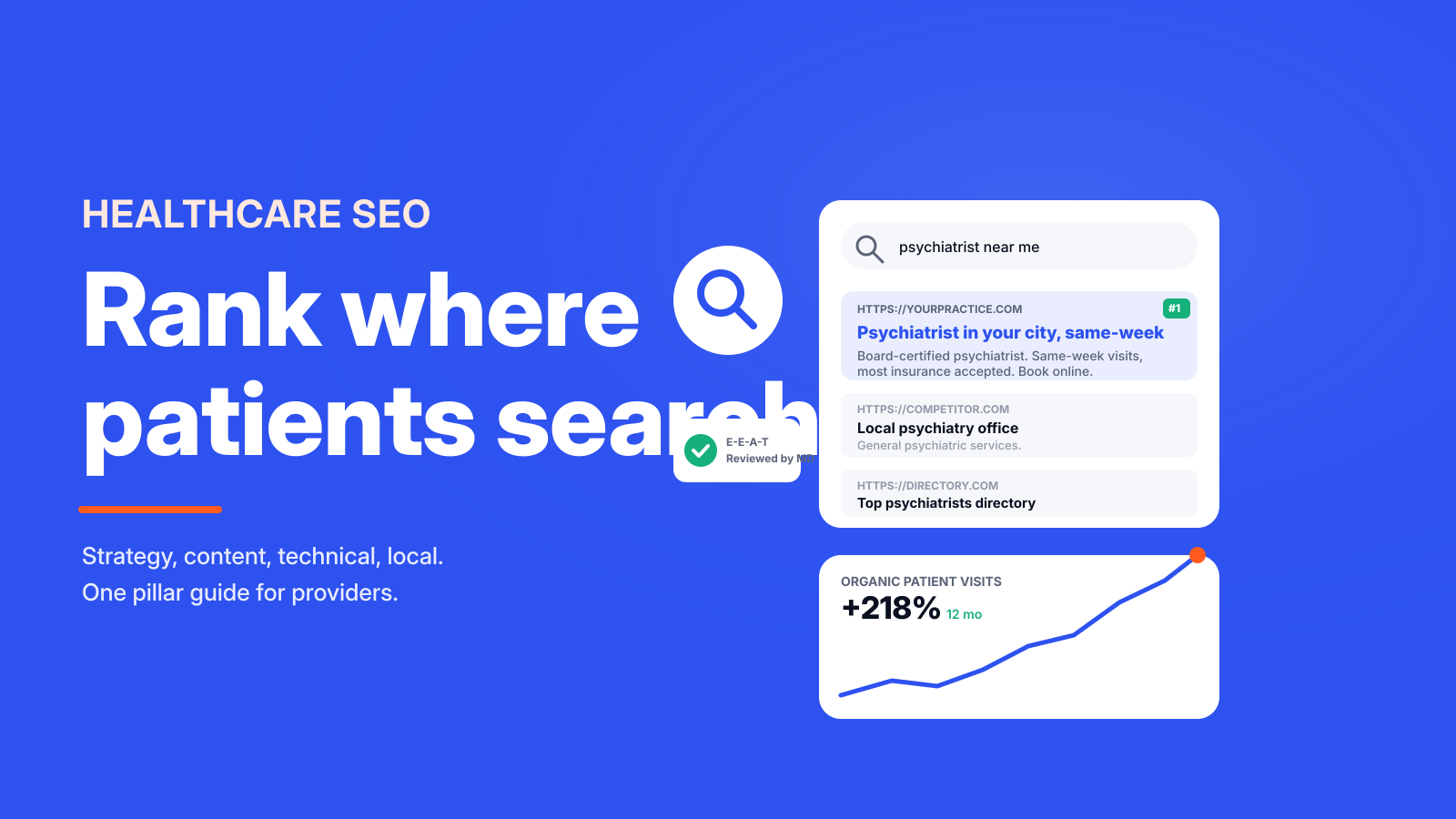
- Healthcare SEO sits inside Google's YMYL rules, so E-E-A-T signals (real providers, medical reviewers, primary source citations) carry more weight than they do in any other vertical.
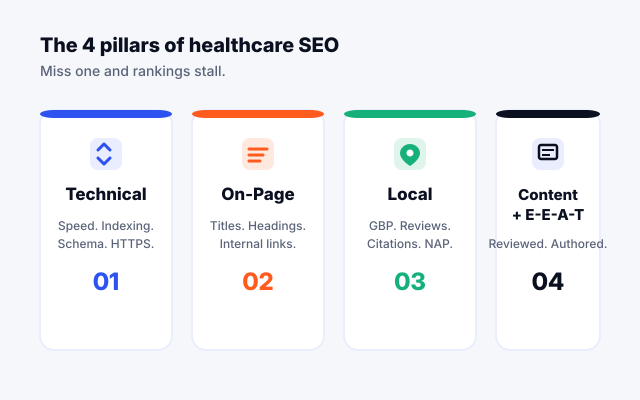
- The four pillars are technical, on-page, local, and content authority. Miss one and rankings stall, which shows up 6-12 months later as flat new-patient volume.
- Local SEO usually moves fastest for clinics because 46% of Google searches have local intent and health queries skew higher. Review velocity is the fastest single lever.
- Real cost ranges: solo practice $1,500-$3,500/mo, multi-location group $7,500-$18,000/mo, regional network $18,000-$45,000/mo. Redefine Web retainers start at $599/mo.
- Rankings are an input, booked patients are the output. A vendor who only reports rankings is charging retainer while patient volume stays flat.
Healthcare SEO is the discipline of making your clinic show up when a real person searches for a symptom, a specialty, or a provider name. It sits at the crossroads of clinical trust, local intent, technical hygiene, and content that a medical reviewer would sign off on. This pillar guide walks the full picture: what actually moves rankings for providers, what to skip, and the order to fix things when your site is already live.
We manage healthcare SEO for solo clinics, multi-location groups, mental-health networks, and hospital-adjacent brands. The winning pattern is boring on purpose. Sites that pull organic patients are fast on a phone, answer the exact question a searcher typed, and back every clinical claim with a real reviewer. Nothing about that changes when Google ships a new algorithm update.
What healthcare SEO actually covers
Healthcare SEO is the full set of decisions that put a clinic in front of a patient at the moment they search. That covers four working layers: technical, on-page, local, and content authority. SEO for healthcare providers is only half a marketing job. The other half is proving to Google that a real, licensed human stands behind the words on the page.
Miss any single layer and rankings stall in a way that only shows up months later when new-patient volume goes flat. Every audit we run starts with the same four checkpoints:
- Technical SEO. Mobile speed, crawlability, HTTPS, structured data, and clean site architecture. If Googlebot cannot render the page, ranking is off the table.
- On-page SEO. Title tags, headings, service-page copy, internal links, and schema for MedicalOrganization, Physician, and FAQPage.
- Local SEO. Google Business Profile, NAP consistency across directories, city and specialty pages, and patient reviews collected on a schedule.
- Content authority and E-E-A-T. Provider bios with credentials, medical-reviewer bylines, condition and treatment content, and citations to primary medical sources.
Our healthcare SEO services team ships all four layers as one program. Skipping any one of them isn’t a shortcut in healthcare SEO. It’s a slower path to the same rank you would have gotten in half the time.
Why SEO for healthcare industry sites plays by different rules
Healthcare sits inside Google’s Your Money or Your Life (YMYL) category. A finance article can be wrong and cost you money. A healthcare article can be wrong and cost you a lung. Google raters treat medical content on a stricter bar than almost any other topic, and the Search Quality Rater Guidelines spell that out in the sections on E-E-A-T and clinical accuracy.
That has three practical consequences for SEO in healthcare. First, thin service pages with no author, no reviewer, and no source list are almost never going to outrank a competitor who did the work. Second, patient reviews on Google Business Profile carry heavier weight for local pack visibility than they do in most other verticals. Third, technical safety signals (HTTPS, no mixed content, valid SSL, no HIPAA-risky pixels) get watched more closely by security scanners that Google raters cross-check against.
The upshot: SEO for healthcare providers is closer to publishing peer-reviewed content than it is to writing blog posts. The healthcare sites that win rankings look like small publishers. The ones that stall look like brochures.
How healthcare SEO differs from local business SEO
Most SEO guides you read are written for e-commerce or local services, and a lot of that advice quietly breaks on a clinic. Here is the honest side-by-side.
| SEO factor | Local business SEO | Healthcare SEO |
|---|---|---|
| Content review | Marketing copywriter | Licensed provider or medical reviewer required |
| Author byline | Optional | Real, credentialed, with photo and license state |
| Trust signals | Reviews, years in business | Reviews, credentials, board certifications, insurance accepted |
| Conversion tracking | Any platform | Server-side, PHI-safe, BAA-backed |
| Local pack weight | Reviews + citations | Reviews + citations + medical NAP + insurance listings |
| Schema priority | LocalBusiness | MedicalOrganization, Physician, MedicalCondition, FAQPage |
| Time to first-page rank | 3-6 months | 6-12 months for competitive terms |
The gap in “time to rank” is the one most providers underestimate. A local plumber can rank a service page in 90 days on a shoestring. A behavioral health practice targeting “psychiatrist near me” is competing with hospital systems, insurance directories, and telehealth VC money, and the timeline reflects it.
The technical foundation every healthcare site needs
Technical SEO for healthcare is the base that everything else rests on. Get this layer wrong and no amount of blog content will rescue the site. The good news: technical SEO is a finite checklist. Every clinic site we take over gets scored against the same eleven items before we touch content.
- HTTPS with a valid SSL certificate. Google’s security scanner will silently downrank any healthcare page served over mixed content.
- Mobile Core Web Vitals in the green. LCP under 2.5s, INP under 200ms, CLS under 0.1. The healthcare web design pillar covers the layout patterns that ship these numbers.
- Clean XML sitemap submitted in Search Console, one URL per page, no orphan condition pages.
- Structured data for MedicalOrganization, Physician, and FAQPage on every service page.
- No render-blocking JS on critical booking pages. Booking widgets that load a 900KB JS bundle are ranking anchors.
- Consistent NAP in the footer, in the schema, and on the Google Business Profile. Our healthcare website design team hard-codes NAP into the theme so a marketing update never breaks it.
- No PHI in URLs, canonicals, or tracking payloads. A URL like
/booking/asthma-follow-up/is a HIPAA problem before it is an SEO problem. - Canonical tags on every page. Provider pages get scraped by directories constantly; canonicals stop duplicate-content drift.
- Image compression to WebP with descriptive alt text. Provider photos are usually the biggest LCP offender.
- Lazy loading below the fold but never on the hero.
- 404 monitoring and 301 redirects when a service line or provider leaves. Old permalinks that 404 waste crawl budget.
None of this is glamorous. All of it moves rankings. If a vendor pitches you healthcare SEO without walking these eleven items in the first audit, they are selling content and calling it strategy.
On-page SEO patterns that rank for healthcare terms
On-page SEO for healthcare is where most healthcare sites lose. Providers write clinical language (“myofascial release therapy”). Patients search plain English (“massage for back pain”). Every service page has to bridge that gap without dumbing down the clinical claim. The pages that rank do six things at once.
First, the H1 leads with the plain-English service name, not the clinical term. Second, the first 100 words contain the primary keyword and a one-sentence direct answer that Google can pull into an AI Overview. Third, the page includes an FAQ block of four to six real patient questions with 40-to-60-word direct answers, wrapped in FAQPage schema. Fourth, internal links point to related conditions, providers, and locations, using descriptive anchor text. Fifth, the page cites at least one primary medical source (a peer-reviewed study, an HHS bulletin, a board specialty group) with an external link. Sixth, a real provider byline sits at the top and a medical-reviewer credit sits at the bottom.
Do those six things on every service page and internal links stop being decorative. They become the map Google uses to rank your specialty for a whole city.
Local SEO for healthcare providers
Local SEO carries more weight for healthcare than for almost any other vertical, because 46% of Google searches have local intent and health-related searches skew even higher. Patients are looking for a provider they can see this week, not next quarter. If your Google Business Profile is stale, you lose the click before your site is even in the running.
The local layer has four moving parts. Your Google Business Profile has to be claimed, categorized correctly (Primary category: the specialty you actually practice, not a generic “medical clinic”), and updated with real photos of the office, providers, and waiting room. Your NAP (name, address, phone) has to match exactly across the site footer, schema, Google Business Profile, Yelp, WebMD, Healthgrades, Zocdoc, and every payer directory that lists you. Your review flow has to run on a cadence, not a burst. Patients who leave a five-star review the same week as their visit count more than the ones from three years ago. Your city + specialty pages need to be real content, not doorway pages. A page for “Cardiologist in Denver” needs local provider details, city context, and enough substance to answer the question, not 300 words padded with the city name.
When we work on the local layer for multi-location groups, review velocity is usually the fastest lever. Patients will leave a review if you ask on the day of the visit, in the room, with a simple QR code. Ask a week later by email and the response rate falls off a cliff.
Content and E-E-A-T for healthcare rankings
Content is the layer that separates a healthcare site from a competitor with a similar budget. Google’s E-E-A-T framework (Experience, Expertise, Authoritativeness, Trustworthiness) is not a checklist you fake. It is the pattern of signals the site emits over 12-18 months. In healthcare, E-E-A-T is what wins the compounding rankings.
The signals that raters and algorithms both look for are concrete. Real, named providers with credentials, license state, and license number where public. Medical reviewers on every condition and treatment page, with photo, credentials, and a review date. Author schema linking to a real About page for each provider. External citations to peer-reviewed studies, government health data, or specialty-society guidelines. Testimonial video with real patients (with written consent) instead of stock photography. A published policy on how medical content is created, reviewed, and updated. Every one of these signals is a small trust brick. Stack forty of them and a competitor with a bigger ad budget still can’t outrank the site.
When Hightop Health came to us in 2024 as a new mental-health Management Services Organization, they had no website at partnership start. Zero organic visibility. Multi-brand complexity across Georgia Psychiatry & Sleep, Psych Atlanta, and Roots Behavioral Health. We built one centralized platform (not four brochure sites, which would have split SEO authority) with modular provider pages, condition pages written for patient search intent, and a full local SEO layer for each clinic location. The result inside 12 months: 450% keyword ranking gain, 300% top-3 keyword growth, and a scalable platform that keeps compounding as more providers join. The clinical care didn’t change. The content structure did.
Measuring healthcare SEO the right way
The metric most providers ask about (keyword rankings) is the wrong one to lead with. Rankings are an input. Booked patients are the output. The SEO programs that ship real ROI report on the input, the intermediate, and the output at the same time.
| Metric type | What it measures | Reporting cadence |
|---|---|---|
| Input | Non-branded keyword rankings for target city + specialty | Weekly |
| Input | Indexed page count, crawl errors, Core Web Vitals | Weekly |
| Intermediate | Organic sessions to service and city pages | Monthly |
| Intermediate | Booking-page views from organic search | Monthly |
| Intermediate | Google Business Profile calls and direction requests | Monthly |
| Output | New patient bookings attributed to organic search | Monthly |
| Output | Booked-to-showed rate on organic-sourced patients | Quarterly |
| Output | Cost per new patient acquired (CPA) | Quarterly |
Reporting only on rankings is how vendors get away with charging retainers for years while patient volume stays flat. This is also why we bundle SEO reporting with our healthcare website maintenance plans, so technical drift (broken canonicals, dead links, Core Web Vitals regressions) gets caught before it costs a rank. Reporting on all three layers is how a healthcare SEO program actually gets renewed on merit.
What healthcare SEO costs (real ranges)
Pricing for healthcare SEO varies more than pricing for design because scope varies more. A solo cash-pay clinic with one location and one specialty is not the same engagement as a five-location behavioral health group with fifteen providers. Real ranges we see across the market in 2026:
- Solo practice, one location, one specialty. $1,500-$3,500 per month for a full program covering technical, content, local, and reporting.
- Multi-provider single location. $3,500-$7,500 per month. More provider pages, more content, more review management.
- Multi-location group (2-10 clinics). $7,500-$18,000 per month. City-page depth, location schema, cross-location review flow.
- Regional network or DSO-style rollup. $18,000-$45,000 per month. Enterprise SEO tooling, brand consolidation, migrations.
- Hospital system or IDN. Custom. Usually $50,000+ per month with a mix of central SEO ops and per-service-line consulting.
Redefine Web’s healthcare marketing retainers start at $599 a month for a solo maintenance-plus-content program, scaling into the ranges above when the practice adds locations, providers, or paid media. Pricing bands shift by vendor shape too. Our healthcare SEO company vs consultant vs agency guide breaks the three tiers apart with 2026 retainer ranges for each. If a vendor quotes you $99 a month for healthcare SEO, they are selling a directory listing and calling it SEO.
How healthcare SEO and paid search work together
SEO is the compounding channel. Paid search is the on-demand channel. Healthcare practices that only run one leave money on the table. The math is straightforward: paid search books patients today, SEO books patients in month six through month sixty. The two channels feed each other when they are set up right.
Paid search data feeds SEO in three ways. The keywords that convert paid clicks into booked patients are the keywords worth ranking organically. The landing-page copy that converts a paid click points to what patient language actually converts. The Search Terms report from Google Ads reveals long-tail patient questions that never show up in a keyword tool. Meanwhile, SEO feeds paid search by raising Quality Scores (higher organic rankings on a keyword mean lower CPC on the same keyword) and by giving the ad copy a real content library to point to. Providers who run both channels well see 15-25% lower blended CPA within 6-9 months.
Our healthcare PPC agency team runs the paid layer alongside the SEO program when both are in scope, and shares one shared reporting dashboard so a physician-owner can see the full patient-acquisition picture without three logins.
Choosing a healthcare SEO partner
The market is noisy. Most SEO agencies pitch healthcare like it is home services with a stethoscope. It is not. Our full healthcare SEO agency evaluation guide walks the vendor scorecard, red flags, and KPI framework in more depth. Five questions separate the operators from the resellers:
- Can you name three healthcare cases with real numbers and dates? Not “large healthcare brand,” but Hightop Health, 450% ranking gain, 2024-2025.
- What is your written HIPAA workflow for tracking, forms, and vendor BAAs? A one-page answer is fine. Zero answer is a red flag.
- Do you write content in-house with medical reviewers, or is it outsourced to a content mill? Ask for the reviewer’s name.
- What is your Core Web Vitals target in the contract? “We’ll try” is not a target. “LCP under 2.5s at 90th percentile in 90 days” is.
- Show me your reporting template. If rankings are the only metric, walk away.
Any partner who cannot answer all five in a first call is going to cost you 6-12 months of ranking momentum. That is the actual expense, not the retainer.
Frequently asked questions about healthcare SEO
How long does healthcare SEO take to work?
Healthcare SEO usually shows early rank movement in 90-120 days on lower-competition long-tail terms, meaningful traffic gains at month 6, and material booked-patient volume between month 9 and month 12. That timeline assumes a technically sound site, real provider content, and a live Google Business Profile. Practices in high-competition metros (New York, LA, Miami, Chicago) can push the meaningful-traffic mark to month 9 for competitive head terms like “dentist near me” or “psychiatrist near me.”
The reason it takes that long is competitive: hospital systems, insurance directories, and telehealth platforms have been indexed for a decade. Google trusts them more than a new site by default. Every month of consistent publishing, reviewer sign-off, and reputation signals closes that trust gap. Practices that stop at month 3 because “we didn’t see enough” are quitting right before compounding kicks in. Practices that stay the course usually watch cost per new patient fall for the next 24-36 months on the same content.
Is healthcare SEO different from medical SEO or physician SEO?
Not really. “Healthcare SEO,” “medical SEO,” and “physician SEO” are all names for the same discipline: search engine optimization applied to clinical practices, hospitals, and health-adjacent brands. Vendors sometimes use one term over another to sound niche, but the underlying playbook (technical, on-page, local, E-E-A-T) is the same across the labels.
The one distinction worth making: “healthcare SEO” tends to include broader brands like insurance carriers, PBMs, or medical device manufacturers. “Physician SEO” and “medical SEO” typically mean clinical practices. If you are a solo doctor, a group practice, or a multi-location clinic, the playbook is identical regardless of which phrase your vendor uses. Ask for the case studies and the reporting template, not the naming preference.
Do healthcare websites need a medical reviewer for SEO to work?
Yes for clinical content, and it is the single biggest E-E-A-T signal you can add without rewriting the site. Every condition, treatment, or symptom page benefits from a named provider byline (Author schema) plus a licensed medical reviewer credit at the bottom. Google’s Search Quality Rater Guidelines call this out explicitly in the medical content sections.
Non-clinical pages (About, Insurance, Contact, blog posts about industry news) don’t need a medical reviewer. Clinical content does. If your current SEO vendor is publishing condition pages under a “Team” byline with no reviewer, that is a rankings ceiling you will hit within 12 months. The Awareness Centre, London’s largest counselling provider, moved from 0 to 93% growth in course sign-ups after we tightened author bylines, added reviewer credits, and lined up their internal content strategy with patient search intent. The clinical work was already excellent. Google just needed the signals to see it.
Can a practice do healthcare SEO in-house?
Partially yes, especially the local layer. Claiming and posting on Google Business Profile, collecting reviews on visit day, keeping NAP consistent across the top 20 directories, and publishing one honest blog post a month are all within reach of a practice manager who blocks 3-5 hours a week for it. Most solo practices we work with started that way and moved to a retainer once patient demand outpaced their time.
What is hard to DIY: technical SEO audits, schema implementation, content briefs that align to search intent, medical-reviewer workflow, migration planning, and enterprise reporting. Those tasks need either a dedicated in-house marketer with 3+ years of SEO experience or a specialist partner. Trying to DIY the technical and content layers while running a clinic usually results in either half-done SEO or half-done clinical work, and neither is a good trade.
How does SEO in healthcare handle HIPAA and patient privacy?
Healthcare SEO has to run inside the same HIPAA rails as the rest of the website. That means no PHI in URLs, no PHI in analytics payloads, server-side conversion tracking with hashed identifiers, and a BAA with every third-party vendor that could receive patient data (analytics platform, tag manager, CRM, call tracker, chat widget). The 2022 HHS Office for Civil Rights guidance made this explicit, and the safe practice hasn’t shifted much after the June 2024 court ruling.
The good news is that HIPAA-safe SEO tracking is not harder, it is just different. Server-side GA4 with consent mode, PHI-safe form routing, and BAA-covered call tracking give you the same insight into channel performance without the compliance risk. If a vendor’s SEO reporting relies on client-side pixels firing on booking-confirmation pages, that is both a HIPAA problem and a data-quality problem worth fixing before the next audit.
What content should healthcare SEO focus on first?
Start with the pages patients search for by name: service pages (one per specialty), provider pages (one per clinician with credentials, licenses, and a real photo), condition pages (one per top-5 conditions treated), and city pages if you have multiple locations. That single pass usually covers 60-70% of the ranking opportunity for a healthcare site, and it is the fastest work to ship.
Blog content comes second, not first. A blog with 40 posts and no rankable service pages is a common vendor pattern that flatters the retainer but doesn’t move new-patient volume. Once the core pages are strong, then blog content targeting long-tail patient questions (“how much does a psychiatrist cost without insurance,” “what happens at a first physical therapy visit”) starts to compound. That order matters. Reverse it and the SEO program spends its first year building on sand.
Ready to see how healthcare SEO translates into booked patients? Talk to our healthcare marketing team about a scoped SEO program for your practice, and get a first-90-days plan you can share with your partners before signing anything.
Book your free 30-minute strategy call.
No spam, no sales rep. We use your email to schedule your call with a senior strategist. That is it.