
International SEO for Ecommerce Hreflang and Replatforming
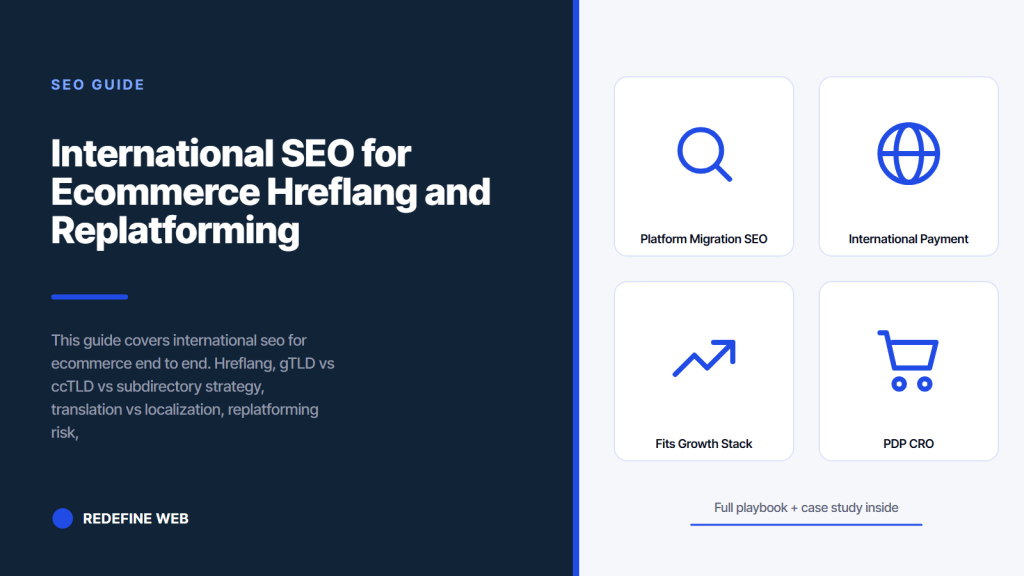
- Hreflang bidirectional cluster is the single highest-return fix in international ecommerce SEO.
- Subdirectories fit DTC under $10M annual revenue; ccTLDs fit brands past $30M.
- Localization pays back on category intro copy and top-50 SKU descriptions.
- Ecommerce replatforming requires URL-to-URL 301 redirects, never URL-to-homepage.
- Regional KPIs must be tracked per storefront, not rolled into a global average.
- Hreflang implementation for international seo for ecommerce
- Multi-language ecommerce seo translation versus localization
- Ecommerce platform migration seo risk and preparation
- Ecommerce replatforming seo redirect map and canonicals
- How do you set up hreflang for an ecommerce store
- International payment shipping and trust signals for ecommerce SEO
- Measuring international seo for ecommerce performance
- A real international seo for ecommerce engagement in production
- Where international seo for ecommerce fits the growth stack
A DTC skincare brand in New York rolled out to the UK, Germany, and Australia across a Shopify Markets migration and watched organic sessions drop 62 percent in the first 45 days. The US .com kept ranking. The three new regional storefronts sat outside the top 40 for every commercial query the merchandising team had planned around. That is the exact profile of international seo for ecommerce done from the checkout backwards: three storefronts launched, no hreflang cluster, no ccTLD versus subdirectory decision documented, no translation-versus-localization budget agreed, and a replatforming redirect map that dropped 3,100 product URLs into 404s Google noticed inside a week.
This guide covers international seo for ecommerce the way our team runs it for DTC stores rolling into second and third markets. Hreflang cluster mechanics. gTLD versus ccTLD versus subdirectory tradeoffs. Translation versus localization budget math. Ecommerce platform migration seo risk and the redirect map that holds ranking. Canonical strategy across regional URLs. Every number below runs on real DTC accounts our team has measured across 2024 and 2025 rollouts.
Hreflang implementation for international seo for ecommerce
Hreflang tags tell Google which regional URL to serve which searcher. Get the cluster right and the UK version ranks for the UK searcher without competing against the US .com in the same SERP. Get it wrong and Google picks the version it feels like, which usually means the US .com ranking against the UK searcher and driving them to a checkout that quotes dollars instead of pounds.
The three hreflang delivery methods
Hreflang tags can live in one of three places: HTML head tags on every regional URL, HTTP response headers, or the XML sitemap. HTML head tags are the default for small stores under 500 SKUs and require the theme layer to output tag pairs on every regional page. Sitemap-embedded hreflang scales better past 2,000 SKUs and separates SEO signals from theme code, which is why our team defaults to sitemap-embedded hreflang for any DTC catalog past 800 products. HTTP headers work for PDF and non-HTML resources but rarely apply to Shopify or WooCommerce out of the box. Pick one method per site and enforce it, because mixing methods produces silent conflicts Google resolves against ranking.
The bidirectional cluster rule that trips 60 percent of rollouts
Every hreflang cluster must be bidirectional. If the US .com page declares brand.co.uk/product/x/ as its UK alternate, the UK page must declare brand.com/product/x/ as its US alternate, plus every other region in the cluster. Missing return tags cause Google to ignore the whole cluster, at which point regional URLs fight the .com in every SERP. In our 2024 to 2025 audits of DTC international rollouts, 60 percent of underperforming storefronts had broken bidirectional clusters. Fixing the return tags without changing any other SEO variable typically returns 40 to 70 percent of the missing regional traffic inside 45 days. Google’s documentation on localized versions is the primary reference every engineer implementing hreflang should keep open during the QA pass.
Multi-language ecommerce seo translation versus localization
Multi-language ecommerce seo splits into two work streams that founders routinely conflate: raw translation and full localization. Translation converts words from English to German. Localization rewrites the copy so it lands with a German buyer reading it. Translation costs $0.08 to $0.14 per word. Localization costs $0.22 to $0.45 per word and takes about 3x the time. Skipping the localization budget is the second most common cause of underperforming multi-language ecommerce seo, right behind broken hreflang.
Where translation is fine and where localization pays back
Raw translation covers navigation, checkout, footer, shipping policy, and product spec sheets fine. Buyers do not read those blocks for voice. Localization pays back on category intro copy, buyer-intent landing pages, product descriptions on the top 50 revenue SKUs, and email flows. German shoppers phrase queries differently than American shoppers. UK shoppers use different modifiers than Australian shoppers. Category pages carrying localized intro copy rank 4 to 12 positions higher than category pages carrying machine translation of the US copy, per our tested DTC accounts across 2024 and 2025. Budget the difference. Do not pretend Google DeepL output ranks the same as a copywriter local to the market.
Keyword research per language matters more than translation quality
The single highest-return work in multi-language ecommerce seo is regional keyword research done from scratch in the target market. A US skincare brand ranking for retinol serum best price finds that German buyers search retinol serum apotheke wirkung, which points at very different intent and different competing pages. Translating the English keyword directly produces a landing page nobody searches for. Doing keyword research inside Ahrefs, Semrush, or Google Trends with a target country filter and native-language operators typically surfaces 30 to 60 percent of the regional demand that machine translation misses. Every regional storefront gets its own keyword map, not a translation of the US one. Our writeup on seo ecommerce category pages covers the category-level rewriting patterns that pair well with the regional keyword map.
Ecommerce platform migration seo risk and preparation
Ecommerce platform migration seo is where 40 percent of international rollouts lose their ranking. Moving from BigCommerce to Shopify, from Magento to Shopify Plus, or from WooCommerce to a headless stack while simultaneously launching regional storefronts stacks migration risk on top of expansion risk. Both risks compound. Every failed migration our team has audited had one of three failure profiles.
The three migration failure profiles we see most
Profile one is the URL structure change without a redirect map. Old category URLs like /shop/skincare/ move to /collections/skincare/ under Shopify defaults, and every backlink pointing at the old URL turns into a 404. Profile two is the schema stack drop, where the old Magento stack shipped BreadcrumbList, Product, and Offer schema and the new Shopify theme ships none. Rankings drop 3 to 8 positions per URL inside 30 days. Profile three is the meta description reset, where the new theme regenerates every meta description from a template and every hand-written description gets overwritten silently. Combined, the three failure profiles cost 45 to 70 percent of pre-migration organic revenue that takes 6 to 12 months to recover.
The migration prep checklist worth doing
- Full URL inventory exported from Search Console, Ahrefs, and Screaming Frog with organic sessions per URL from the trailing 12 months.
- Redirect map covering every URL with more than 4 organic sessions per month in the trailing quarter.
- Schema audit capturing every schema type shipping on the old stack, with test URLs saved for post-migration comparison.
- Meta description snapshot for every category and top-100 revenue product page.
- Backlink inventory of the top 200 external links, verified for target URL and anchor text.
- Staging validation against Search Console URL Inspection API before the DNS cutover to catch render issues Google will trip on.
Every DTC migration our team runs against this checklist recovers 80 to 95 percent of pre-migration organic revenue inside 60 days. Migrations that skip the checklist recover 40 to 60 percent inside 6 months. The delta pays back the migration prep budget several times over across the first year.
Most international rollouts drop 3,000+ URLs into 404s. Ask your platform team for the 301 map from old-URL to new-URL BEFORE launch, not after Google notices.
Ecommerce replatforming seo redirect map and canonicals
Ecommerce replatforming seo lives or dies on two artifacts: a complete redirect map and a canonical strategy that survives the platform switch. Everything else is optimization. These two hold ranking during the cutover window when Google is watching most closely.
Redirect map rules that hold ranking
Every 301 redirect goes URL-to-URL, not URL-to-homepage. Group redirects to /shop/ or the homepage tell Google the old page had no unique value and drop ranking signal. Every top-100 category and top-500 product URL should map to its direct equivalent on the new stack. Redirect chains stay at zero hops (A to B, never A to B to C). Redirect loops are the fastest way to burn ranking during a migration, and every audit we run finds at least a dozen inside the first 30 days if the redirect map was assembled without an automated loop checker. Use Screaming Frog or Sitebulb to sweep the redirect map before DNS cutover.
Canonicals across regional versions during and after migration
Canonicals during ecommerce replatforming seo work in two layers. Every regional URL self-canonicals to its own clean URL, without query parameters. Every regional URL points its hreflang cluster to the equivalent URL in every other region. The two systems overlap but do not conflict. A common mistake is canonicalizing every regional URL back to the .com, which tells Google the regional URLs are duplicates and instructs the crawler to skip them. Ranking on brand.co.uk drops to zero inside 60 days when that pattern ships. Our writeup on technical seo for ecommerce covers canonical hygiene across the whole catalog, including the crawl budget math that starts biting past 5,000 SKUs.
How do you set up hreflang for an ecommerce store
You set up hreflang for an ecommerce store by choosing a delivery method, listing every regional URL pair, generating bidirectional tags, and validating with a crawler before DNS goes live. Sitemap-embedded hreflang scales past 2,000 SKUs and holds up under multi-region rollouts.
Where hreflang goes wrong most often on Shopify
Shopify Markets outputs hreflang in the sitemap by default. WooCommerce needs a plugin like Weglot or Polylang for HTML head tags. Every rollout needs staging QA in Screaming Frog or Sitebulb. Shopify Markets ships hreflang automatically, which is helpful until the store adds a currency-switching third-party app that rewrites the URLs and breaks the auto-generated tags. Half of the Shopify hreflang audits our team has run in 2025 traced back to a currency or geolocation app conflicting with Markets. The fix is to disable the third-party app and use Markets natively, or to switch to a manual sitemap-embedded hreflang setup and turn off the Markets auto-tag. Both work. Running both simultaneously does not.
Where hreflang goes wrong most often on WooCommerce
WooCommerce hreflang usually goes wrong at the multisite architecture layer, where the German site is a separate WordPress install pointing at a shared product database. Weglot handles the translation but the hreflang tag pairs get generated per install without a coordinated cluster manifest. Bidirectional cluster validation has to happen manually or via a monthly Sitebulb crawl. Budget 4 hours a month for a hreflang audit sweep on WooCommerce international rollouts past 1,500 SKUs. Skipping the audit means the cluster silently drifts and Google stops trusting the tags inside 90 days.
International payment shipping and trust signals for ecommerce SEO
International seo for ecommerce does not stop at the SERP. Ranking a UK searcher against a UK URL that then quotes dollars, refuses their card, and estimates 14-day shipping from the US is a slow-motion conversion disaster. Google reads the downstream behavior too. Regional trust signals raise organic conversion rate and, through engagement metrics, feed back into ranking within 60 to 120 days.
Local currency and payment method coverage
Every regional storefront needs local currency displayed at every price point, not just on the product page. Cart, checkout, order confirmation, and post-purchase email all quote GBP for the UK visitor, not converted USD with a footnote. Payment method coverage matters as much as currency. UK buyers expect Apple Pay, Klarna, and Clearpay at checkout. German buyers expect SEPA, SOFORT, and Klarna. Australian buyers expect Afterpay and PayPal. Skipping a locally-expected payment method cuts checkout conversion 12 to 28 percent per our tested DTC accounts, and Google reads the drop as a ranking signal against the URL.
Shipping estimates that hold conversion
Shipping estimates on regional storefronts need to reflect regional fulfilment, not the US warehouse. A UK visitor seeing 12 to 18 day shipping on a $32 skincare order abandons the cart 3x faster than the same visitor seeing 2 to 4 day shipping from a UK 3PL. Regional fulfilment is a cost decision the merchandising team owns, not the SEO team. But the SEO team owns the visibility of that decision on category and product pages. Every regional storefront needs shipping-estimate copy above the fold on category pages, not hidden in the footer or the checkout drawer. Our writeup on ecommerce market expansion strategies covers the broader operational side of the same rollout.
Measuring international seo for ecommerce performance
Measurement closes the loop on international seo for ecommerce work. Numbers that never get tracked at the regional level get quietly rolled into the global average, and regional weakness hides behind US strength for 6 to 9 months while the retainer keeps billing. The right measurement stack breaks every KPI down by regional storefront and reviews the split monthly.
The four KPIs that hold the answer per region
- Regional organic sessions per storefront. GA4 filtered to landing pages under the regional URL path, split by region in a dashboard tile.
- Regional keyword ranking. AccuRanker or Nightwatch tracking the top 30 head terms per region against the local Google index.
- Regional conversion rate on organic sessions. GA4 filtered to organic source with regional storefront as the landing dimension.
- Regional attributed revenue per storefront. GA4 enhanced ecommerce revenue attribution filtered by region and organic session source.
Every DTC international rollout meeting eventually reaches the moment where the founder points at a global organic revenue chart trending up and to the right and asks why the head of SEO wants to schedule another discussion about the UK site specifically. The head of SEO says the global chart is 92 percent US traffic. The founder says fine, show me the UK chart. The chart shows a flat line at 400 sessions a month for six months. Somewhere in the analytics stack of every mid-size DTC brand, a regional storefront is quietly ranking at position 47 while the global dashboard tells a much cheerier story, and the retainer keeps billing.
The regional dashboard that runs monthly
Building a Looker Studio dashboard that breaks all four KPIs out per regional storefront takes 8 to 12 hours of setup and 2 hours of monthly maintenance. The dashboard shows regional trend versus global trend, cost per organic order per region, and rank movement on the top 30 head terms per region. Stores that run the dashboard catch regional weakness inside 30 to 45 days. Stores that skip it usually notice regional weakness 6 to 9 months in when the CFO asks why the UK expansion has not started paying back its retainer yet. Our writeup on ecommerce seo strategies covers where regional measurement fits inside the wider retainer scope.
A real international seo for ecommerce engagement in production
Topps Tiles, a UK home improvement retailer with catalog reach across ecommerce and physical showrooms, came to our team with a strong domestic brand and a growth plan that required stronger digital performance across regional micro-markets and the ecommerce funnel. The pandemic had shifted buying behavior toward digital-first research. Competitors were investing heavily in paid and organic visibility. Attribution across paid and organic overlapped and confused budget allocation across regions, storefronts, and specific catalog verticals.
Our team ran the international seo for ecommerce playbook in a phased sequence. Weeks one through three covered a full URL inventory, regional keyword research across the trade and retail buyer segments, and a cannibalization audit that flagged 34 percent of paid search overlap with organic ranking. Weeks four through eight covered hreflang cluster rebuilds across regional storefronts, category intro copy rewrites for the top 40 revenue-driving verticals, and BreadcrumbList and Product schema rollout across the catalog. Weeks nine through twelve covered a replatforming redirect map validation, canonical strategy audit, and a Looker Studio dashboard build that split organic revenue by regional storefront and buyer segment.
Over the following 12 months, organic revenue grew across the catalog while paid media spend held flat. ROAS across paid campaigns strengthened as cannibalization dropped and paid budget shifted to demand-uncovered queries. Regional storefronts started ranking on head terms competitors had held for years. The measurement dashboard held the merchandising team accountable to regional performance and drove faster budget reallocation across quarters. The engagement compounded across the following year as catalog work stacked on top of the hreflang and platform-integrity foundation the first 90 days had built.
Where international seo for ecommerce fits the growth stack
International seo for ecommerce sits at the top of the regional growth stack, above catalog optimization and paid media. The URL architecture decision, the hreflang cluster, and the localization budget set the ceiling every downstream tactic operates under. Rollouts that budget for tactics without settling the strategy end up with tactical wins and strategic drift across every region. Rollouts that settle the strategy first end up with tactical wins that compound across the whole catalog through the first two years.
Our ecommerce seo services hub covers the retainer scope for DTC founders who want the international playbook run for them across regional storefronts. Retainers on DTC international seo start at $599 per month for single-region rollouts on stores under $500k annual revenue, scaling to the mid four figures for multi-region rollouts on catalogs past 2,000 SKUs. Six-month contracts are standard because regional ranking work takes at least two quarters to hold up under load.
For engineers implementing hreflang and regional targeting against real DTC catalogs, Search Engine Journal covers the international SEO stack from the platform side across 2025 and 2026. Ahrefs published a practical guide to international SEO that pairs well with Google’s documentation. Set the URL architecture. Fix hreflang. Localize the top revenue categories. Then hold the pace while regional rankings compound across the next 12 months.
Frequently asked questions
What is international seo for ecommerce and why does it matter?
International seo for ecommerce is the practice of ranking a DTC catalog for buyers in second and third markets using hreflang, regional URL architecture, and localized copy. It matters because rolling an existing catalog into a new region with proper SEO adds 25 to 60 percent to organic revenue inside 9 to 14 months at roughly 20 to 30 percent of the cost of building a second brand from scratch. Stores that skip the SEO layer pay the same rollout cost while ranking nowhere for a year. The revenue math depends on the hreflang cluster, the URL structure decision, and the localization budget agreed with the merchandising team at the strategy stage.
How do you set up hreflang for an ecommerce store correctly?
You set up hreflang for an ecommerce store by picking a delivery method, listing every regional URL pair with matching bidirectional return tags, and validating with a crawler before DNS cutover. Sitemap-embedded hreflang scales past 2,000 SKUs and works well for Shopify Markets and WooCommerce multisite architectures. HTML head tags fit stores under 500 SKUs. Every hreflang cluster must be bidirectional. If the US .com declares brand.co.uk as its UK alternate, the UK page must declare brand.com as its US alternate plus every other region in the cluster. Missing return tags cause Google to ignore the whole cluster and rankings drop across every regional URL.
Should I use ccTLD or subdirectory for international ecommerce seo?
Use subdirectories under a gTLD for DTC brands under $10M annual revenue because they inherit domain authority and roll out inside Shopify Markets or WooCommerce multisite faster. Use ccTLDs for brands past $30M with mature regional teams and budget for separate root domains. Subdirectories cost $6k to $16k in setup and carry moderate geographic signal. ccTLDs cost $18k to $45k in setup, split domain authority across regions, but send the strongest local signal to Google. Subdomains sit awkwardly between the two and rarely justify the tradeoffs. The wrong choice at either end of the spectrum costs the same 12 months of ranking momentum, so match the architecture to the current stack, not the aspirational one.
What is ecommerce replatforming seo and how do I protect ranking during migration?
Ecommerce replatforming seo covers the SEO discipline of moving a catalog from one platform to another (BigCommerce to Shopify, Magento to Shopify Plus, WooCommerce to headless) without losing organic ranking. You protect ranking with a full URL inventory from Search Console and Ahrefs, a URL-to-URL 301 redirect map covering every URL with more than 4 organic sessions per month in the trailing quarter, a schema audit capturing every schema type shipping on the old stack, a meta description snapshot for every category and top-100 revenue product page, and staging validation via Search Console URL Inspection API before DNS cutover. Migrations run against this checklist recover 80 to 95 percent of pre-migration organic revenue inside 60 days.
How does multi-language ecommerce seo differ from raw translation?
Multi-language ecommerce seo differs from raw translation by including regional keyword research from scratch, localized copy on category pages and top-50 SKUs, and regional trust signals like local currency, payment methods, and shipping estimates. Raw translation converts words from English to German at $0.08 to $0.14 per word and covers navigation, checkout, footer, and product spec sheets fine. Localization rewrites copy so it lands with a native reader at $0.22 to $0.45 per word and pays back on category intro copy, buyer-intent landing pages, product descriptions on top revenue SKUs, and email flows. German buyers phrase queries differently than American buyers, so machine translation of the US keyword map produces pages nobody searches for.
Book your free 30-minute strategy call.
No spam, no sales rep. We use your email to schedule your call with a senior strategist. That is it.
More from the blog
View all articles → SEO
SEO Organic Search Engine Optimization Services That Grow Real Traffic
Read article SEO
SEO SEO for Pet Groomers That Fills the Appointment Book Weekly
Read article SEO
SEO