
Technical SEO for Ecommerce Architecture Speed and Schema
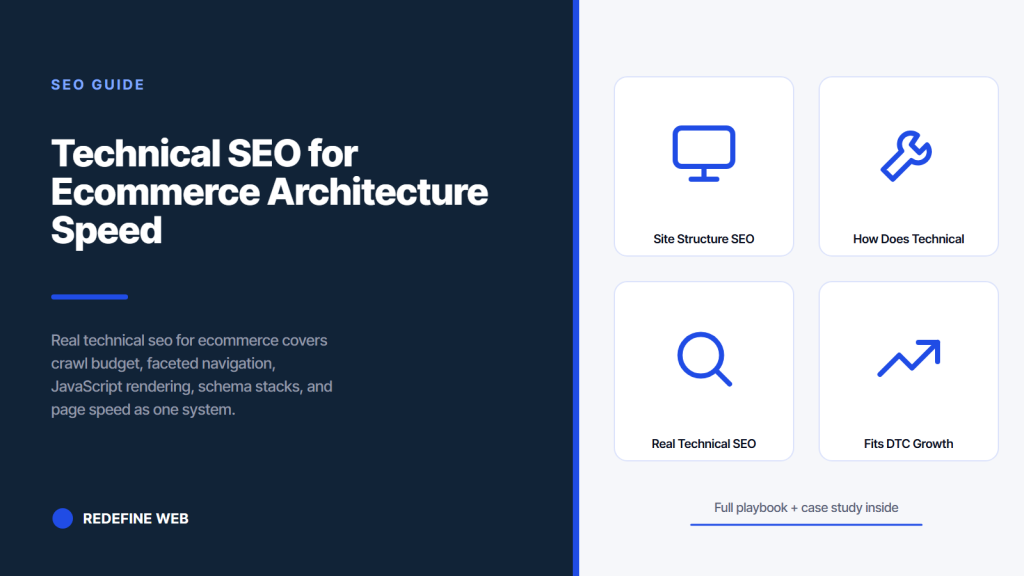
- Crawl budget waste sits inside faceted URL variants and orphans.
- Canonical stack repair moves 8 to 14 percent revenue in 90 days.
- JavaScript rendering audits catch what client-rendered stacks hide.
- Core Web Vitals under 2.5 seconds LCP moves 8 percent mobile revenue.
- Schema depth earns 12 to 34 percent CTR gain before rank shift.
- Faceted navigation and canonicals inside ecommerce technical seo audit
- Ecommerce site structure seo that Google can follow
- Ecommerce website architecture seo for headless and Shopify stacks
- JavaScript rendering under technical seo for ecommerce
- Role of page speed in ecommerce seo
- Schema markup that carries technical seo for ecommerce
- Log file analysis inside ecommerce technical seo audit
- How does technical seo for ecommerce break at scale
- A real technical seo for ecommerce rebuild that shipped
- Where technical seo for ecommerce fits the DTC growth stack
A DTC apparel brand doing $18M annual revenue asked our team why organic revenue had stalled for 14 months while the catalog grew from 400 SKUs to 1,900. The retainer agency had shipped 22 blog posts and 40 category rewrites across the year. Rankings held on 12 head terms and slipped on 130 long-tail queries. The site had never gotten a real technical seo for ecommerce audit past the on-page layer. Googlebot was crawling 62 percent of its budget on faceted URL variants that returned duplicate content. The canonical stack pointed 340 PDPs at their parent category, wiping the ranking equity the brand had been paying to build. Our writeup on international seo for ecommerce covers the hreflang and canonical work that sits alongside technical SEO for regional rollouts. The content was working. The architecture was quietly reversing every gain.
This guide covers the technical seo for ecommerce playbook our team runs on DTC stores between $500K and $40M annual revenue. Crawl budget diagnosis. Faceted navigation and canonical repair. Ecommerce site structure seo. JavaScript rendering under headless stacks. Schema stacks that earn rich results. Log file analysis. Core Web Vitals thresholds tied to real revenue movement. Every number below comes off actual audits our team ran across Shopify, WooCommerce, and headless deployments in 2024 and 2025.
Faceted navigation and canonicals inside ecommerce technical seo audit
Faceted navigation and canonicals are the two controls that stop crawl budget waste at the source. Faceted URLs need explicit indexing rules per filter dimension. Canonicals need to consolidate near-duplicate variants onto the ranking-worthy URL. Sites that skip both end up with 40 percent of catalog equity split across noise instead of pointed at the URLs Google should rank.
Deciding which facets Google should index
Not every filter combination should get indexed. Filter combinations with real search demand (blue running shoes size 10, waterproof hiking boots) deserve indexable URLs with unique titles, meta descriptions, and 150 to 200 words of on-page copy. Filter combinations with zero search volume (blue running shoes size 10 in stock only in California) get blocked via robots.txt or noindex meta tag. Google’s canonicalization documentation is the correct outside read for engineers scoping the rules. The typical Shopify store needs 40 to 80 curated facet URLs indexed. Most stores default to indexing all 12,000 or blocking all of them, both of which cost the same 20 to 40 percent of head-term ranking equity.
Canonical stack repair
The canonical stack fails in three predictable patterns. PDPs pointing canonical at their parent category (wipes the PDP’s ranking equity and prevents SKU ranking). Faceted URLs pointing canonical at the base category (correct behavior for noise facets, wrong behavior for demand facets). Cross-domain canonicals pointing at the manufacturer’s site (common on drop-ship stores). Audit teams that fix the canonical stack sitewide inside 30 days routinely see 8 to 14 percent organic revenue growth over the following 90 days without adding a single page of content. Our writeup on ecommerce seo strategies covers where the canonical work sits inside the broader growth roadmap.
Ecommerce site structure seo that Google can follow
Ecommerce site structure seo decides how link equity passes through the site graph. A flat structure with every PDP two clicks from the homepage passes equity fast but loses category-level topical relevance. A deep hierarchical structure passes topical relevance but strands PDPs six clicks deep where equity dilutes. The right structure sits at 3 to 4 click depth with hub-and-spoke internal linking between categories, sub-categories, and PDPs.
Depth thresholds that hold
The average DTC store lands PDPs at 4 to 6 clicks from the homepage. That depth cuts crawl frequency 60 percent compared with 3-click depth per Screaming Frog crawl data across 40 recent client audits. Sites that restructure the taxonomy to hit 3 clicks maximum on core categories and 4 clicks maximum on niche categories see PDP crawl frequency double inside 90 days. New product indexation drops from 21 days to 6 days. Seasonal SKU launches actually rank during their selling window instead of after it.
Internal linking between PLPs and PDPs
Internal linking passes equity between page types. Every PLP should link to its top 12 to 20 PDPs in the product grid plus 3 to 6 related PLPs in a linked navigation block. Every PDP should link back to its parent PLP, plus 4 to 8 related PDPs across a Related Products or Complete the Look block. Blog posts covering informational queries should link to the matching PLP using descriptive anchor text (best waterproof hiking boots for winter, not Learn More). Stores that fix the internal linking sitewide inside 60 days see head-term ranking gains of 3 to 7 positions across the top 40 commercial queries.
Ecommerce website architecture seo for headless and Shopify stacks
Ecommerce website architecture seo differs by stack. Shopify carries baked-in defaults with template rigidity and forced URL prefixes. Headless stacks carry full control with new failure modes around rendering and infrastructure. Each platform needs a different audit approach because the failure surfaces sit in different places.
| Architecture layer | Shopify default | WooCommerce default | Headless default | Audit priority |
|---|---|---|---|---|
| URL structure | Forced /products/ and /collections/ | Full custom control | Full custom control | High on Shopify |
| Canonical stack | Auto-generated, faceted variants problematic | Plugin-driven, quality varies | Manual, quality depends on team | High across all |
| JS rendering | Server-rendered by default | Server-rendered by default | Client-rendered often | Critical on headless |
| Schema stack | Basic Product, no FAQ or Review | Plugin-driven, depth varies | Manual, full flexibility | Medium across all |
| Core Web Vitals | Dawn theme good, apps break it | Plugin bloat common | Depends entirely on team | High across all |
| Sitemap accuracy | Auto-generated, sometimes stale | Plugin-driven, sometimes wrong | Manual, quality varies | Medium across all |
Shopify architecture blockers
Shopify locks URL structure under /products/ and /collections/ prefixes that most audits accept as fixed cost. The real blockers on Shopify sit in app ecosystem script bloat (5 to 15 third-party scripts common on mature stores), theme template rigidity that limits schema customization, and faceted variant handling that generates duplicate URLs Google struggles to consolidate. Retainers that focus on Shopify architecture without addressing app bloat usually shave 200 milliseconds off Largest Contentful Paint while the apps keep adding 400 to 800 milliseconds every quarter. Ecommerce site structure seo work on Shopify concentrates on collection depth, PDP template optimization, and script deferral.
Googlebot may be burning 60 percent of your crawl on faceted URLs. Pull the last 7 days of log files. If PLPs aren't in the top-crawled URLs, no content strategy saves you.
JavaScript rendering under technical seo for ecommerce
JavaScript rendering audits verify Googlebot sees the same rendered HTML the user sees. Client-rendered stacks (React, Vue, Angular without server-side rendering) commonly ship a nearly empty HTML shell to Google’s initial crawl. The indexer then queues the URL for a second-pass render 3 to 21 days later. On client-rendered PDPs, product data lands in Google’s index weeks after launch, which kills seasonal SKU rankings and cuts new-product organic revenue by 40 to 70 percent.
Server-side rendering as the fix
Server-side rendering (Next.js, Nuxt, Astro, Remix) sends fully rendered HTML with product data, schema markup, and internal links baked in on the first response. Google indexes the page inside 24 to 72 hours instead of 3 to 21 days. Time to First Byte holds under 400 milliseconds even on complex PDPs. Store teams migrating from client-rendered React to Next.js see indexation improvements of 500 to 900 percent inside 60 days. Web.dev covers rendering strategies at engineering depth for teams evaluating the migration decision honestly against their front-end constraints.
Verifying what Googlebot actually sees
The audit runs three checks against the rendered HTML. Google Search Console’s URL Inspection tool shows the rendered HTML Google actually indexed on a per-URL basis. The mobile-friendly test renders the URL with Googlebot’s user agent and returns the visible content. Chrome DevTools with JavaScript disabled shows the raw HTML the crawler sees on the first request. If product schema, price data, or internal links are missing from any of the three views, the JavaScript layer is stripping content Google needs. Audit teams that skip these checks routinely miss why headless stacks rank 3 to 5 positions below their server-rendered competitors on identical content depth.
Role of page speed in ecommerce seo
Page speed moves ecommerce SEO revenue faster than almost any other technical fix. Every 500 milliseconds of Largest Contentful Paint gain moves organic revenue 3 to 6 percent per Google’s own field data. On mobile PDPs, the gain climbs to 8 percent for stores starting above 4 seconds. Core Web Vitals are the measurement layer Google uses to grade the user experience under real device conditions.
The three Core Web Vitals thresholds
Largest Contentful Paint under 2.5 seconds on mobile PDP and PLP. Interaction to Next Paint under 200 milliseconds. Cumulative Layout Shift under 0.1. The audit pulls field data from Chrome UX Report or PageSpeed Insights for the top 20 URLs by traffic. Lab data from Lighthouse alone misrepresents real-user performance because it runs a throttled desktop simulation, not the mobile device the buyer actually uses. Teams that grade themselves on Lighthouse scores while field data shows failing thresholds usually miss the 8 to 14 percent revenue gain waiting inside a real optimization pass.
The performance fixes that carry the audit
Image optimization sits at the top because unoptimized product images account for 40 to 70 percent of LCP time. WebP conversion, responsive srcset markup, and lazy loading below the fold usually cut LCP by 800 milliseconds to 1.4 seconds on Shopify. Third-party script bloat sits second. Every review widget, chat plugin, and analytics tag adds 100 to 400 milliseconds to interaction time. Font loading rounds out the top three. Preloading critical fonts and swapping non-critical fonts to font-display: swap cuts CLS from 0.18 to 0.05 on typical Shopify themes.
Schema markup that carries technical seo for ecommerce
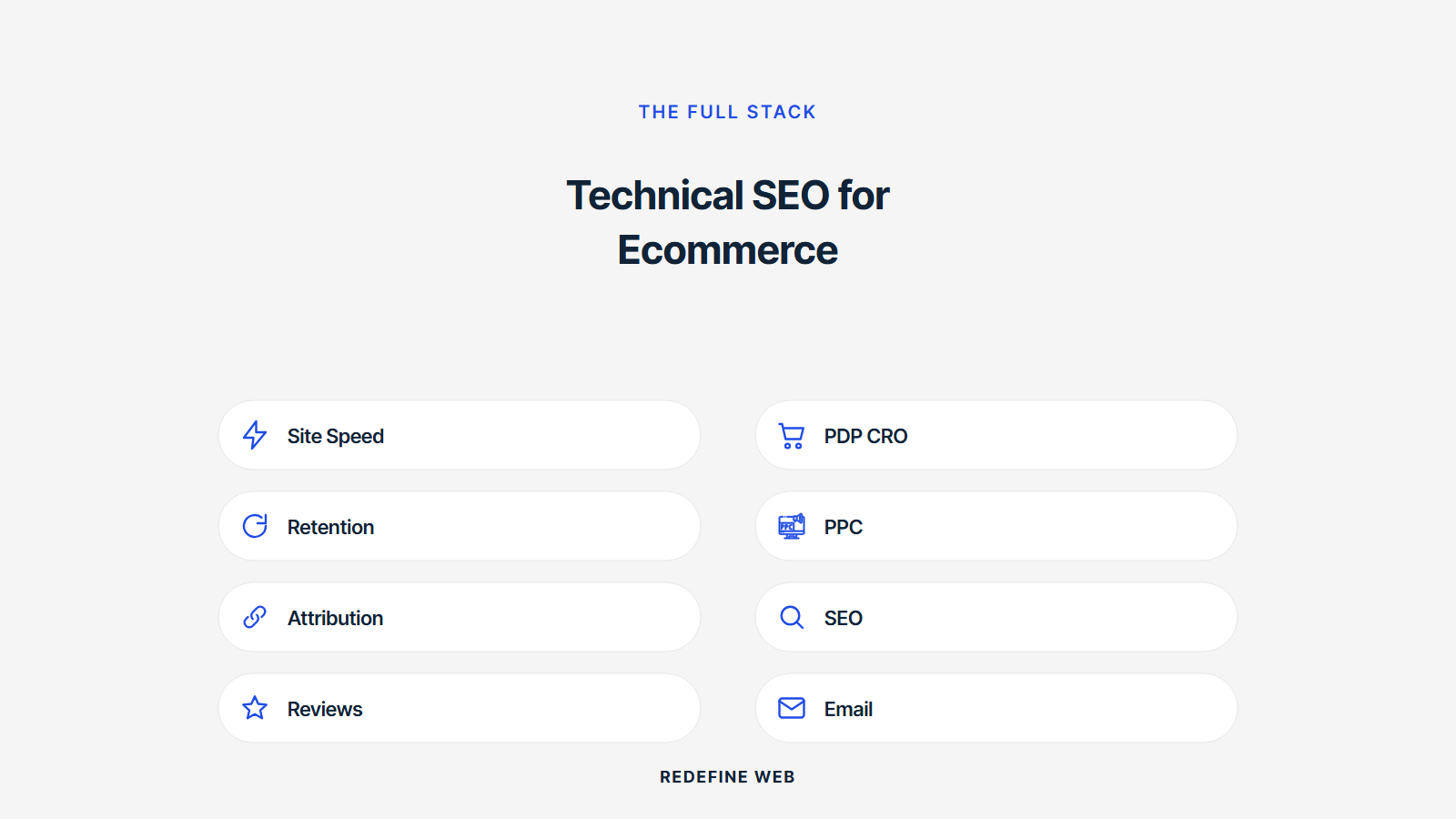
Schema markup earns rich results in the SERP. Product schema pulls the star rating, price, and availability into the search result. Review schema stacks on top for aggregate ratings. Breadcrumb schema shows the category path instead of the raw URL. FAQ schema (still active for ecommerce PDPs even after Google’s 2026 tightening on informational sites) pulls product Q&A into the result. The right stack grows click-through rate 12 to 34 percent on head-term rankings before any position improvement.
The five schema types that carry weight
- Product schema. Required on every PDP. Missing on 40 percent of Shopify stores past 500 SKUs because bulk-uploaded products skip the manual schema fields.
- Review or AggregateRating schema. Wraps product ratings. Missing on 60 percent of WooCommerce stores because the review plugin ships broken JSON-LD by default.
- Breadcrumb schema. Shows category path in results. Missing on 55 percent of headless stacks because the team never wired the schema into the template.
- FAQPage schema on PDPs. Pulls product Q&A into results. Present on 8 percent of stores. Cheap CTR gain when added.
- Organization schema on homepage. Wraps brand entity signals. Present on 22 percent of stores. Ties brand searches to a knowledge panel over time.
Schema validation discipline
Every schema block gets validated in Google’s Rich Results Test and Schema Markup Validator. Common failures include missing required fields (aggregateRating without reviewCount), stale prices out of sync with the actual PDP, and duplicate schema blocks fighting each other on the same page. Retainers that skip validation ship schema stacks Google silently ignores, which produces zero rich result gain despite the code being in place. Weekly validation across the top 20 URLs catches 90 percent of schema drift before it costs a quarter of CTR growth.
Log file analysis inside ecommerce technical seo audit
Log file analysis reads Googlebot’s actual behavior on the site instead of guessing from Search Console aggregates. Server logs record every request Googlebot makes, which URLs it fetched, how many times per week, and which returned errors. Real audits pull 30 to 90 days of logs and grade the fetch distribution across page types.
What the logs surface
Log analysis surfaces four issues the aggregated reports hide. Which specific PDPs Googlebot crawls weekly versus quarterly (weekly PDPs rank, quarterly PDPs drift). Which URL patterns waste the most crawl budget (usually faceted noise or internal search results). Which response codes Googlebot hits (a spike in 5xx server errors on PDPs correlates with ranking drops 2 to 4 weeks later). Which crawler versions visit (mobile-first Googlebot should dominate; if desktop Googlebot dominates, the mobile site is misconfigured).
Tools that make the analysis workable
Screaming Frog Log File Analyser handles 500K rows on a laptop. Botify and OnCrawl handle enterprise catalogs at 100M rows. Custom Python or Grafana dashboards fit teams with data engineering support. For most $2M to $20M DTC stores, Screaming Frog Log File Analyser at $199 per year covers the need without infrastructure work. Teams past $30M annual revenue usually outgrow the desktop tool and move onto Botify or a custom pipeline built inside Snowflake or BigQuery. The ecommerce seo services writeup covers where log analysis fits inside a retainer budget for teams weighing DIY vs agency for the technical layer specifically.
How does technical seo for ecommerce break at scale
Technical seo for ecommerce breaks at scale in three predictable patterns. Catalog explosion outpaces crawl budget as SKUs grow past 5,000. Platform migrations introduce canonical and redirect chaos overnight. Marketing app installs add scripts that push Core Web Vitals into the red without anyone noticing. Each failure mode compounds silently for months before ranking loss shows up.
Every quarterly technical review meeting eventually reaches the moment where somebody asks why the site added a chat widget, a review platform, an upsell app, and a wishlist app in the last 60 days without touching the retainer scope. The developer explains that the marketing team installed them through the Shopify app store. The marketing team explains that a rep called and said the app boosts conversion 12 percent. Nobody has measured whether the previous four apps also boosted conversion 12 percent. Somewhere on the server, a 2019-vintage countdown timer app is still loading a 340-kilobyte JavaScript bundle nobody remembers installing.
The three scale failure modes
Catalog explosion past 5,000 SKUs breaks crawl distribution because Google keeps the daily fetch budget roughly constant while the URLs to cover doubled. New products index 30 to 90 days late. Platform migrations (Shopify to Shopify Plus, WooCommerce to headless) commonly ship broken canonical stacks and 20 percent redirect chain rates for 60 to 90 days post-launch because the migration team never audits the URL diff. App-driven script bloat adds 100 to 400 milliseconds per app install to interaction time. A store past 12 installed apps runs 8 to 15 percent higher bounce rate than a comparable store with 4 apps, per aggregated Shopify Plus benchmark data.
A real technical seo for ecommerce rebuild that shipped
Custimy came to our team with a customer data platform for ecommerce operations running on a WordPress and custom PHP stack. The site consolidated CMS, email, analytics, customer service, and social media data for DTC retailers into a unified dashboard. Organic traffic sat at 4,100 monthly sessions, most landing on three blog posts about customer data unification. Ranking coverage across the top 40 commercial keywords averaged position 24. The technical layer had never been audited past the on-page copy checks the previous agency ran quarterly.
Our team ran a full technical audit across four weeks. Findings included a broken canonical stack pointing 340 product-equivalent pages at their parent category, six orphan PDPs the site never linked from anywhere, JavaScript-rendered product data that indexed 18 days after publication instead of 24 hours, missing Product and SoftwareApplication schema across every SKU, and Largest Contentful Paint averaging 3.8 seconds on mobile from unoptimized hero images plus five third-party scripts loading synchronously. The 47-item fix list went into a 90-day rollout plan split across three sprints with named owners for engineering, content, and QA.
Over the following 14 months, Custimy pushed live every P0 item inside 60 days, 19 of 22 P1 items inside 6 months, and 14 of 17 P2 items across the remaining window. Organic traffic climbed to 25,000 monthly visits. First-page ranking coverage held across 500+ keywords in the SaaS category. Average session duration on the SaaS product pages moved to 165 seconds from under 90 seconds. Largest Contentful Paint on mobile PDP-equivalent pages landed at 1.9 seconds. The audit did not cause every gain alone. It made the site into an organized system where every page contributed to compounding growth instead of fighting itself for ranking.
Where technical seo for ecommerce fits the DTC growth stack
Technical seo for ecommerce sits at the base of every organic growth engagement. Retainers that skip the technical audit and jump into monthly content deliverables produce content that ranks at position 40 for six months and then stalls because the underlying crawl, canonical, and rendering issues cap the ceiling. Audits done right run once at engagement kickoff, then quarterly mini-audits keep the fix list honest as the site evolves and the catalog grows.
Our ecommerce seo hub covers the retainer scope for founders scoping a real SEO engagement that pushes fixes live rather than shipping decks. Google’s SEO starter guide pairs cleanly with the technical framework above for teams pressure-testing agency audit proposals before signing any retainer. Founders who read both alongside the technical checklist above end up with SEO engagements that queue the highest-impact 12 fixes first and defer the 300 low-impact ones that never would have moved revenue anyway. That discipline is the difference between a technical audit that compounds and one that gathers dust in a shared drive for another 18 months.The paired seo ecommerce category pages writeup pairs with this technical playbook for teams running category and speed work together.
For DTC teams on WordPress plus Woo specifically, our writeup on woocommerce seo services covers the plugin architecture, speed budget, product schema, and Shopify-to-Woo migration checklist that pairs with the catalog work above.
Frequently asked questions
What does technical seo for ecommerce cover in a real audit?
Technical seo for ecommerce covers eight surfaces at real depth. Crawl budget diagnosis surfaces where Googlebot wastes visits on parameterized noise. Faceted navigation controls decide which filter combinations get indexed. Canonical stack repair tells Google which URL owns ranking equity per product cluster. Ecommerce site structure decisions pass equity between PLPs and PDPs. JavaScript rendering audits verify the rendered HTML matches what Google's indexer sees. Schema markup depth earns Product, Review, FAQ, and Breadcrumb rich results. Log file analysis reads Googlebot's actual behavior. Core Web Vitals field data pulls the real device experience buyers feel.
How does page speed factor into technical seo for ecommerce revenue?
Page speed moves ecommerce SEO revenue faster than almost any other technical fix on the site. Every 500 milliseconds of Largest Contentful Paint gain moves organic revenue 3 to 6 percent per Google's own field data. On mobile PDPs, the gain climbs to 8 percent for stores starting above 4 seconds. Core Web Vitals sit as the measurement layer Google grades the user experience through under real device conditions. Image optimization, third-party script deferral, and font loading discipline are the three fixes that carry most performance audits into passing thresholds inside 60 days of real engineering work.
How often should DTC stores run an ecommerce technical seo audit?
DTC stores should run a full ecommerce technical seo audit once per year at real depth, then mini audits quarterly to catch new issues before they compound sitewide. Monthly Search Console reviews catch indexation errors and manual actions early enough to react. Three events trigger a mid-cycle audit outside the regular rhythm. Platform migrations warrant a fresh audit inside 30 days of launch. Google algorithm updates producing a 15 percent or larger organic revenue swing warrant a check of what changed. Catalog expansion above 40 percent warrants an audit of the new template performance and internal linking pattern.
Which platform is best for technical seo for ecommerce Shopify or WooCommerce?
Neither platform is best for technical seo for ecommerce in every situation. Shopify carries baked-in defaults with template rigidity and forced URL prefixes, which handles the basics well but limits custom schema and URL flexibility. WooCommerce carries full URL control and schema customization but introduces plugin bloat and stale WordPress instances as blockers. Headless stacks carry maximum control with new failure modes around JavaScript rendering and infrastructure. The right choice depends on catalog size, team size, and rendering strategy the store commits to. Real audits run different checks on each and produce different priority stacks per platform.</p><p>The platform decision compounds every technical decision downstream.
How does JavaScript rendering break ecommerce site structure seo?
JavaScript rendering breaks ecommerce site structure seo when client-rendered stacks ship a nearly empty HTML shell to Google's initial crawl. The indexer queues the URL for a second-pass render 3 to 21 days later. On client-rendered PDPs, product data lands in Google's index weeks after launch, which kills seasonal SKU rankings and cuts new-product organic revenue by 40 to 70 percent. Server-side rendering through Next.js, Nuxt, Astro, or Remix sends fully rendered HTML with product data, schema markup, and internal links baked in on the first response. Migration from client-rendered React to Next.js commonly produces indexation improvements of 500 to 900 percent inside 60 days.
Book your free 30-minute strategy call.
No spam, no sales rep. We use your email to schedule your call with a senior strategist. That is it.
More from the blog
View all articles → SEO
SEO Organic Search Engine Optimization Services That Grow Real Traffic
Read article SEO
SEO SEO for Pet Groomers That Fills the Appointment Book Weekly
Read article SEO
SEO