Dental website maintenance splits into two piles at every practice. One pile the front desk clears in 10 minutes on a Tuesday. The other needs a vendor with staging environments, backup rotations, and Core Web Vitals dashboards. Most practices get the split wrong for a year before they notice. They outsource copy edits the office manager could finish in 2 minutes, then run plugin updates themselves and crash the appointment form during peak Monday call volume. This guide walks the outsource dental website decision task by task so the retainer dollar covers only the work that needs it.
Redefine Web runs website work across roughly 120 practice sites. The right split depends on practice size, front desk technical fluency, and whether the site sits on a custom build or a template. The right split saves $200 to $700/month at solo practices without cutting into site stability. The wrong split shows up as a broken booking form on a Friday afternoon with nobody available to fix it until Monday.
Dental website maintenance tasks tempting to outsource but often unneeded
A middle band of maintenance tasks gets billed by vendors, but most practices can hold them in-house with a small tooling investment. Practices that outsource these tasks usually pay $200 to $500/month for work the office manager could finish in 30 minutes with the right tooling. Pick the tools that bring the work in-house cleanly. Skip the ones that create more tickets than they save.
Copy edits and hours updates
Copy edits and hours updates belong in-house at practices running a WordPress admin plugin like ACF Frontend, Elementor Pro, or Divi. Front desk staff can update the phone number, hours, and holiday closures in 2 minutes without a vendor ticket. Practices that outsource these tasks usually pay $150 to $300/month for edits that take 2 minutes each. Bringing them in-house saves the retainer dollar without adding technical risk, and the tooling runs $50 to $100/year in plugin licenses.
New team member additions
New team member additions on the About page belong in-house at any practice that hires a hygienist or associate more than twice a year. Site-build templates let the marketing coordinator drop in the headshot, bio, and credentials without touching theme code. Practices that outsource this task pay $75 to $200/team member added. Doing it in-house saves the fee and launches the new hire the same day rather than waiting a week for the vendor to schedule the work.
Blog post uploads and dental website management
Blog post uploads belong in-house at practices with a marketing coordinator on staff. Copy usually comes from a writer or agency, but the upload runs 15 minutes per post inside Gutenberg. Practices that outsource the upload alone pay $50 to $150/post for work that fits inside a coordinator role. Practices without a coordinator can train the office manager or leave uploads with the vendor. The training pays back in 2 months at any practice publishing more than one post per month. Delicate Dental Group runs their entire content upload workflow in-house through a trained marketing coordinator after outsourcing the site build.
Maintenance tasks to always keep in-house
A floor of maintenance tasks belongs in-house at every practice size. These tasks pair urgency with low technical risk and high context sensitivity. No vendor handles them faster or better than the front desk. Practices that route these tasks to a vendor create bottlenecks that cost patient bookings with no offsetting benefit.
Google Business Profile posts and updates
Google Business Profile posts and updates belong in-house because the front desk sees the daily patient interactions that produce the best GBP content. Patient testimonials, holiday closure notices, promotions, and service line announcements should post on GBP within a day of the event. Vendors that handle GBP for $200 to $400/month post generic content 2 weeks late and miss the real events that drive local rankings. Front desk staff trained on the GBP dashboard post the same content the same day for zero incremental cost.
Review responses
Review responses belong with the office manager or practice owner. Patient reviews reference specific staff members, procedures, and service dates only the practice knows. Vendors writing template responses turn out generic text that patients read as impersonal. Practices that respond in-house within 48 hours produce authentic responses and often turn negative reviews into repaired patient relationships. The task takes 5 to 10 minutes per review at typical volume, and it pairs with the review request rhythm we cover in our dental review generation playbook.
Emergency phone number swaps
Emergency phone number swaps hit when the practice changes service providers, adds a tracking number, or forwards the main line to a partner practice during holidays. These tasks need to happen inside an hour. Vendors with a 2 hour service level agreement (SLA) cannot beat the front desk here, even at premium tier scope. Practices with a WordPress admin plugin swap the phone number across the header, footer, contact page, and appointment form in under 5 minutes. Practices that route the task to a vendor hit the 48 hour lag of normal ticket cadence.
Tier by tier scope split for dental website maintenance
The split shifts at each retainer tier because vendor scope grows and in-house responsibilities shrink as the practice pays more. The tier-by-tier split below reflects what we ship at Redefine Web across managed dental accounts. Practices comparing quotes should map each quote against the tier below rather than comparing headline monthly numbers alone.
Basic tier at $199/mo
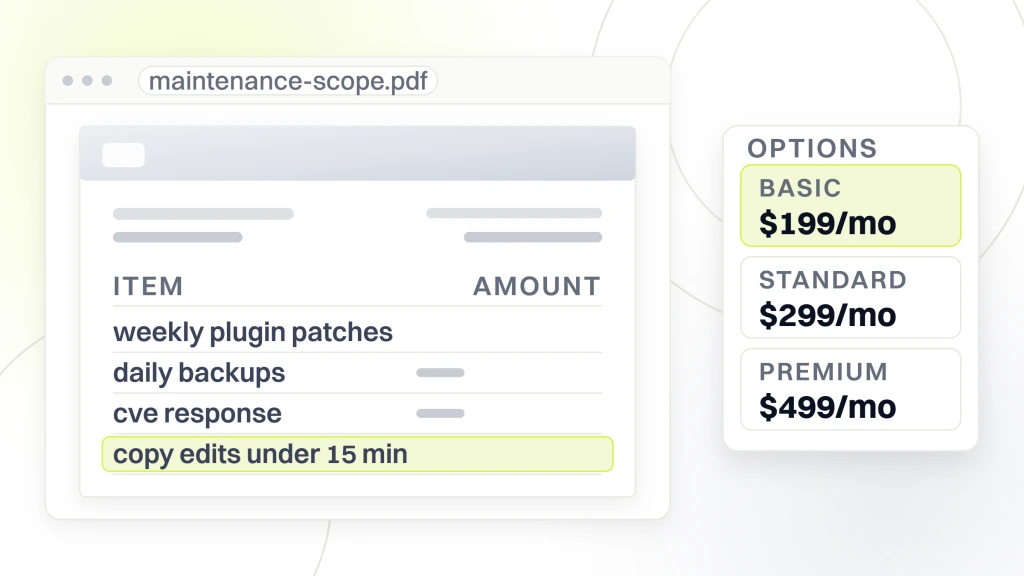
Basic tier at $199/month covers hosting, weekly patch cadence with staging, daily backups, uptime monitoring, and Common Vulnerabilities and Exposures (CVE) response. Everything else stays in-house. Copy edits, hours updates, team member additions, blog uploads, Google Business Profile posts, review responses, and promotion swaps all belong to the front desk or marketing coordinator. Practices at the basic tier need a WordPress admin plugin and 30 minutes of training for the office manager. The setup pays back in 2 months.
Standard tier at $299/mo
Standard tier at $299/month adds 3 to 6 hours of vendor edit time, monthly Lighthouse and Search Console review, quarterly accessibility scans, and monthly performance reporting. In-house scope shrinks to Google Business Profile posts, review responses, and small copy edits under 15 minutes. Practices land here when the front desk owns local content but the technical layer needs vendor attention beyond basic patch cadence. Most solo practices settle here after 12 to 18 months of retainer maturity.
Premium tier at $499/mo
Premium tier at $499/month adds a dedicated account manager, 10 to 30 edit hours, monthly SEO refinement, quarterly content additions, and a documented SLA. In-house scope shrinks to Google Business Profile posts and review responses. Everything else goes to the vendor. Premium tier fits multi-location groups or Dental Service Organizations (DSOs) that need scale, not solo practices. Smile Design Dentistry runs a premium tier scope across 50 plus locations with one account manager owning the network, and their program cut cost per call 30% while lifting PPC conversion rate 20%. See our DSO dental marketing for the multi-location retainer breakdown.
Comparison table for dental website maintenance outsource splits
The comparison table below tracks the outsource split by task across the three retainer tiers. Practices should map each vendor scope against the table rather than trusting the sales deck alone. Vendors billing for tasks that fit at a lower tier usually deliver less scope than the invoice implies. Vendors billing for tasks that fit at a higher tier usually deliver a solid program.
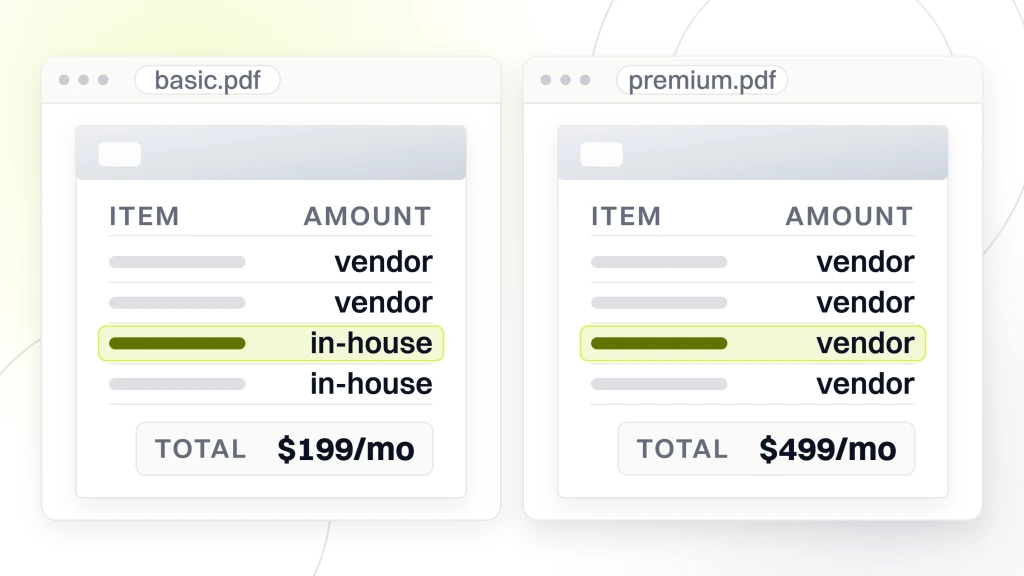
| Task | Basic $199/mo | Standard $299/mo | Premium $499/mo |
|---|---|---|---|
| Weekly plugin patches | Vendor | Vendor | Vendor |
| Daily backups | Vendor | Vendor | Vendor |
| CVE response | Vendor | Vendor | Vendor |
| Copy edits under 15 min | In-house | Vendor | Vendor |
| New team member add | In-house | Vendor | Vendor |
| Blog post upload | In-house | Split | Vendor |
| GBP posts | In-house | In-house | In-house |
| Review responses | In-house | In-house | In-house |
| Phone number swap | In-house | In-house | Split |
| Accessibility scans | Split | Vendor | Vendor |
| Core Web Vitals tuning | Split | Vendor | Vendor |
Read the table with the practice-specific context in mind. Solo GP practices with a small front desk and no marketing coordinator often need to push a few more tasks to the vendor than the basic tier implies. Practices with a full-time marketing coordinator can hold more tasks in-house even at the standard tier. Multi-location groups almost always need the premium tier scope because centralizing GBP posts across 15 or 50 offices usually falls apart in-house within 2 quarters. Practices should map their specific staff situation against the table before signing any retainer.
The Split cells reflect tasks some practices route in-house and others route to the vendor based on frequency. Blog post upload at the standard tier goes to the vendor when the practice publishes 2 or 3 pieces per month but stays in-house at 6 or more. Accessibility scans at basic tier stay in-house when the practice has a WAVE-trained staff member, and go to the vendor otherwise. Both splits produce the same accessibility outcome, so the choice comes down to internal capacity rather than technical necessity.
VP Dental case on the dental website maintenance outsource split
VP Dental came to Redefine Web on a full-outsource maintenance retainer with a boutique dental agency that billed $725/month plus $75 to $150 per copy edit. The office manager sent 8 to 12 tickets per month across phone number swaps, hours updates, holiday closures, and team member additions. Monthly true-up billing landed at $1,200 to $1,600/month across the base retainer and the extras.
What we restructured
We moved VP Dental to a basic tier retainer at $350/month covering hosting, weekly patches, daily backups, uptime monitoring, and CVE response. We installed a WordPress admin plugin for the office manager and ran 90 minutes of training on the phone number swap, hours update, holiday closure, and team member workflows. We also added Google Business Profile access for the office manager and moved review responses in-house to the practice owner.
The cost and coverage result
Monthly maintenance spend dropped from a $1,300 average to $350/month. Response time on small copy edits moved from 48 hours to under 10 minutes because the office manager owned the task. New monthly patients grew 100%, and recurring revenue grew by $8,100/month through faster site updates and matched Google Business Profile activity. Search impressions grew 776% across the same window as the site stayed fast and the GBP stayed current.
North County Dental Care case on unified dental website management
North County Dental Care in Vista, CA had run 20 years of strong offline reputation on fragmented digital vendors. Several agencies ran campaigns that did not line up, with no clear plan and no way to measure ROI. The practice held no top 10 search positions, had inconsistent directory listings, and a weak GBP presence.
Consolidation and coverage rebuild
Redefine Web rebuilt the site on a secure, mobile-friendly foundation with fast load times and conversion-focused service pages. We ran NAP citation cleanup, added schema markup, fixed broken links, and restored crawlability. Local SEO wiring tied the site content to keyword-mapped service pages, and a GMB PPC campaign drove qualified patient leads through targeted map ads. Practice-led video content added a credibility layer that generic vendor stock could not match.
The coverage and growth result
Patient volume grew 1,000% from 2021 to 2024, reaching 12 to 16 new patients each month. Organic traffic grew 385% through technical SEO and keyword targeting. Marketing ROI hit 500%, and the cost of winning each patient came down. Consolidating dental website management under one vendor with a defined scope produced the accountability the fragmented model could not.
Vendor questions on maintenance scope
Vendor selection comes down to three questions. What’s included. What costs extra. How fast the vendor responds. The questions below separate real vendors from monthly-invoice vendors on the pitch call. Practices should ask these before signing any retainer and require specific answers rather than vague reassurances.
Scope questions to ask
Ask the vendor to list every task included in the base retainer, every task that bills extra by the hour, and every task that lives outside the retainer entirely. Ask for patch cadence specifics. What day of the week updates run, and whether staging tests happen before every production push. Ask for the backup retention window and the last date a restore drill happened. Ask for the response SLA on emergency versus standard tickets. Real vendors answer with detail. Vague answers tell you the scope is vaguer than the sales deck implies.
In-house transition questions
Ask the vendor which tasks the practice could hold in-house at a lower tier. Real vendors describe the tradeoffs honestly and often recommend a lower tier when it fits the practice. Vendors that push the highest tier regardless of context are selling a subscription rather than a service. Ask whether the vendor provides admin plugin recommendations and staff training. Ask for a scope worksheet mapping tasks against tiers. Vendors who cannot produce one have not documented their own scope internally.
Exit and portability questions to outsource dental website work safely
Ask what happens if the practice leaves the retainer at contract end. Real vendors hand over hosting credentials, backup archives, and admin access without friction. Contract vendors sometimes hold hosting hostage or bill exit fees to force renewal. Ask whether the practice owns the hosting account under its own credit card or whether the vendor owns it on the practice’s behalf. Practice ownership matters at any tier because it stops the vendor from holding hosting hostage and costing weeks of downtime during transitions. Our dental website hosting post covers the ownership question in more depth.
In-house tooling for maintenance tasks
In-house work needs the right tooling. Front desk staff without it either avoid the tasks or make edits that break the site design. The tooling below covers 90% of the in-house work at solo practices and costs $100 to $300/year total. That investment pays back inside 2 months of retainer savings.
WordPress admin plugin selection
Elementor Pro at $99/year fits most template sites. Divi at $89/year fits Divi theme builds. ACF Frontend at $49/year fits custom builds where the front desk should only touch specific fields. Practices should ask the vendor which plugin fits their build during the setup conversation. Installing the wrong admin plugin creates conflicts with the theme and produces more support tickets than it saves. Fifteen minutes of vendor advice on the plugin choice locks in the right decision.
Google Business Profile management
Google Business Profile management fits inside the free GBP dashboard for most solo practices. Multi-location groups can use the GBP API through a management tool like Yext or Uberall at $30 to $80/location/month. Front desk staff at solo practices should have GBP dashboard access through Google Workspace. Google Business Profile Help documentation covers the training material at zero cost. GBP posts and updates should hit weekly rather than monthly for meaningful local ranking impact.
Review response templates
Review response templates work in a shared Google Doc the office manager and practice owner both edit. Ten templates cover 80% of review categories including positive reviews, neutral reviews, negative reviews about wait times, negative reviews about billing, and negative reviews about clinical outcomes. Templates should never post verbatim. They serve as a starting frame the responder edits with specific patient context. Practices with template systems produce responses inside 48 hours rather than the 2 to 3 week lag that plagues fully outsourced review programs.
Training plan for in-house maintenance staff
In-house work needs a training plan that gets the front desk from zero WordPress fluency to task-competent in 2 weeks. Practices that skip it see the office manager avoid maintenance tasks entirely and route them back to the vendor at higher cost. Practices that run a structured plan see the front desk own the tasks confidently after 90 minutes of training plus one week of shadowed practice.
Week one training scope
Week one covers WordPress admin login, dashboard navigation, page and post editing, media library uploads, and Gutenberg block basics. Training runs 45 to 60 minutes and pairs with a written cheat sheet the front desk can reference. Scope should skip theme file editing, plugin installation, and any task outside the intended admin permission set. Role-based permissions in WordPress keep the front desk from accidentally breaking the site during early practice sessions.
Week two shadowed practice
Week two runs shadowed practice on real maintenance tasks. The office manager handles phone number swaps, hours updates, holiday closures, and team member additions with vendor oversight. Any task that produces uncertainty goes to a scheduled vendor call rather than a rushed decision. By end of week two, most front desk staff can handle the daily task load without vendor involvement. The shadowed period needs 2 to 4 hours of vendor time total, billed at standard rate rather than as an emergency fee.
Quarterly refresh sessions
Quarterly 30 minute refresh sessions catch drift in the in-house workflow. Staff turnover, WordPress version changes, and plugin updates all shift the admin experience over 90 days. A short refresh with the vendor covers new admin features, addresses tasks the office manager avoided during the quarter, and reviews ticket volume that stayed in-house versus routed to the vendor. Practices running these refreshes maintain in-house savings across staff transitions rather than losing them within a year.
Outsource splits at multi-location groups
The split shifts at multi-location groups because centralization matters more than in-house capacity. Groups with 3 to 15 locations often try to run maintenance through a central marketing coordinator and find the coordinator becomes the bottleneck. Groups above 15 locations almost always need vendor scope for most tasks because the central team cannot scale linearly with location count.
Central content with local overrides
Multi-location groups need central promotion control with local overrides for team photos, hours, and testimonials. Central marketing sets the network-wide promotion. Each location keeps its own local content. Vendors that support this pattern through WP Multisite or a headless CMS setup handle the split cleanly. Vendors that force everything through a single admin break the balance and either lock local content or expose central promotions to accidental edits. Canadian Orthodontic Partners runs this pattern across 65 plus clinics with clean central-plus-local content flow.
Per-location reporting
DSO leadership teams need per-location performance reporting rolled up to a single dashboard. Uptime, Core Web Vitals, form submissions, and phone calls should aggregate across all locations with drill-down to individual sites. Vendor scope on rolled reporting adds $200 to $500/month at typical multi-location scale. Central marketing teams without rolled reporting make bad budget decisions because the data sits scattered across 20 or 50 dashboards. The reporting investment pays back inside the first quarter through better budget allocation.
Location-manager training rhythm
Multi-location groups need a training rhythm that reaches every location manager without burning out the central team. Quarterly video sessions covering GBP posts, review responses, and small content edits keep the local team fluent without requiring central coordination on every task. Groups that skip the rhythm see the central team become the bottleneck within 6 months. Groups that build the rhythm from the start scale cleanly across 15, 30, or 65 locations without central capacity constraints. The Google Search Central documentation at developers.google.com and the Google Business Profile Help resource at support.google.com both provide free training material for location-manager sessions.
A final read on dental website maintenance outsource decisions
The split shifts at every practice, but the framework holds. Weigh technical risk, time pressure, and frequency. Any task that combines high risk with high impact goes to a vendor. Any task with low risk and reasonable frequency stays in-house. Any task with high time pressure but low technical risk depends on whether the front desk can respond within an hour of the trigger event.
Solo practices save $200 to $700/month by moving copy edits, GBP posts, review responses, and team member additions in-house at the $199/mo basic tier. Multi-location groups need more vendor scope because central capacity does not scale linearly with location count, and the $499/mo premium tier fits their reality. Both patterns work when the practice maps tasks against the technical-risk axis rather than defaulting to full outsource or full in-house.
Practices comparing vendors on the maintenance retainer should ask the scope, response time, and exit questions from this guide before signing. Vendors that answer with specifics deliver the scope they promise. Vendors that answer vaguely deliver less scope than the invoice implies. The right vendor works as an extension of the practice team. The wrong vendor sends a monthly invoice and reports that nobody reads. The American Dental Association marketing guidance at ada.org covers the professional standards that inform every scope conversation at any practice level.