
Top Beauty Marketing Agencies
A top beauty marketing agency for your brand is the one whose case studies, retainer band, and channel mix line up with what your line actually needs next. Not the flashiest deck. Not the agency with the most followers on Instagram. The one that has run the exact combination you are hiring for on brands whose growth you can verify. Prestige clean beauty at 5x ROAS on Meta needs a different partner than a sub-brand launching on TikTok Shop with a $40 AOV, and both need a different partner from a spa retail line that lives on Klaviyo refill flows.
Below are the ten profiles of top beauty marketing agencies worth putting on a shortlist, the ideal brand for each, the honest retainer band you should expect, and the questions to ask on the first call. If you want the strategic frame underneath the shortlist, our beauty marketing agency team maintains a live scorecard we run on every intake, and we walk it below.
Full-service beauty marketing agencies with named skincare case studies
This is the tier most top beauty marketing agencies claim to sit in, and where about a third of them actually do. A full-service beauty agency runs brand strategy, paid media, SEO, ecommerce web, email, and creative under one roof, staffs a named strategy lead who has worked on five or more skincare or color brands, and can point you to named clients with real dollar figures on the case study page. If the beauty case studies are anonymized (a Southeast skincare brand grew sales 220 percent), or the numbers are all round tens and hundreds, keep looking.
What to ask on the first call: name three beauty or skincare clients in the last 24 months, walk me through the month-one deliverables, and show me the reporting dashboard the brand sees every month. If the answer to any of those three is a slide with no numbers, cut the firm. Retainer band for this tier typically runs 6,000 to 15,000 dollars per month for a single-line brand, higher for multi-SKU or multi-market work.
When a cruelty-free premium D2C skincare start-up in Mumbai came to us, they were being drowned out in a hyper-saturated category with strong product but invisible online. We ran a 6-month, 360 degree program covering brand repositioning, problem-led content, technical and on-page SEO, segmented paid plus micro-influencer, a social rebuild, and Klaviyo email automation. Organic traffic grew 220 percent, monthly sales scaled 3.5 times, and paid ROAS hit 5.2 times inside 90 days on Shopify + Klaviyo. That is the deliverable pattern to expect from a top beauty marketing agency working across the full funnel.
Performance-first paid media agencies for brands that need sales inside 30 days
Some top beauty marketing agencies specialize in Meta, TikTok Shop, and Google Ads with a clear brief: unit sales inside the first 30 days. This tier fits new launches, brands with a hero SKU going through a promo window, and mature lines opening a new geography where the ad account has to spin fast. The agency runs Ads Manager, builds the product detail page variants, sets up the TikTok Shop affiliate seed drop, and typically hands SEO and content to a second vendor or your in-house team.
The question that separates a beauty and skincare digital marketing agency from a generalist is landing-page and PDP discipline. A performance agency that sends every Meta campaign to your homepage is not a performance agency. Ask to see the last three PDPs and landing pages they built for beauty clients, and check whether ingredient story, before-and-after (with FTC-compliant disclaimer), review count, and add-to-cart CTA all sit above the fold. CPC on skincare hero terms runs 1.60 to 3.20 dollars on Google, and CAC on cold Meta prospecting sits between 28 and 65 dollars for prestige tier brands, so disciplined performance firms earn the specialist premium.
SEO-first beauty marketing agencies for brands with time to compound
Beauty and skincare brands with 12+ months of runway and a stable ad account are the right fit for SEO-first top beauty marketing agencies. These firms run non-branded organic content, ingredient and how-to topic clusters, technical SEO on Shopify or WooCommerce, and PDP-level schema as the primary lever, with paid as a secondary channel. The economics favor the brand over the 12 to 24 month arc: once ingredient and routine content is ranking on page one and category pages hold, every organic session costs zero incremental spend.
The question here is proof of non-branded traffic growth on skincare and beauty queries. Any firm can claim SEO. Fewer can send you five Search Console screenshots of non-branded skincare queries (retinol vs bakuchiol, salicylic acid for sensitive skin, best moisturizer for oily skin) climbing top ten across six months. Retainer band typically runs 3,500 to 8,500 dollars per month, lower than performance-first since the work compounds instead of resetting every 30 days. Our beauty SEO service details the exact monthly deliverables that map to this arc, and salon and spa brands with a physical footprint should also read the beauty salon SEO guide alongside this one, and read our guide to local SEO strategies for beauty professionals for the map pack side of the play.
| Agency profile | Best fit for | Typical retainer band |
|---|---|---|
| Full-service beauty agency | Established brand, multi-SKU, rebuild | $6K to $15K per month |
| Performance-first paid specialist | New launch, promo window, geo expansion | $4K to $10K plus ad spend |
| SEO-first specialist | 12+ month runway, non-branded growth | $3.5K to $8.5K per month |
| Ecommerce web-design specialist | Shopify or WooCommerce rebuild, replatform | $25K to $95K project |
| Influencer and TikTok Shop boutique | Gen Z hero SKU, seeding at 40 to 150 per month | $4K to $9K plus creator fees |
| Email and retention specialist | Refill category, subscription, retail-heavy | $2.5K to $6K per month |
Ecommerce web-design specialists for Shopify and WooCommerce rebuilds
A subset of the best beauty marketing agencies are ecommerce web specialists first, marketing services second. This tier fits brands whose site is honestly broken: an outdated template, a bolted-on cart, no PDP schema, review widgets slowing the largest-contentful-paint over four seconds, or a Shopify to WooCommerce (or the reverse) replatform. Engagement is usually a project fee between 25,000 and 95,000 dollars depending on catalog size, followed by a hosting-and-maintenance line.
What separates a real specialist from a template shop is beauty-specific PDP defaults (ingredient list, before-and-after with disclaimer, subscription toggle, shade or skin-type filter), FDA-safe claim handling on clean and cruelty-free copy, native review integration with Yotpo or Judge.me, and Klaviyo or Attentive connection tested at go-live. Ask to see the last three beauty sites the firm launched. If the demos are all restaurants and boutique retailers, the beauty fit is not there. Our beauty web design service holds to these defaults on every rebuild.
Influencer and TikTok Shop boutiques for Gen Z-native hero SKUs
TikTok Shop LIVE has become the single fastest-scaling channel in prestige skincare and color for Gen Z buyers. A segment of top beauty marketing agencies specialize in TikTok Shop affiliate scaling, creator seeding at 40 to 150 seeds per month, UGC production, and Shop LIVE hosting. Agency seed lists routinely produce 3 to 6 percent conversion when the creator pool is matched to the SKU tier and price point, and top-tier boutiques run the affiliate margin math backwards from a target 25 to 35 percent contribution margin post-fee.
The question is portfolio depth and creator matchmaking. Any social agency can post a reel. Ask to see three beauty accounts they run on TikTok Shop, the seed-to-affiliate conversion rate, the average GMV per LIVE hour, and the exact aftercare workflow when a creator posts a review that goes soft-viral. Retainer band typically runs 4,000 to 9,000 dollars per month, plus creator fees paid on separate line items. This tier does not fit brands whose primary buyer is 40+ and lives in email.
Email and retention specialists for refill and subscription categories
Skincare and haircare refill categories live and die on Klaviyo. A subset of top beauty marketing agencies specialize in email and SMS retention, subscription flow design, refill reminder logic, and post-purchase win-back sequences. The right fit is a brand with 4,000+ active buyers, a refill cadence between 28 and 90 days, and a repeat-purchase rate below the category benchmark of 42 percent that needs to move up.
What to ask: show me the last three Klaviyo accounts you rebuilt, the pre-and-post repeat-rate delta, the subscription retention curve at day 30, 90, and 180, and the exact refill-reminder timing you set (30 percent of remaining supply is the industry rule of thumb). Retainer band runs 2,500 to 6,000 dollars per month, cheaper than performance media because the work does not depend on paid budget. The premium Mumbai D2C brand mentioned earlier hit 27 percent email repeat rate after we rebuilt their Klaviyo flows, which is roughly triple the pre-rebuild rate.
Retail-ready agencies for Sephora Accelerate and Ulta MUSE readiness
Getting into Sephora Accelerate, Ulta MUSE, or a Target Made-by-Us line requires a specific readiness pattern: named founder story, a category-defining hero SKU with 200+ verified reviews, a working D2C surface generating enough velocity to prove product-market fit, and a brand deck that reads the way a Sephora buyer expects. A niche of top beauty marketing agencies focus on that readiness prep. They run the founder-story creative, the D2C velocity build, the retail-deck design, and the buyer-meeting rehearsal.
Ask to see three brands they have prepped for retail in the last 24 months, whether any of those brands landed on shelves, and what the actual retail placement was (Sephora dot com vs full store rollout, Ulta MUSE cohort year, Target endcap vs full aisle). Retainer band typically runs 6,500 to 12,500 dollars per month for a 4 to 6 month prep window, sometimes with a placement bonus baked in.
The best beauty marketing agency is often the one that says no to work that is not theirs
A signal I trust more than any case study or polished deck: the firm names the work they will not do. A performance-first paid media agency that turns down an SEO-only engagement is a firm that knows its bar. A full-service agency that flags an FDA claim risk in your current copy before signing you is a firm that understands regulatory exposure on clean and cruelty-free language. A specialist that says we would not be the right partner for a retail-readiness brief, here are three firms who are, is showing you the exact honesty you want across a 12 month retainer.
The opposite signal is a firm that says yes to every scope. That is a firm that will run every play the same way for every brand, hand you a template PDP, staff a rotating account manager, and report on clicks and impressions instead of closed revenue. Brands that hire that firm typically spend six months learning what they should have asked on the shortlist call.
How to score a top beauty marketing agency on the first call
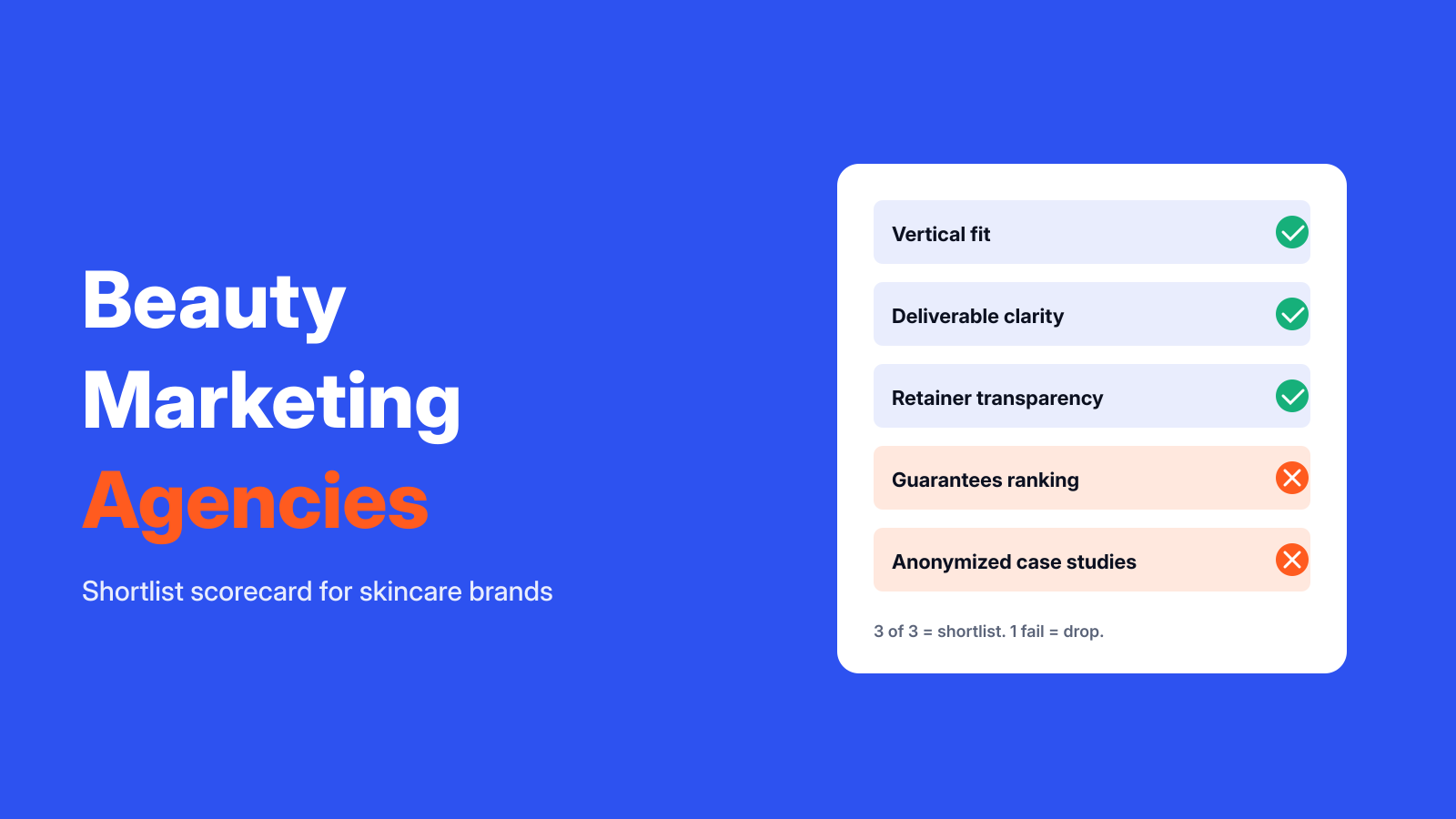
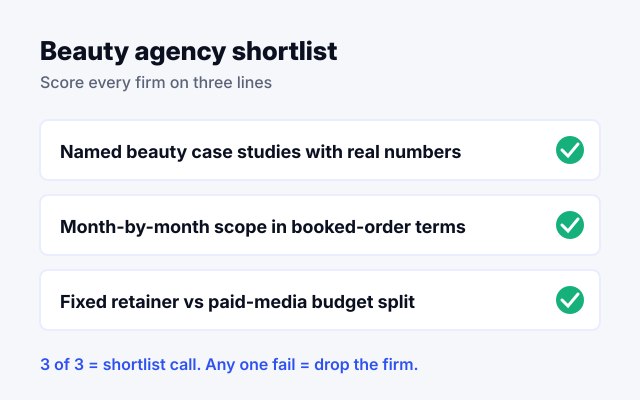
The first call is where most decisions are actually made. A tight 30-minute call with the right questions separates the top beauty marketing agencies from the generalists that added a beauty page to their site last quarter. Score every firm on three lines. Vertical fit, deliverable clarity, retainer transparency. Any one that fails on one line should not make the second call.
Vertical fit is proven by named beauty case studies with real numbers, not anonymized. Deliverable clarity is a month-by-month scope written in booked-order and revenue terms, not vague hours and channels. Retainer transparency is a fixed retainer line separated from variable paid-media budget, with no up-to language. Firms that score 3 for 3 make the second call. Our beauty marketing retainer plans list these deliverables and the fixed vs variable split so a brand knows what to demand from every firm on the shortlist.
Red flags that should end the shortlist call
Some patterns come up often enough on discovery calls to justify a hard cutoff. Any firm that guarantees rankings, guarantees ROAS, or guarantees a specific sales volume is misreading how Meta, TikTok, and Google actually work and how beauty compounds. Google does not guarantee rankings to anybody. Meta demotes clean-beauty ad copy for unsupported claims. TikTok Shop suspends accounts for FTC-noncompliant creator disclosures. A firm that guarantees outcomes is a firm that will over-promise, blame the brand on month four, and hand back a spent budget with a slide about market conditions.
Other patterns to hard-cutoff: a proposal that references unnamed “seasoned experts” without naming the human doing the work, a scope document that reads identically to the last three proposals you received, or a firm that will not name the ecommerce platform, review platform, and email platform they have already integrated with. Our beauty PPC service lists the exact platforms integrated and the exact scope by month, so a brand knows what to demand of every firm on the shortlist. The Beauté Aesthetics New York engagement, which grew leads 166 percent and conversion rate 27 percent inside 12 months, is a good example of the level of specificity to expect back.
Frequently asked questions
What defines the top beauty marketing agencies in 2026
The top beauty marketing agencies in 2026 are the ones publishing named skincare and color case studies with real dollar figures, running against modern channel-specific playbooks (Meta plus TikTok Shop plus Google plus Klaviyo), and separating fixed retainer spend from variable ad budget on the proposal. Score every firm on vertical fit (named beauty clients), deliverable clarity (month-by-month scope in booked-order terms), and retainer transparency (fixed vs variable split). Firms that score 3 for 3 make the second call. Retainer bands run 2,500 dollars per month for email specialists to 15,000 dollars per month for full-service brand rebuilds.
How much do top beauty marketing agencies charge every month
Retainer bands vary by agency profile. Email and retention specialists run 2,500 to 6,000 dollars per month, SEO-first specialists run 3,500 to 8,500 dollars per month, performance-first paid specialists run 4,000 to 10,000 dollars per month plus ad spend, influencer and TikTok Shop boutiques run 4,000 to 9,000 dollars per month plus creator fees, retail-readiness firms run 6,500 to 12,500 dollars per month, and full-service beauty agencies run 6,000 to 15,000 dollars per month. Ecommerce web-design specialists quote project fees between 25,000 and 95,000 dollars followed by a hosting-and-maintenance line. Every firm should separate fixed retainer from variable paid-media budget on the proposal.
How do I know if a top beauty marketing agency is the right fit
A right-fit beauty marketing agency will name the work they will not do, cite specific compliance rules (FDA structure-function claim limits on clean beauty, FTC endorsement disclosures on influencer seeds, Meta prestige-cosmetics ad review) in the first 15 minutes of the discovery call, and turn down scope that is not theirs. Ask them to name three beauty clients in the past 24 months, walk you through the month-one deliverables, and show you the reporting dashboard the brand sees every month. If the answer to any of those three is a slide with no numbers, keep looking.
Should I hire a specialist or a full-service beauty agency
A specialist is the right pick when one channel is the primary lever for the next 90 days. Choose a performance-first firm when the brand needs unit sales inside 30 days for a launch or promo window. Choose an SEO-first firm when the brand has 12+ months of runway and paid is already working. Choose an influencer and TikTok Shop boutique when a Gen Z hero SKU is your growth thesis. Choose a full-service beauty marketing agency when the brand needs strategy, paid, SEO, web, and creative under one roof with a named strategy lead who has run at least five prior beauty accounts.
How long should I give a beauty marketing agency before switching
The first 90 days are for foundation work (audit, PDP rebuild, ad account restructure, Klaviyo flow reset, dashboard setup). The 90 to 180 day window is where paid channels should be producing sales at the target CAC and the non-branded organic surface should be showing early ranking gains. If the dashboard is not moving on sales, CAC, ROAS, and repeat-purchase rate by day 180, escalate with the strategy lead. If nothing changes by month 8, the fit is wrong and it is time to shortlist again.
What red flags should end a shortlist call with a beauty marketing agency
Hard cutoffs include any firm that guarantees rankings, ROAS, or sales volume; proposals that reference unnamed experts without identifying the human doing the work; scope documents that read identically across proposals; agencies that will not name the ecommerce, review, and email platforms they have integrated with before; and agencies whose beauty case studies are anonymized or show only round-number growth percentages without dollar figures. Any one of those patterns is enough to end the shortlist call and move on to the next firm.
See how our beauty marketing agency team runs the same scorecard from the inside, and where the numbers land after 90 days.
Book your free 30-minute strategy call.
No spam, no sales rep. We use your email to schedule your call with a senior strategist. That is it.
More from the blog
View all articles → Marketing Strategy
 How Dental DSOs Grow Through Marketing. Tactics That Scale
Read article Marketing Strategy
 Dental DSO Marketing Services. What to Expect From an Agency Partner
Read article Marketing Strategy