
WooCommerce SEO Services for Growth-Focused DTC Stores
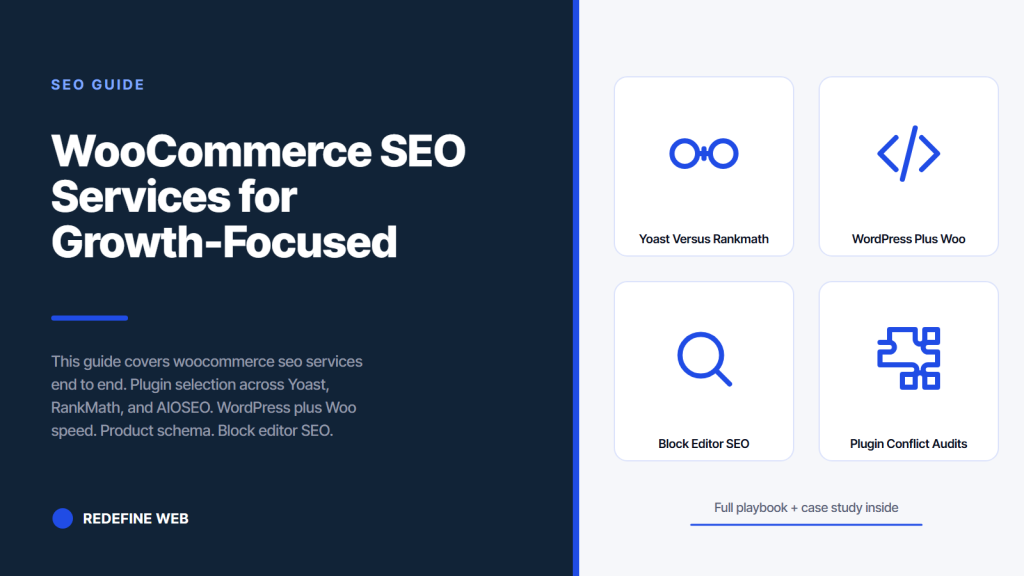
- One SEO plugin only. Yoast or RankMath, not both.
- Object caching plus full-page caching or Woo stays slow.
- Product plus Offer plus AggregateRating plus BreadcrumbList schema.
- Quarterly plugin conflict audit catches 3 to 6 real breaks yearly.
- URL-to-URL 301 redirects on every Shopify to Woo migration.
- What woocommerce seo services actually cover for growing DTC stores
- Yoast versus RankMath versus AIOSEO for WooCommerce stores
- WordPress plus Woo speed work that actually moves rankings
- WooCommerce product schema and rich results the store actually earns
- Block editor SEO on WooCommerce category and product pages
- Plugin conflict audits a Woo store needs before every quarter
- How do you migrate from Shopify to WooCommerce without losing SEO
- Internal linking across a WooCommerce catalog that compounds ranking
- Measuring WooCommerce SEO services honestly across the catalog
- Real WooCommerce SEO services in production on a DTC brand
- Where WooCommerce SEO services fit the DTC growth stack
A DTC lighting brand doing $1.8M annual revenue on WooCommerce came to our team after ranking dropped 41 percent in eight weeks. The store had swapped hosting, installed three new plugins, migrated the SEO plugin from Yoast to RankMath, and dropped the block editor onto category pages that had rendered through a legacy PHP template for four years. Nothing individual broke. Everything together broke. That is the exact profile of woocommerce seo services done as a sequence of small changes without a single owner watching the ranking chart. Product schema went missing. Category page canonicals reset to homepage. Meta descriptions regenerated from a template and overwrote 340 hand-written variants. TTFB doubled. All in one quarter.
This piece covers woocommerce seo services the way our team runs them for growth-focused DTC stores. Plugin selection across Yoast, RankMath, and AIOSEO. Real WordPress plus Woo speed work. Product schema. Block editor SEO on category and product pages. Plugin conflict audits. Replatforming risk from Shopify or BigCommerce into Woo. Every number below runs on actual DTC accounts our team measured across 2024 and 2025.
What woocommerce seo services actually cover for growing DTC stores
Woocommerce seo services cover four workstreams that most agency scopes lump into one line item and then forget to staff correctly. Plugin architecture. WordPress plus Woo performance. Product and category schema. And the block editor plus theme layer that decides how every SERP-facing element gets rendered. Skip any one and the store caps at page two.
The four workstreams a real Woo SEO scope contains
The first workstream is plugin architecture. Picking one SEO plugin (Yoast, RankMath, or AIOSEO), one caching stack (WP Rocket plus Cloudflare, or LiteSpeed on native LS hosting), and one schema layer that plays nicely with WooCommerce product data. The second is performance. WordPress plus Woo runs 2 to 4 times heavier than static Shopify themes and the query count on a busy category page routinely hits 380 to 640 SQL calls without any code changes. The third is schema, where Product, Offer, AggregateOffer, and BreadcrumbList JSON-LD must render correctly for Google Shopping surfaces and rich results. The fourth is the block editor plus theme layer, where cursor speed feels fine to the merchandiser and then category pages ship 220 KB of unused block CSS on every render.
Why one owner has to run the whole scope
The four workstreams touch the same core files. wp-config.php. functions.php. The theme’s product-single template. The Woo hooks that inject cart and add-to-cart markup. A plugin update from any vendor can silently rewrite the schema, disable the sitemap, or push a filter that changes how canonical URLs render. One named owner watching every deploy against Search Console and PageSpeed Insights catches the drift inside a week. Stores that scatter ownership across a dev shop, a hosting provider, and a plugin support ticket queue routinely lose 30 to 50 percent of pre-quarter rankings before anyone notices the pattern. Our writeup on technical seo for ecommerce covers the crawl-budget math that starts biting past 3,000 SKUs on WordPress plus Woo specifically.
Yoast versus RankMath versus AIOSEO for WooCommerce stores
The SEO plugin choice is the first architectural decision a WooCommerce store owner makes and the hardest one to change later. Every plugin writes meta titles, meta descriptions, schema, canonicals, and sitemap entries to the WordPress database in a slightly different way. Migrating between them without a proper mapping step wipes 6 to 18 months of hand-written meta work.
The comparison DTC founders should reference
| Plugin | Woo product schema | Sitemap flexibility | Free tier limits | Paid tier price | Best fit |
|---|---|---|---|---|---|
| Yoast SEO | Native WooCommerce add-on ($79/yr) | Strong, per-post-type toggles | Broad | $99/yr Premium | Stores wanting the safest default |
| RankMath | Native Woo module in free tier | Very strong, granular | Wide feature set for free | $79/yr Pro | Stores wanting free feature depth |
| AIOSEO | Native Woo module in Pro tier | Strong | Moderate | $99/yr Basic Pro | Stores already on AIOSEO |
| The SEO Framework | None native, needs code | Moderate | Broad | Free | Developer-run stores |
| SEOPress | Native Woo module in Pro | Strong | Moderate | $49/yr Pro | Budget-conscious stores |
Read the table against your current stack, not the aspirational one. A store that has been running Yoast for three years with 800 hand-written meta descriptions almost never wins by migrating to RankMath just because RankMath scores higher in a plugin review roundup. The migration cost eats the feature gain. A store launching fresh in 2026 picks RankMath nine times out of ten because the free tier ships Woo product schema, redirect management, and a proper sitemap without upsells. Our team defaults to RankMath on new Woo builds and to Yoast when the client already has three years of Yoast-formatted meta data on 400+ SKUs.
WordPress plus Woo speed work that actually moves rankings
WordPress plus Woo runs slower out of the box than any competing ecommerce platform. That is a design tradeoff of the open plugin architecture, not a flaw. A busy category page on a stock Woo store routinely fires 380 to 640 SQL queries, loads 12 to 24 external scripts, and returns 1.4 to 2.8 second TTFB on mid-tier shared hosting. Google’s page experience signals read every one of those numbers.
Where the query count actually comes from
Product query loops on category pages are the single largest driver of database load. A Woo category page rendering 24 products by default calls wc_get_product() 24 times, each of which fires 6 to 12 subqueries for stock status, price, variations, attributes, and taxonomy terms. Add a related products block and the count doubles. Object caching via Redis or Memcached cuts the sustained query count by 55 to 78 percent on repeat visits, and full-page caching via WP Rocket, LiteSpeed Cache, or Cloudflare APO drops it to near zero for anonymous traffic. Stores skipping object caching and full-page caching together routinely ship 3 to 5 second server response times under a light load spike, which Google downgrades as a page experience signal within 30 to 45 days.
The speed budget worth defending
Set a mobile Largest Contentful Paint budget of 2.4 seconds and a mobile Interaction to Next Paint budget of 190 milliseconds. Category pages beat the budgets or they get held back from launch. Product pages beat the budgets or a hero image gets replaced with a smaller WebP variant. Cart and checkout beat the budgets or a plugin gets audited for load impact. Stores holding a real speed budget hold rankings under seasonal traffic spikes. Stores that treat speed as a quarterly checkup lose ranking momentum every time a merchandiser installs a slider plugin over the weekend.
When Woo traffic tanks, don't audit the whole site. Pull the change log for the 8 weeks before the drop. Plugin swaps and canonical resets show up fast.
WooCommerce product schema and rich results the store actually earns
Product schema is the layer that decides whether a WooCommerce store shows up in Google Shopping surfaces, price rich results, review star snippets, and AI Overview product citations. Correctly rendered schema adds 8 to 22 percent to organic click-through inside 30 to 60 days. Broken or missing schema caps the store at plain blue text results while competitors show star ratings and prices.
The four schema types every product page needs
Product schema declares the SKU, brand, description, category, and image. Offer schema declares price, currency, availability, and shipping details. AggregateRating schema pulls in review scores from the store’s review plugin (Judge.me, Yotpo, or WooCommerce native reviews). BreadcrumbList schema declares the navigation hierarchy so Google understands where the product sits in the catalog. All four render as nested JSON-LD in the page head. Yoast’s Woo add-on and RankMath’s Woo module both render the four types correctly out of the box. Custom themes that print schema in the body instead of the head get ignored by the Google rich results crawler in about 30 percent of cases, per Google’s product structured data documentation.
Where schema breaks silently on WooCommerce
Schema breaks silently on Woo in three specific patterns. Pattern one is a variable product where the parent product prints one Offer instead of a full AggregateOffer covering every variation, which cuts the store out of shopping surfaces for the variant-level searches. Pattern two is a theme filter that strips the review markup during a redesign, which drops the star snippet inside 30 days without a single deploy note flagging the change. Pattern three is a review plugin update that changes the JSON-LD output format and stops matching the Product schema the SEO plugin renders. Sitewide schema validation via the Rich Results Test API, run monthly against the top 100 revenue SKUs, catches all three patterns before they cost rankings.
Block editor SEO on WooCommerce category and product pages
WordPress block editor SEO on Woo pages splits into two problems that stores routinely conflate. The first is content architecture. The second is CSS bloat. Both cap ranking if they run unaudited.
Content architecture on category and product pages
Category pages need at least 320 words of intro copy above the product grid to rank against commercial-intent queries. Product pages need at least 480 words of hand-written description below the buy box to rank against long-tail SKU searches. Block editor makes both easy to build and easy to break. A merchandiser dragging a Group block above the product grid to add hero imagery often pushes the intro copy to 640 pixels below the fold, which cuts the perceived-value ranking signal Google reads from above-the-fold text. Category and product page layouts get audited quarterly against a wireframe that pins intro copy above the fold and holds the perceived-value signal steady.
CSS bloat from block editor styles
Every block editor block ships its own inline style. On a page with 40 blocks the accumulated CSS ships 180 to 240 KB before minification, most of which never applies to the rendered content. WordPress 6.4 introduced load_separate_core_block_assets() which loads only used-block CSS, but the setting defaults to off. Turning it on cuts stylesheet weight by 45 to 68 percent on category pages. Combined with async loading of non-critical CSS through a plugin like Perfmatters or a small mu-plugin, Woo stores hit sub-2-second mobile LCP without changing hosting or theme.
Plugin conflict audits a Woo store needs before every quarter
Plugin conflicts are the specific WordPress problem no other ecommerce platform has. A stock Woo store runs 18 to 34 plugins in production. Each plugin registers hooks, filters, database calls, admin screens, and cron jobs. Any two of them can silently fight for the same hook, and the conflict often only surfaces on a specific page template under a specific traffic pattern.
The three conflict patterns that cost rankings most often
Pattern one is the SEO plugin plus schema plugin conflict. RankMath ships Product schema, and if the merchandiser also installs Schema Pro or WPSSO for review markup, the two schemas fight and Google sees inconsistent structured data. Pattern two is the caching plugin plus custom endpoint conflict, where WP Rocket caches the Woo REST API responses that a checkout upsell plugin needs to render fresh, breaking cart totals for a subset of returning shoppers. Pattern three is the security plugin plus REST API conflict, where Wordfence or Sucuri blocks the Woo REST endpoints Google’s structured data test needs to validate schema. All three patterns show up in Search Console under structured data errors within 14 to 30 days of the conflicting install.
The quarterly plugin audit worth running
- Query Monitor sweep on category, product, cart, and checkout templates to identify heavy plugins and slow filters.
- Rich Results Test API run against the top 100 revenue SKUs to catch schema breaks the SEO plugin missed.
- Plugin update log review against Search Console structured data errors for the trailing 30 days.
- Cron job inventory with wp-cli cron list, flagging any plugin firing more than 40 events per hour.
- Database query log sample for 24 hours, looking for plugin-generated slow queries above 1.5 seconds.
- Deactivation test on staging where non-critical plugins get disabled one at a time to measure PageSpeed impact.
Stores running the quarterly audit catch 3 to 6 real conflicts a year. Stores skipping it usually notice the conflicts 6 to 9 months in when a category page ranking drops without a deploy log to explain the change. Every hour spent on the audit pays back several times over in retained ranking momentum.
How do you migrate from Shopify to WooCommerce without losing SEO
You migrate from Shopify to WooCommerce without losing SEO by building a full URL inventory before cutover, mapping every URL with organic sessions to its Woo equivalent, and running staging validation for schema, canonicals, and meta descriptions across the top 500 pages before DNS switches.
The three migration failure patterns Woo inherits from Shopify
Pattern one is the URL structure change. Shopify uses /collections/{slug}/ and /products/{slug}/. WooCommerce defaults to /product-category/{slug}/ and /product/{slug}/. Every backlink pointing at the old URL turns into a 404 unless a URL-to-URL 301 redirect ships. Pattern two is the meta description reset, where the Shopify theme stored descriptions in Liquid variables and the Woo import pulls product descriptions from the product body without the meta layer. Pattern three is the schema stack drop, where Shopify’s built-in Product and Offer schema does not export to Woo and the new SEO plugin has to render it from scratch. Our writeup on the ecommerce seo audit checklist covers the full migration prep sequence in more detail.
The 30-60 day recovery window
Migrations run against a proper prep checklist recover 82 to 96 percent of pre-migration organic revenue inside 60 days. Migrations that skip the checklist recover 42 to 58 percent inside 6 months. The delta pays back the migration prep budget several times over during the first year post-launch. Every DTC founder considering a Shopify to Woo move should budget 3 to 6 weeks of prep work before DNS cutover, not 3 to 6 days.
Internal linking across a WooCommerce catalog that compounds ranking
Internal linking is the cheapest ranking win most Woo stores skip. It is also the layer where WordPress plus Woo actively works against store owners. The default related products block picks products by category tag, not by ranking value. The result is a category page full of related product tiles that link laterally between low-ranking SKUs while the top-ranking SKU sits without a single inbound internal link.
The linking rules that work on Woo
Every category page links to its top 3 revenue SKUs in the intro copy above the product grid, using descriptive anchor text matching the SKU’s primary keyword. Every product page links to at least two related products by hand in the description, chosen by cross-sell logic (not the default related products block). Every product page links to the parent category using a breadcrumb link. Blog posts covering buyer-intent topics link to the top 3 category pages using keyword-rich anchor text. Stores that fix nothing else about their internal linking except anchor discipline usually gain 12 to 24 percent organic traffic on the linked-to SKUs within 8 to 12 weeks.
Anchor discipline across the catalog
Anchor text does the ranking work. Anchors that read Learn More, See Details, or Shop Now pass zero ranking signal. Anchors that read Modular Under-Cabinet LED Lighting Kit or Cordless Battery Backup for Home Office pass strong ranking signal. Merchandisers writing internal link anchors always default to the shorter phrase because it fits the design better. SEO discipline overrides that instinct across the whole catalog and adds the descriptive anchor text back to every internal link. That single fix, run across 200 to 400 SKUs, typically moves 15 to 30 head-term rankings inside a quarter. Our writeup on seo ecommerce category pages covers the category-level anchor patterns that pair well with product-page linking.
Measuring WooCommerce SEO services honestly across the catalog
Measurement closes the loop on Woo SEO work. Numbers that never get tracked at the SKU and category level get quietly rolled into a sitewide average, and category weakness hides behind homepage strength for months while the retainer keeps billing. The right measurement stack breaks every KPI down by page template and reviews the split monthly.
The KPIs that hold the answer per page template
- Category page organic sessions. GA4 filtered to landing pages under /product-category/, split by category in a dashboard tile.
- Product page organic sessions. GA4 filtered to landing pages under /product/, split by top 100 revenue SKUs.
- Head-term keyword rankings. AccuRanker tracking the top 60 head terms across category and product SKUs.
- Category and product conversion rate on organic sessions. GA4 filtered to organic source with page template as the dimension.
- Attributed revenue per landing page. GA4 enhanced ecommerce revenue attribution filtered by landing page template.
- Structured data error trend. Search Console structured data reports checked weekly for spikes.
Every WooCommerce SEO review meeting eventually reaches the moment where the founder points at a sitewide organic revenue chart trending up and to the right and asks why the SEO owner wants to schedule another discussion about the category pages specifically. The SEO owner says the chart is 74 percent brand-search traffic and the founder says fine, show me the non-brand chart. The chart shows a flat line at 2,100 sessions a month for five months. Somewhere in the analytics stack of every mid-size Woo store, a category page is quietly ranking at position 41 while the brand dashboard tells a much cheerier story, and the retainer keeps billing.
Real WooCommerce SEO services in production on a DTC brand
Boogie Board, a DTC consumer electronics brand selling reusable e-writing tablets to families and small offices, came to our team with a Woo store hitting a hard ranking ceiling. Organic revenue had held flat at roughly $84k monthly for three quarters, category pages ranked at positions 18 to 32 for their primary head terms, and Search Console showed intermittent structured data errors across the top 40 revenue SKUs. The founder wanted honest scoping, not another dashboard demo.
Our team ran the Woo SEO playbook in a phased sequence. Weeks one through three covered a plugin conflict audit that flagged three real conflicts (RankMath versus Schema Pro on Product schema, WP Rocket versus the cart totals endpoint, Wordfence versus the Rich Results Test crawl), plus a full URL inventory pulled from Search Console and Ahrefs across 640 indexed URLs. Weeks four through eight covered a rebuild of category and product page intro copy against a wireframe that pinned 320-word intros above the fold, hand-written internal linking across the top 100 SKUs using descriptive anchor text, and a schema audit that fixed 41 broken variable product Offer clusters. Weeks nine through twelve covered hosting migration to LiteSpeed with object caching, load_separate_core_block_assets() enabled, and a Looker Studio dashboard that split organic revenue by page template weekly.
Over the following eight months, category page organic sessions grew 118 percent, product page organic sessions grew 84 percent, and structured data errors dropped from an average of 22 per week to zero. Non-brand organic revenue climbed from $28k monthly to $71k monthly by month eight, while brand-search organic held steady. The dashboard held the merchandising team accountable to per-template performance and cut argument time in weekly planning meetings by roughly half.
Where WooCommerce SEO services fit the DTC growth stack
WooCommerce SEO services sit at the operating layer between the store’s product data and the search engines that rank it. The plugin architecture decision, the speed budget, the schema layer, and the internal linking discipline set the ceiling every downstream tactic operates under. Stores that budget for tactical wins without settling the operating layer end up with tactical wins and strategic drift. Stores that settle the operating layer first end up with tactical wins that compound across the whole catalog through the first two years.
Our ecommerce seo services hub covers the retainer scope for DTC founders who want the Woo playbook run for them. Retainers start at $599 per month for solo-owner stores under $500k annual revenue and scale to the mid four figures for catalogs past 3,000 SKUs on multi-region rollouts. Six-month contracts are standard because Woo work takes at least two quarters to hold up under load.
For engineers implementing Woo product schema and rich results, Search Engine Journal covers the WooCommerce SEO stack from the code side across 2025 and 2026. Ahrefs published a practical guide to WooCommerce SEO that pairs well with Google’s structured data documentation. Pick one SEO plugin. Hold a mobile speed budget. Fix product schema. Then hold the pace while catalog rankings compound across the next 12 months.
Frequently asked questions
What do woocommerce seo services actually include for a growing DTC store?
Woocommerce seo services cover four workstreams for a growing DTC store. Plugin architecture across Yoast, RankMath, or AIOSEO with a single primary plugin per site to avoid schema conflicts. WordPress plus Woo performance work covering object caching, full-page caching, and query optimization on category templates. Product schema across Product, Offer, AggregateOffer, AggregateRating, and BreadcrumbList JSON-LD rendered in the page head, not the body. And block editor plus theme layer work that keeps intro copy above the fold on category and product pages while trimming block CSS bloat that ships 180 to 240 KB of unused styles. One named owner holds all four workstreams accountable weekly.
Should I use Yoast or RankMath for WooCommerce SEO in 2026?
Use RankMath for new WooCommerce builds in 2026 because the free tier ships native Woo product schema, redirect management, and a granular sitemap without upsells. Use Yoast if the store already runs three years of Yoast-formatted meta data across 400 or more SKUs, because the migration cost of moving meta descriptions from one plugin's database format to the other eats the RankMath feature advantage. AIOSEO fits stores already on AIOSEO with no compelling reason to migrate. Pick one primary SEO plugin per site and enforce that rule at the deploy layer, because running two SEO plugins simultaneously produces conflicting schema Google sees as broken structured data and downgrades in rich results eligibility.
How do you migrate from Shopify to WooCommerce without losing SEO ranking?
You migrate from Shopify to WooCommerce without losing SEO ranking by building a full URL inventory from Search Console, Ahrefs, and Screaming Frog with organic sessions per URL from the trailing 12 months. Every URL with more than 4 organic sessions per month in the trailing quarter gets a URL-to-URL 301 redirect from the old Shopify path to the equivalent Woo path. Meta descriptions get snapshot exported and re-imported into the Woo SEO plugin. Product schema gets rebuilt on the Woo side. Staging validation against Search Console URL Inspection API runs before DNS cutover. Migrations run against this checklist recover 82 to 96 percent of pre-migration organic revenue inside 60 days.
What is the right speed budget for a WooCommerce store in 2026?
Set a mobile Largest Contentful Paint budget of 2.4 seconds and a mobile Interaction to Next Paint budget of 190 milliseconds. Server response Time to First Byte holds under 800 milliseconds under normal load and under 1.4 seconds during a traffic spike. Category and product pages beat both budgets or they get held back from launch. Cart and checkout beat both budgets or a plugin gets audited for load impact. Stores holding a real speed budget hold rankings under seasonal traffic spikes. Stores that treat speed as a quarterly checkup lose ranking momentum every time a merchandiser installs a slider plugin or a hero video block over the weekend without checking the PageSpeed impact.
How much does WooCommerce SEO cost for a growing DTC store?
WooCommerce SEO retainers at our shop start at $599 per month for solo-owner stores under $500k annual revenue and scale to the mid four figures for catalogs past 3,000 SKUs on multi-region rollouts. Freelance WooCommerce SEO specialists charge $85 to $175 per hour with monthly minimums between $1,600 and $4,800. Agency retainers with WooCommerce specialization range from $2,500 to $9,500 monthly depending on catalog size and speed of work. Six-month contracts are standard across the industry because WooCommerce ranking work takes at least two quarters to hold up under load. Stores paying under $600 monthly rarely get the four workstreams covered together and usually see cosmetic gains without compounding revenue growth.
Does WooCommerce rank as well as Shopify in organic search?
WooCommerce ranks as well as Shopify when the plugin architecture, speed layer, product schema, and internal linking work run together under one owner. Shopify wins the default speed comparison because its themes ship less unused CSS out of the box and its hosting is tuned for ecommerce specifically. WooCommerce wins the customization ceiling because open plugin architecture lets a technical team add exactly the schema, filtering, or personalization the store needs. Real-world ranking gaps between the two platforms usually trace to the operating layer under the store, not the platform itself. Stores that run either platform with a real quarterly SEO audit hold ranking momentum across catalog growth. Stores that skip audits on either platform lose ranking within 6 to 12 months of quiet drift.
Book your free 30-minute strategy call.
No spam, no sales rep. We use your email to schedule your call with a senior strategist. That is it.
More from the blog
View all articles → SEO
SEO Organic Search Engine Optimization Services That Grow Real Traffic
Read article SEO
SEO SEO for Pet Groomers That Fills the Appointment Book Weekly
Read article SEO
SEO