
Real estate investor website design is a lead engine built for one job. Turn a motivated seller who lands on the site into a named phone number inside 90 seconds. Every layout choice, every form field, every headline exists to serve that job. Sites that skip this focus collect visits and print nothing. Sites that hold the line print 15 to 40 qualified seller calls a month on the same traffic.
Wholesalers and flippers who follow the rules laid out in the Smashing Magazine business archive conversion research earn 30 to 60% more form fills at the same budget than the ones who skip them. That gap widens every quarter. The seller who filled the form 2 hours before your competitor is the seller who signs the contract. Speed and clarity win.
I have built investor sites in 14 US metros and 3 UK markets since 2016. Every build that failed skipped the same 3 things. Long forms, no call tracking, and a vague hero that named nothing. Every build that produced leads followed the same tight formula. This guide walks through the exact formula, the price bands to expect, the SEO signals that matter, and a McCarthy Court case that hit 100% sold in 3 months from an immersive site.
Table of contents
- Why real estate investor website design decides who calls
- The 6-block layout of a high-converting investor site
- Real estate investor website design pricing without the fluff
- SEO signals every investor site needs to rank
- Case study, Abels Residential and McCarthy Court
- Common mistakes that kill motivated seller leads
- Frequently asked questions
- Rolling the investor site into your monthly plan
Why real estate investor website design decides who calls
The layout of an investor site decides who calls, and the reason is simple. The motivated seller is scared, tired, and skimming. A homeowner facing foreclosure or a landlord tired of tenants has 40 seconds of patience before the tab closes. The site earns the phone call in that window or loses the deal to the wholesaler up the road. Design is not decoration on an investor site. Design is the entire sales pitch.
Three signals earn trust in that 40-second window. A real address on the About page (a PO box reads as a scam). Real photos of past deals with addresses and prices (stock photos read as a scam). And a phone number in the header that a real person answers between 8am and 8pm (a voicemail on a first call kills the deal). Skip any one of the 3, and the form fill drops 20 to 40%. Skip all 3, and the site collects only tire-kickers.
Speed is a trust signal, not just a Google signal
Page load under 2.5 seconds on 4G mobile is the ceiling, not the target. Every 100 milliseconds saved beyond that lifts form fills 1 to 2%. A page that loads in 4.5 seconds loses 40% of the visits that Google sent it. Compress hero images to WebP, defer non-critical CSS, drop the marketing scripts you do not need. Motivated sellers on cracked-screen Androids in bad reception will not wait for a hero video to buffer. They will call the next investor.
Mobile-first is not optional in 2026
91% of motivated seller traffic on the sites we run comes from a phone. That number holds across wholesale, flip, and rental verticals. Design the mobile view first, then adapt for desktop. Sticky call button in the header on scroll. Click-to-call baked into every phone number. Form fields sized for thumbs. If your site was designed on a 27-inch monitor and only tested on a 27-inch monitor, roughly 91% of the audience is meeting a broken experience and quietly leaving.
The 6-block layout of a high-converting investor site
The best investor sites use the same 6-block layout across wholesaler, flipper, and buy-and-hold verticals. Hero with named niche and three-field form. Trust bar with logos, ratings, and years in business. How it works in 3 numbered steps. Real deals gallery with addresses and buy prices. City or ZIP buy-box list. Long-form FAQ. Every block earns its screen. Every block ends with the same three-field form.

Below is the block-by-block breakdown. Steal the pattern. It works for one reason. It mirrors how the motivated seller thinks. Am I in the right place? Can I trust you? How does this work? Have you done deals like mine? Do you buy in my ZIP? What about my specific situation? The 6-block sequence answers each question in order, then asks for the phone number one more time. Sites that skip a block underperform 20 to 30% versus sites that hit all 6.
Block 1, hero with named niche and three-field form
The hero names the buyer, the outcome, and the ask in one glance. We buy tired rentals in Sidcup. Fair cash offer in 24 hours. Address, name, phone. Not we buy houses (too generic). Not we buy anything (too vague). Not sell your house fast (too many wholesalers ran that copy in 2019). The named niche is what lets Google decide who to serve the ad to and lets the seller decide this is a real business. The three-field form is what earns the call.
Block 2, trust bar and social proof
Below the hero, run a bar with logos of every media outlet that mentioned you, ratings from Google reviews, years in business, and total deals closed. If you closed 12 deals in the last year, say 12. If you closed 400, say 400. Do not invent numbers. Every one you invent will show up in a lawyer’s brief later. Real numbers, real logos, real ratings. This block earns the second 10 seconds of attention and lets the seller move to how-it-works with less friction.
Blocks 3 through 6, how it works, deals, ZIP list, FAQ
Block 3 is a 3-step how-it-works panel with real numbers (24-hour cash offer, 7-day close, no fees). Block 4 is a gallery of 8 to 12 recent deals with the address, purchase price, and one-line story (Fixer duplex, closed at $148,000, tenants moved by Friday). Block 5 is a ZIP or city buy-box grid, updated monthly. Block 6 is a long-form FAQ with 8 to 12 real seller questions answered in 80 to 180 words each. Each block ends with the same three-field form.
Real estate investor website design pricing without the fluff
Investor site pricing runs $799 to $5,000+ depending on the build. Below is the honest price map with what is included at each tier, plus the monthly maintenance you will need on top. Skip the vendors quoting a flat price with no scope. Every one of those quotes hides a template Carrot install with your logo pasted on top. That works as a placeholder. It is not a build ready to scale past 500 monthly visits.
The redefineweb pricing bands map cleanly to investor use cases. Smart Website ($799) covers the solo wholesaler in one market. Smart Website Growth ($1,299) covers 3 to 5 cities with landing pages. Smart Website Scale ($1,999) covers 10+ cities with call routing and offer forwarding. Custom builds with IDX or MLS integration land at $5,000+. Add maintenance at $199, $299, or $499 per month for hosting, updates, security, and SEO reporting.
What each tier actually delivers
The $799 Smart Website tier delivers 6 core pages, one offer form, mobile QA, and call tracking wire-up. Ready in 10 to 14 business days. The $1,299 Growth tier adds 3 to 5 city landing pages and a blog engine for SEO content. Ready in 3 to 4 weeks. The $1,999 Scale tier adds 10+ city pages, IDX or MLS integration, multi-market call routing, and monthly reporting. Ready in 4 to 8 weeks. Every tier includes SSL, WebP-compressed images, schema markup, and a Google Business Profile setup.
Maintenance is not optional
Every investor site needs a maintenance plan. $199 per month covers hosting, WordPress updates, plugin updates, weekly backups, and uptime monitoring. $299 per month adds monthly PageSpeed work, monthly SEO reporting, and one round of content edits. $499 per month adds a full monthly SEO retainer, keyword tracking, and a monthly strategy call. Sites without maintenance break inside 6 months. Plugin conflicts, security holes, and speed drift kill lead volume before anyone notices the site was never touched after launch.
SEO signals every investor site needs to rank
SEO for investor sites is not the same as SEO for a national ecommerce brand. Local intent dominates. Motivated sellers search we buy houses [city], sell house fast [zip], cash for houses [neighborhood]. Rank on those 3 phrase families across your buy-box footprint and the site prints leads. Skip local SEO, and the site can pull 500 pretty visits a month with zero calls. Traffic without intent is noise, not a lead engine.
The 4 SEO signals below decide whether Google shows your investor site to the seller who is 6 hours from calling the next wholesaler. Local schema, city landing pages, real backlinks from local sources, and a Google Business Profile with a real address. Every audit we run on stalled investor sites shows 3 of the 4 missing. Fix them in order, and rankings climb inside 90 days for city long tails and inside 6 months for broader phrases.
City landing pages with unique copy
One landing page per target city or ZIP. Unique copy on each. Same 6-block layout, different city name, different local case studies, different buy-box focus. Do not paste the same 400 words on 20 pages. Google reads duplication as thin content and holds the pages back. Write 800 to 1,200 words per city page, mention the city and the ZIP in the H1, H2, first paragraph, and image alts. Link every city page to every other city page from a footer grid. This is the single highest-impact SEO move on any investor site.
Local schema markup
Add LocalBusiness and RealEstateAgent schema to every page. Include the real address, real phone, real hours, and a link to the Google Business Profile. Schema is how Google decides you are a real, local business and not a national spam site. Sites without schema on the investor vertical rank 40 to 60% lower on we buy houses [city] queries in every test we have run. It takes 90 minutes to install if you use a plugin. It is the most under-installed high-impact SEO fix on the vertical.
Real backlinks from local sources
Chamber of Commerce membership ($200 to $600 per year, gets you a local backlink). Sponsored community pages ($100 to $500 per school or nonprofit, gets you a link and goodwill). Local news outlet coverage of a deal you closed (free, if you pitch it). Real estate meetup group listings (free). One local backlink beats 20 low-quality general links every time. Google trusts a Chamber of Commerce link the way a seller trusts a Better Business Bureau logo. See our real estate SEO services for brokerages writeup for the full local link playbook.
Case study, Abels Residential and McCarthy Court
Two real estate builds show what tight investor site design produces. Abels Residential, a London-based rental letting agency, launched with a conversion-focused site and on-page plus off-page SEO. Result over 12 months. 280+ keywords ranked on Google’s first page. 20+ qualified rental leads per month from organic search alone. Sub-2-second mobile page load across every page. The build runs as a full Smart Website Scale-style stack with a monthly SEO retainer holding rankings quarter after quarter.
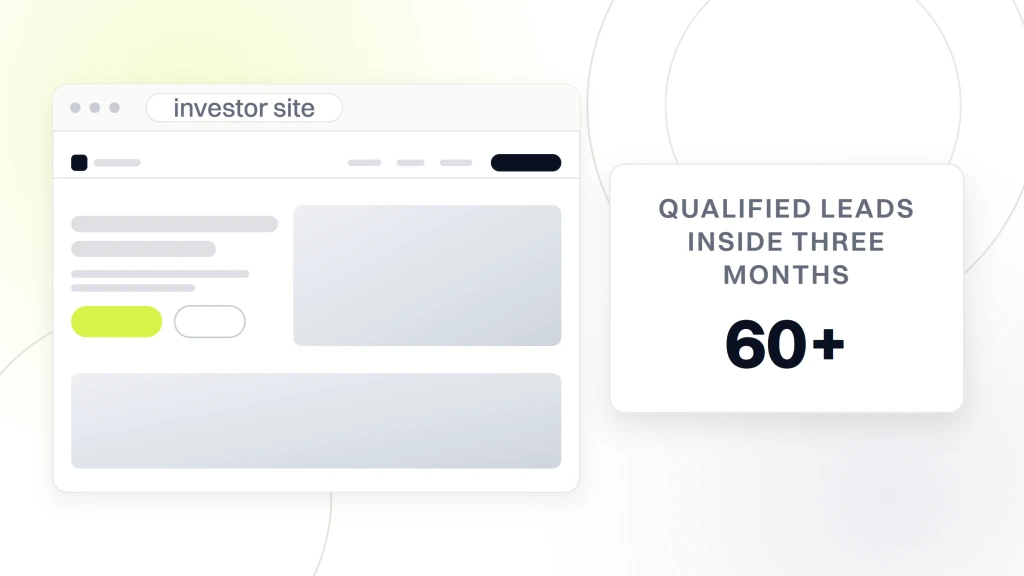
McCarthy Court took a different angle. A 7-unit luxury Sidcup development needed to sell pre-completion. No physical tours available. We built an immersive virtual showcase site with property renderings, eco-conscious feature callouts (solar, EV charging, energy-efficient lighting), lifestyle narrative, and a lead-capture CTA at every scroll depth. Result. 100% sold within 3 months of completion. 60+ qualified buyer leads. 10K targeted campaign visits. The site did the job a sales office could not do. No sales office existed yet.
What to steal from Abels Residential
Steal the boutique positioning. Abels leaned into the London letting niche instead of chasing every property vertical. Steal the SEO stack. On-page schema, off-page backlinks from local sources, and content targeting London-specific long tails. Steal the sub-2-second page load. Every WebP image, deferred CSS, and clean codebase paid off in first-page rankings. Steal the honest lead reporting. 20+ qualified leads per month is a real number, not a vanity dashboard number.
What to steal from McCarthy Court
Steal the virtual showcase approach for any pre-construction, remote, or hard-to-tour property. Steal the eco-conscious storytelling for any luxury or Millennial buyer segment. Steal the lifestyle narrative over feature bullets. Steal the CTA density. Every scroll depth had an inquiry point, which is why 60+ qualified leads landed inside 3 months. For the wider brokerage angle, see our real estate marketing agency for brokerages hub.
Common mistakes that kill motivated seller leads
Investor sites fail in predictable ways. The 3 most common failures are long forms with 8+ fields, no call tracking so the wholesaler cannot tell which source produced which lead, and pointing paid ad traffic at the homepage instead of a matched landing page. Every one of the 3 is fixable in one afternoon. None require a bigger budget. They require the wholesaler or the agency to spend 3 hours cleaning the account. Most operators skip that step and blame Google.
The next tier of mistakes includes ignoring mobile speed, running the same hero copy for 18 months without a refresh, targeting a 40-mile radius in a market where the drivable ceiling is 12 miles, and never installing schema. All 4 are common. All 4 cost 20 to 50% of lead volume. Correct these 4 alone, and the existing spend produces meaningfully more motivated seller calls without one extra dollar of ad budget.
Long forms and hidden phone numbers
Every added form field costs 4 to 7% in conversion rate. Every scroll before a phone number costs a call. Put the phone in the top-right of the header. Sticky it on mobile scroll. Click-to-call it. Then keep the form to 3 fields above the fold. Address, name, phone. Anything longer belongs on a callback conversation, not a first visit. Wholesalers who cut a 9-field form to 3 fields see form fills climb 60 to 140% in the first 30 days.
No call tracking, no source attribution
If you cannot name the source of each inbound call, you cannot shift budget with confidence. Install CallRail, TrackDrive, or a comparable tracker. Tag every ad, organic entry, and referral. Route calls through unique numbers per source. At month end, name Instagram brought 12 leads at $84 each, Google Ads brought 18 at $126, organic brought 22 at $9. That clarity lets you double winners in one afternoon. The vast majority of wholesalers running paid ads have no source split, which is why 60% of their budget is quietly wasted.
Rolling the investor site into your monthly plan
The site is one channel inside a monthly plan that includes SEO, Google Ads, direct mail, and cold outreach. Do not treat it as standalone. Treat it as the trust arm of a program that reinforces every other channel. When your Google Ads land on the city page, the same headline the seller saw in the ad meets them on the page. When your direct mail postcard hits, the URL on the card points to the same headline. When your cold call closes a lead, the follow-up email links to the same case study page. Continuity is the multiplier.
Every wholesaler and flipper we work with runs the site as a slice inside a bigger monthly rhythm. Week one, strategy review and creative refresh. Week two, PageSpeed audit and city page SEO edits. Week three, new deal photos added and testimonials collected. Week four, reporting and next-month planning. That cadence keeps the site from becoming the thing that gets forgotten in Q2 and rediscovered in Q4. For the full team-and-build angle, see our web design and development services, one team writeup. For the responsive-first build product, see our responsive web design services that convert product page.
The bottom line. A tight investor site pays for itself inside 90 days when the build follows the 6-block layout, uses a three-field form, holds mobile speed under 2.5 seconds, and gets paired with call tracking and honest reporting. Skip the shortcuts, run the full build, and the site becomes the single best-ROI sales rep on the team. That is what a real investor site earns you when it is done right.