Dental marketing strategies win when they match the size of the practice, the market, and the growth budget. A solo practice in a Denver suburb never runs the same playbook as a 40-office dental service organization across Florida. Both need marketing that produces new patients. Neither gains from the generic tactic list every agency emails once a quarter. This guide walks through the 7 dental marketing strategies that actually move practices in 2026, the sequencing that fits your practice size, and the numbers that tell you whether each strategy is working. Redefine Web runs these strategies across solo practices, mid-sized groups, and 200-location DSOs, so the recommendations below reflect real accounts, real budgets, and real conversion data. You will finish the read with a short list and a clear sense of which lever to pull next quarter.
Every dental marketing strategy below feeds new-patient volume. None of them exists in isolation. Practices that pick 2 strategies and run them well beat practices that pick 8 and run them badly. The size of the practice, the local competition, and the growth budget together decide which 2 to run first, and the sequencing framework in section 5 pins that down for solo, group, and DSO operators.
Paid Search as the Fastest Lever in a Dental Marketing Strategy
Paid search moves the pipeline the fastest of every dental marketing strategy on the list. A well-structured Google Ads campaign produces new-patient calls inside 7 days. That speed makes paid search the funding engine for the slower organic strategies, and most practices spend 40% to 60% of the first-year marketing budget on Google Ads during a serious growth push. Cost per new patient from dental Google Ads runs $60 to $140 in most markets once the campaigns have 60 days of conversion history.
Campaign structure that converts
Split campaigns by service line and by intent stage. A new-patient special campaign runs against high-intent brand and generic terms. A cosmetic campaign runs against cosmetic queries. An emergency campaign runs 24/7 with call-only ads. Groups running one flat campaign covering every service waste 30% to 50% of spend on mismatched intent, and the audit for that pattern takes 20 minutes inside Google Ads Editor.
Local Services Ads for map-pack presence
Google Local Services Ads (LSAs) put the practice above the map pack for local dental searches. Setup takes background checks and license verification. The pay-per-lead model runs $25 to $65 per verified lead in most dental markets. Practices that add LSAs alongside standard Google Ads pick up 10% to 25% additional call volume without cannibalizing the main campaigns, and LSA leads often convert to booked patients at higher rates than search-ad leads since Google pre-qualifies the caller.
Landing pages that actually convert
Every campaign points to a dedicated landing page. Home-page traffic converts at 2% to 4%. Dedicated landing-page traffic converts at 8% to 14%. That difference is the single largest ROI multiplier in dental paid search, and it costs nothing beyond the page build. Our dental ppc landing pages covers the layout that consistently books more consults per click.
Meta Ads and Social That Produce Cases in Any Dental Marketing Strategy
Meta ads work for dental practices when the offer, the creative, and the funnel match the platform’s demand-generation nature. Google Ads captures people already searching for a dentist. Meta creates demand by showing the right offer to the right audience. The 2 channels answer different sides of the funnel and reinforce each other when run in parallel, and the strongest dental marketing strategies use both once the budget clears $6,000 per month combined.
Offers that move on Meta
New-patient specials with a specific dollar figure or service (free whitening after cleaning, $99 exam plus x-rays). Cosmetic case studies with before-and-after photos and a soft consult offer. Invisalign starter offers with financing terms. Sedation dentistry reassurance ads targeting anxious patients. Broad brand awareness ads without a clear next step almost never convert profitably on Meta for dental practices, so cut them from the plan.
Full-funnel campaign structure
Awareness campaigns show video content to broad local audiences. Engagement campaigns retarget video viewers with case-study creative. Lead-gen campaigns retarget the engaged pool with a specific offer. Each stage has its own creative, audience, and conversion goal. Groups running only bottom-funnel lead ads to cold audiences pay 3 to 5 times more per lead than groups running full-funnel structure, and the math gets worse each month as the cold audience fatigues.
Send Meta traffic to a dedicated landing page for emergency and implant offers. Use lead ads for soft cosmetic consults where intent runs lower.
Landing page and form choices
Meta lead ads capture the lead inside the platform, which speeds submission but produces lower-intent leads. Sending traffic to a dedicated landing page produces higher-intent leads at higher cost per lead. The right mix depends on the offer. Emergency offers work on landing pages. Cosmetic soft-consult offers work on lead ads. Test both. Our dental facebook ads covers the mechanics of setup and creative testing.
Review Workflows That Drive Close Rate
Review workflows do double duty inside dental marketing strategies. Reviews rank the practice higher in the map pack. Reviews convert local searchers into first-visit patients at meaningfully higher rates. A practice with 1,240 reviews at 4.9 stars closes a first-time visitor at roughly triple the rate of a practice with 87 reviews at 4.6 stars. Every strategy pass should include a review workflow refresh, and every marketing for dental offices program should track review velocity as a leading indicator.
Request cadence that actually works
SMS request 2 hours after checkout. Email follow-up at 48 hours if no review posts. No third contact. Practices that ping patients more than twice usually create the exact review problems they were trying to avoid. Cadence discipline outperforms request frequency in every dental patient acquisition workflow we run, so cap the ask at 2 touches and let the automation carry the rest.
Which reviews to prioritize
Google reviews carry the highest weight for local ranking and close rate. Yelp, Facebook, and Healthgrades matter less than the marketing industry claims. Focus 80% of the request effort on Google. Sprinkle Yelp and Healthgrades to prevent obvious platform imbalances. Ignore review sites nobody in your local area actually reads, and stop letting vendors upsell you on directories that produce no traffic.
Responding to reviews properly
Respond to every review, positive and negative. Positive responses take 30 seconds and reinforce loyalty. Negative responses take longer and need care with HIPAA (Health Insurance Portability and Accountability Act). Never confirm the patient’s identity in the response. Never reference specific medical facts. Acknowledge, thank, offer to talk offline. Our respond to negative reviews dentist covers scripts you can use verbatim.
Cap review requests at 2 touches per patient. SMS at 2 hours, email at 48 if nothing posts. No third contact.
Website Conversion Inside a Dental Practice Marketing Plan
Every dental practice marketing plan runs traffic to the same website, and the website’s conversion rate multiplies every dollar spent on any other channel. A practice website converting at 2% needs twice the traffic to hit the same new-patient volume as a website converting at 4%. Conversion rate optimization is the free budget increase every strategy pass should include, and it usually pays back inside 45 days once the fixes go live.
The conversion elements that actually matter
Phone number in the header, big and clickable on mobile. Book-appointment CTA above the fold. Real photos of the office and doctors, not stock photography. Live insurance list. Doctor bios with credentials. Service pages with specific procedure detail. Google reviews block. Trust badges. These 8 items drive the majority of conversion gains on dental websites, and 3 of the 8 usually move the needle inside a 2-week sprint.
Online booking that reduces drop-off
Online booking that integrates with the PMS (practice management system) captures the roughly 25% of visitors who never call. Practices that add real online booking (not a contact form pretending to be booking) usually see new-patient submissions rise 20% to 40% inside 60 days. Show rates track 8% to 15% lower than phone bookings, so build the operations plan around confirmation calls the day before every online appointment.
Page speed and mobile experience
Mobile page speed under 2.5 seconds against Google’s Core Web Vitals. Time to first meaningful paint under 1.5 seconds. Mobile-friendly forms with autofill support. Practices with mobile-slow websites lose 25% to 40% of the mobile traffic they paid to attract. Every dental marketing strategies pass should include a Lighthouse audit and a fix list. Our dental website optimization covers the technical checklist.
Patient Retention as a Marketing for Dental Offices Strategy
Marketing for dental offices without a retention plan loses new-patient volume out the back door. A new patient acquired for $180 who lapses inside 2 years costs the practice more than a new patient acquired for $220 who stays for 8 years. Retention is the second-largest ROI multiplier inside dental marketing strategies after conversion, and the retention systems that work are cheap to build once and effectively free to run month over month.
Recall and reactivation workflows
Automated 6-month recall texts with an easy booking link. Reactivation emails for patients who missed the last recall window. Birthday touches, seasonal check-ins, and treatment-plan follow-ups. These workflows run inside the PMS or the practice’s marketing automation tool. Practices with strong recall workflows hit 78% to 85% recall attendance. Practices without them hit 55% to 62%, and the gap on hygiene revenue alone often covers the entire marketing budget.
Email and SMS content that stays welcome
Monthly newsletter with 1 dental tip, 1 team update, 1 call to action. Quarterly treatment-plan follow-ups to patients with unfinished plans. Insurance year-end reminder in October. Whitening seasonal push before summer. Practices that email weekly with sales-heavy content lose subscribers faster than they gain them. Cadence and content quality matter more than volume, and the unsubscribe rate is the leading indicator to watch.
Membership plans work for the 25% to 40% of your local market without dental insurance. Insured patients rarely enroll, so aim the offer accordingly.
Loyalty programs and membership plans
In-house membership plans (annual fee for cleanings, exams, and treatment discounts) drive retention and cash flow. Uninsured patients treat membership as insurance-lite. Insured patients rarely enroll. Structure the plan for the 25% to 40% of the local market without dental insurance. Our dental marketing automation covers the tool stack that runs these workflows.
How to Sequence Your Dental Marketing Strategies by Practice Size
Sequencing decides whether a dental marketing strategy compounds or stalls. Solo practices sequence differently than groups. Groups sequence differently than DSOs. Every practice starts with the strategies that produce the fastest ROI and layers on the slower ones once the funding covers the effort. The 3 sequences below reflect what we run for new accounts across the last 4 years, and each maps to a 6-month cadence.
Solo practice sequence
Start with GBP (Google Business Profile) optimization, review workflow, and Google Ads. Those 3 produce measurable results inside 60 days. Add website conversion improvements in month 3. Layer in local SEO for dentists content publishing in month 4. Start Meta ads in month 5 if the budget covers $2,000 to $3,500 per month. Patient retention workflows go live in month 6. Solo practices that skip this order and start with Meta lose 20% to 30% of the first-quarter budget on wasted testing.
Group practice sequence (2 to 5 locations)
Consolidate ad accounts across locations first. Deploy a unified review platform. Build real per-location website pages. Start Google Ads with location-specific campaigns and landing pages in month 2. Add Meta ads with location-specific creative in month 3. Local SEO content ramp in month 4. Retention workflows through the shared PMS in month 5. Groups running location-agnostic ads pay 20% to 40% more per booked patient than groups running per-location structure.
DSO sequence (10+ locations)
The DSO sequence starts with account consolidation, attribution setup, and multi-location dental SEO architecture. Google Ads restructure and landing page builds come next. A central review workflow deploys across every location. The Meta full-funnel program launches once attribution is clean. Retention workflows run through the PMS across the group. Our dental marketing plan covers the month-by-month cadence.
Benchmarks That Tell You If Your Strategy Is Working
Working dental marketing strategies produce measurable outputs by month. The table below tracks median results across practices Redefine Web runs across the strategies above. Compare your practice against the row that matches your size. Gaps against the benchmark tell you which strategy to prioritize next, and each gap maps to 1 of the 7 strategies covered above.
| Metric | Solo practice | 3-location group | DSO (10+ locations) |
|---|---|---|---|
| New patients per month (median) | 48 | 52 per location | 68 per location |
| Cost per new patient | $92 | $74 | $56 |
| New patients from Google Ads | 18 per month | 20 per location | 25 per location |
| New patients from organic search | 16 per month | 18 per location | 26 per location |
| New patients from Meta | 8 per month | 10 per location | 12 per location |
| Recall attendance rate | 72% | 78% | 82% |
| Website conversion rate | 3.8% | 4.5% | 5.2% |
Read the table as a target, not a verdict. A solo practice landing 38 new patients per month is not failing, but it likely has a specific gap on one of the top 3 strategies (GBP completeness, Google Ads structure, review workflow). Groups landing 42 new patients per location per month usually have a landing-page problem or an attribution problem. DSOs landing 55 per location often have consolidated only halfway through the vendor stack. Every gap on the benchmark maps to 1 of the 7 strategies. Pick the strategy with the largest gap, allocate 2 to 3 months of focus to it, and expect the numbers to move inside a quarter. Practices that pursue the whole benchmark row at once spread effort too thin and see less movement than practices that pick a lane and drive down it.
Case Study VP Dental Doubled New Patients With a Unified Dental Marketing Strategy
VP Dental, a 20+ year practice led by Dr. Valerie Preston, ran fragmented agencies for years. Web sat with 1 vendor, SEO sat with another, and neither talked to the other. The site was outdated and slow, online scheduling did not exist, and search visibility dropped sharply just a few miles outside the office. Cosmetic patients (the highest-margin segment) went to the practice down the road instead.
What we prioritized
Redefine Web took over both web and SEO under 1 unified strategy. A modern WordPress rebuild with online scheduling, virtual consults, digital forms, and integrated payments went live in month 2. A Google Maps SEO campaign targeted the 8-mile radius the practice cared about most. Reporting ran monthly and tied every dollar back to booked new-patient revenue instead of vanity ranking screenshots.
What the numbers showed
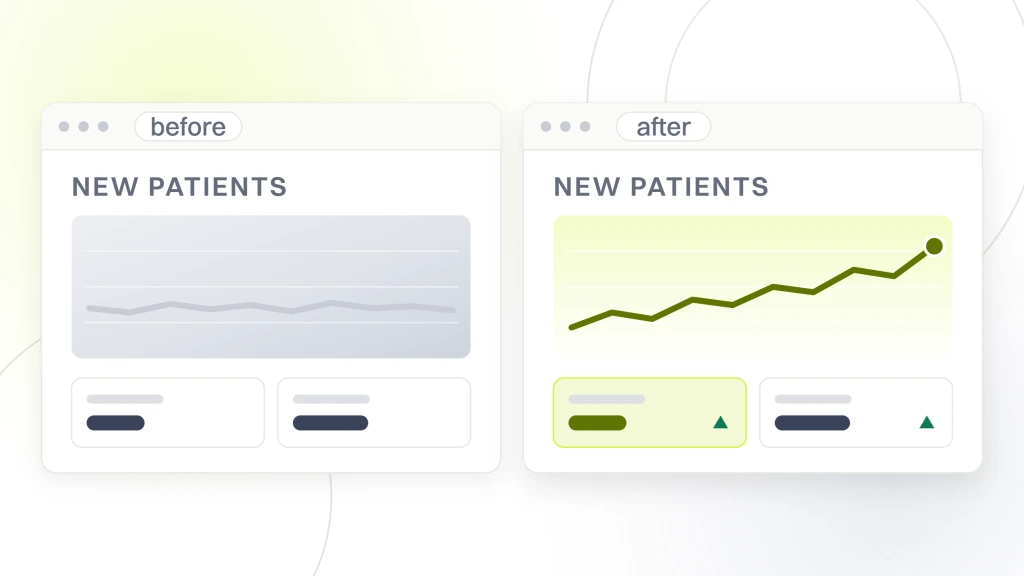
New monthly patients doubled, up 100% from the pre-launch baseline. Recurring monthly revenue from those patients added $8,100 per month within the first 12 months. Google Maps search impressions grew 776% as the location expanded far beyond the office radius. 1 partner, 1 strategy, 1 accountable team produced the compounding that 2 fragmented vendors could not.
What we would repeat
The decision to unify web and SEO under 1 team was the largest single lever. Practices juggling multiple agencies pay a coordination tax that shows up as slower launches, mismatched messaging, and lost attribution. The 8-mile Google Maps SEO focus was the second lever, and it beat trying to rank statewide. See our dental marketing for dentists for the fuller version of that sequencing framework.
VP Dental doubled new monthly patients and added $8,100 per month in recurring revenue after unifying web and SEO under 1 accountable team.
What to Cut From Most Dental Marketing Programs
Most dental marketing programs carry 4 to 8 tactics that produce almost no measurable output for the practice. Cutting them frees budget and attention for the dental marketing strategies that actually move the pipeline forward. Every strategy review pass should include a kill list of the underperforming tactics that quietly consume cash, and the audit takes 90 minutes with the last 6 months of ad-account and analytics data open.
Untargeted display and video ads
Display and YouTube campaigns that run against generic dental interest audiences almost never produce measurable new-patient volume for a local practice. Cut them. Reallocate the budget to search or Meta. Display works as retargeting for warm audiences only, not as a cold acquisition channel, and confusing the 2 use cases is the single most common paid-media mistake we see in dental patient acquisition audits.
Yelp and paid directory memberships
Yelp Business, 1-800-DENTIST, and paid directory memberships rarely produce enough attributable new-patient volume to justify the cost. Track the actual booked appointments from each source over 6 months. If the cost per booked patient exceeds $250, cut the source. Redirect the budget to Google Ads or GBP investment where the same dollars produce 2 to 4 times the booked volume.
Vanity SEO reports
Monthly SEO reports full of ranking screenshots without traffic or conversion data are a vendor tell. The rankings that matter are the ones that produce traffic and calls. Ask the agency to report on new-patient contribution by channel, not on rank position for 40 obscure keywords. Vendors that cannot produce that report are selling activity, not results. See the Google Search ranking systems guide for a grounding on what actually drives visibility.
Where to Take Your Dental Marketing Strategies Next
The dental marketing strategies list above is not a wish list. Once you have picked the 7 strategies and cut the tactics that were quietly bleeding budget, the sequencing question becomes practical. Solo practices usually see meaningful new-patient volume growth inside 90 days. Groups see it inside 120 days. DSOs see it inside 180 days as the coordination pays back. Every quarter you sit still is a quarter your dental competitor analysis gap widens against rivals winning the map pack.
Pick the strategy with the biggest gap against your benchmark row. Give it 2 focused months. Measure the delta. Move to the next gap. That rhythm produces the compounding VP Dental and North County Dental Care saw, and it works whether the practice runs $3,500 or $150,000 a month across channels. In short, the practices that pick a lane and stay in it beat the practices that spray effort across all 7 dental marketing strategies at once.