
The best SEO companies for food and beverage brands don’t rank by conference sponsorships, awards decks, or Domain Authority scores. They rank by operational muscle. Recipe schema deployed live across a 200 page hub with nutrition data pulled from real product labels. Cluster maps that separate transactional intent from informational intent per SKU category. Editorial outreach into food publications where editors actually open the pitch. And technical audits that catch the Shopify pagination and WooCommerce canonical mismatches generalists miss for lack of category reps. Every one of those muscles gets trained by prior client work, and that’s the specific bar you can measure any pitching agency against.
You’ll get the 6 point screening framework for evaluating shortlisted vendors, retainer bands at $999 to $4,500 per month at Redefine Web, red flags that surface inside the first sales call, 4 real case studies from Custimy, Vejrø Resort, Boogie Board, Abigail Ahern, and BSH Hausgeräte GmbH covering DTC, hospitality, ecommerce, and enterprise consumer goods, and 8 FAQs answering what founders and marketing directors ask before signing. Read straight through and you’ll be able to run a first sales call with any food or beverage SEO agency and know inside 45 minutes whether the shop belongs on your shortlist. Our food and beverage SEO service page carries the scope we run on client accounts today, and the wider food and beverage marketing hub covers the paired channels.
Screening framework the best SEO companies for food and beverage clear on the first call
The screening framework runs 6 checks inside the first 45 minute sales call. Category retainer count over 18 months, with 3 plus food accounts as the floor for real muscle. Live recipe schema deployment demo, run through Google Rich Results Test in 90 seconds on a client URL. Editorial backlink placements from the last 6 months, named by publication rather than a generic count. PDP internal linking pattern demonstrated with real anchor text mix on a live account. Technical audit sample from a food client with screenshots redacted for confidentiality. And a Search Console screenshot showing category-specific commercial queries, not brand queries. Category specialists answer all 6 inside the first call. Generalists deflect or promise to circle back.
The circle back is the tell. Specialists have already run 3 to 8 food accounts and can pull screenshots from Search Console, Ahrefs, and their internal dashboard while you’re on the call. Generalists don’t have the accounts and can’t produce the artifacts. Watching response speed and specificity in the first call saves you 6 months of a mismatched retainer. Google’s own recipe structured data reference and the Rich Results Test tool are the standards you’re asking the vendor to walk you through, and the pass status shows up in seconds on a client URL if the schema is really live.
Screening the shortlist this way is faster than reviewing pitch decks or awards. Agencies that hold real client work spend the first 20 minutes proving it. Agencies that don’t spend the first 20 minutes describing their process. Any founder who’s picked wrong once already knows the difference. See our writeup on SEO for food and beverage brands for the deeper cluster architecture that pairs with the screening call.
Scope of work a category specialist delivers in the first 90 days
Scope of work from a category specialist covers 7 operational areas inside the first 90 days. Technical audit with 40 plus checkpoints. Keyword clustering by intent and category. On-page rewrites on the top 40 revenue-driving URLs. Recipe or product schema build-out across the hub. PDP and collection page internal linking maintenance. Content gap analysis against 3 category competitors. And a backlink audit with a disavow file for anything Google Search Console flags. Any shop scoping fewer than 7 areas is either working narrow (technical-only retainer with content in-house) or padding scope without depth. The right answer depends on what your team already covers before the retainer starts.
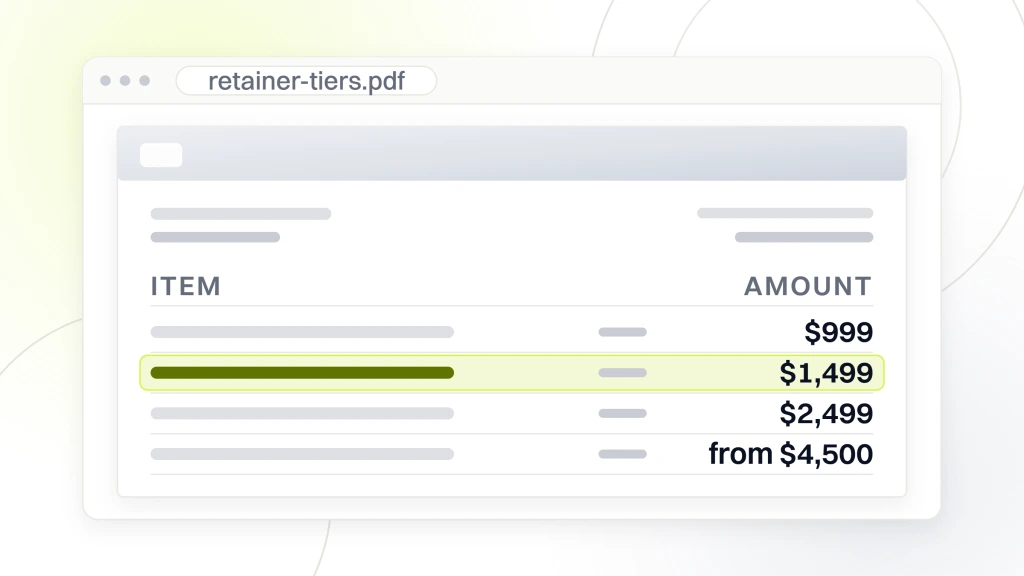
Deliverables per month vary by retainer band. Technical-only retainers deliver 2 audits per quarter, ongoing Core Web Vitals monitoring, and schema template maintenance. Content plus technical retainers add 4 to 8 recipe or cluster pages per month with SEO-optimized copy. Full-service retainers add 5 to 10 editorial backlink placements per quarter and 1 digital PR campaign. A category specialist makes the retainer band explicit at kickoff so both sides know what’s in scope. Vague scope with as-needed language turns into scope creep by month 3 and damages the relationship.
Redefine Web publishes 4 SEO retainer tiers at $999, $1,499, $2,499, and from $4,500 per month, and the tier picks itself once you count the pages, target markets, and content refresh volume the program needs. Ad spend for creator seeding and paid amplification sits outside the retainer scope, billed separately at cost plus management. Read our food and beverage digital marketing agency comparison for the way SEO scope pairs with paid, email, and creator scope across a full-service engagement, and see the food and beverage PPC guide plus the content marketing for food brands breakdown for the paired scopes.
Custimy earned 500 first-page keywords with isometric design plus off-site SEO
Custimy is a customer data platform that unifies e-commerce operations by consolidating data from CMS, email, analytics, customer service, and social media. This centralized approach enables personalized newsletters, intelligent product recommendations, and targeted campaigns. Built for scalability, Custimy supports rapid growth while ensuring efficient data handling. As a SaaS startup, they needed to stand out, attract investors, and convert visitors into users. Redefine Web replaced a generic identity with isometric brand-aligned design and a scalable backend, then ran off-site SEO campaigns targeting niche category keywords.
The Custimy program delivered 500 first-page keywords, 25,000 monthly organic visits, and 165 second average session duration. Custom illustrations differentiated the site visually from generic SaaS competitors. Multiple API integrations powered real-time sales and customer data views on the backend. Off-site campaigns targeted industry keywords and built out link acquisition against 3 category competitors. The engagement ran across 2023 and 2024, and the outcome numbers rolled forward as the platform kept publishing category content on the isometric hub. Founders scoping a similar SaaS-adjacent food data play should study the Custimy pattern first because it compresses several of the muscles a category specialist should already carry.
The Custimy work is a useful reference for CPG SaaS or subscription food brands where the site has to sell to buyers, investors, and platform partners all at once. See our managed hosting for food and beverage websites comparison for the infrastructure side that keeps the isometric UI loading fast under real traffic.
Vejrø Resort turned social presence into 10,000 organic visitors in 3 months
Vejrø Resort is a private island getaway featuring luxury suites and cozy guest houses, ideal for a serene retreat. The onsite restaurant focuses on organic, locally sourced cuisine. Accessible by charter boat or marina, the resort welcomes both private travelers and small groups. Strong social media presence and strong appeal didn’t translate to bookings because the property had no website. Guests couldn’t easily find details, view galleries, read reviews, or book directly. No central digital hub or booking system meant the property lost customers to competitors who ranked and converted.
Redefine Web developed a website integrating with social media and establishing a direct booking system. User-friendly layout, strong CTAs, and SEO-driven content pulled the compounding curve forward. Competitor analysis guided design and content decisions. The program delivered 10,000 organic visitors, 200 first-page keywords, and a 2.2% booking conversion in 3 months. Social engagement finally turned into paying guests. Hospitality-specific design, direct booking integration, on and off-site SEO, competitor analysis, and mobile-first performance all shipped inside the same engagement window.
Vejrø is a useful reference for food and beverage brands running a hospitality flow (private dining, tastings, farm stays, brewery tours). Direct booking integration paired with SEO compounds faster than either channel on its own because Google reads booking flow signals as strong intent. The Google reservation structured data reference is the schema pattern the resort site launched with. See our writeup on restaurant marketing agency scope for the closest food-service adjacency where the same pattern applies.
Boogie Board cut cost per sale to $31 across $650,000 in ad spend
Boogie Board, creator of the first reusable writing tablet in 2009, pioneered sustainable digital writing with liquid crystal technology, reducing paper use while supporting creativity. They expanded into educational toys and stylish stationery, selling millions in 40 plus countries. Boogie Board’s Google Ads lacked precise targeting, resulting in wasted spend and limited visibility. Conversion rates suffered because unoptimized landing pages didn’t showcase product benefits clearly. They lacked customer nurturing, missing repeat purchase and loyalty opportunities. No A/B testing or expansion into new ad platforms slowed the compounding.
Redefine Web ran a multi-faceted approach across keyword research, targeted Google Ads, and LinkedIn Ads to extend reach. Reworked ad creatives and optimized landing pages simplified shopping. Lead magnets showcasing sustainability and creativity captured engaged prospects. Automated email follow-ups and retargeting drove repeat purchases. The program delivered an 11% conversion rate gain, a $31 cost per sale at scale, and $650,000 in managed ad spend with sustainable ROI. Boogie Board’s pattern applies directly to DTC food and beverage brands where product page conversion depends on both organic visibility and paid amplification working together.
The Boogie Board work also illustrates why category specialists rarely stop at SEO alone. Google reads brand query volume as an authority signal. Coordinated paid social plus SEO plus email drives the brand queries that pull entire clusters up in ranking. See our email marketing for food brands writeup for the retention layer that compounds SEO gains after the first purchase.
Abigail Ahern grew ecommerce revenue 179% without a discount banner
Abigail Ahern, a global leader in luxurious, trend-defying interiors, offers high-quality furnishings and accessories that inspire bold, lasting design. Despite strong brand recognition, their digital marketing relied too heavily on discounts and branded searches, drawing short-term traffic but weakening their premium positioning. In August 2020 they partnered with Redefine Web to unify SEO and paid-media strategies, with the dual goals of boosting ecommerce sales and expanding their online audience while maintaining their aspirational, high-end aesthetic.
Redefine Web executed a full-funnel, premium-aligned marketing strategy across organic and paid channels. SEO efforts focused on optimizing category and product-level pages with enriched content to strengthen organic rankings and support higher-intent searches. Paid campaigns replaced discount-led messaging with depth, mood, and craft. Segmented shopping campaigns tuned bid logic to margin, not volume. Prospecting campaigns introduced the brand to new design-conscious audiences without relying on price. Sequenced retargeting brought interested visitors back at the moments that close the sale. Negative keyword discipline and weekly budget reallocation kept spend on intent that converts.
The Abigail Ahern program drove a 179% ecommerce revenue increase, 1,588% paid search ROAS, and 3,000% paid social ROAS across a 4 year partnership. Ecommerce conversion rate doubled without a single discount banner. The pattern maps onto premium food and beverage DTC brands (specialty coffee, functional beverages, artisan chocolate) where discounting damages the brand equity that the SEO cluster is trying to build.
BSH Hausgeräte lifted leads 15% while preserving SEO equity
BSH Hausgeräte GmbH, founded in 1967, is Europe’s largest home appliance manufacturer with brands including Bosch, Siemens, Gaggenau, and Neff. The company generated €15.9 billion in revenue in 2022. Despite substantial traffic, BSH Turkey’s website underperformed in conversions because of outdated backend systems and poor user flows. An outdated backend created bottlenecks, slowing performance and limiting frontend improvements. Frontend navigation was not user-friendly, making it hard for customers to find information or connect with departments. Strong SEO rankings couldn’t be sacrificed during the redesign. Weak funnel optimization led to low conversions despite traffic.
Redefine Web delivered a UX-focused redesign and backend optimization. The approach balanced technical upgrades, usability, and SEO preservation. A more functional backend removed the technical bottlenecks. Streamlined navigation gave customers easier department access. Data-driven methodology identified and resolved conversion bottlenecks in the funnel. Faster loads and higher uptime completed the technical baseline. BSH Turkey earned a 15% lead generation gain, 3% organic traffic growth, and a 45 second average session duration lift.
The BSH Hausgeräte work applies directly to enterprise consumer goods and food manufacturer sites where a legacy backend blocks conversion improvements. Category specialists know that redesigning without preserving SEO architecture forfeits years of ranking equity. Real food and beverage SEO agencies protect that equity while modernizing the funnel. See our marketing agency for food manufacturer comparison for the enterprise-scoped version of the same pattern.
Red flags in food and beverage SEO pitches to catch on the first call
Red flags surface in the sales pitch if you know what to listen for. Any promise of specific rankings inside 90 days is a red flag. SEO is compounding work, and legitimate specialists don’t promise position numbers on specific keywords in a defined window. Any shop that won’t share a Search Console screenshot from a live food account is a red flag. Any retainer priced below $999 monthly with real deliverables is a red flag because the operational depth costs more than that to run. Any shop that quotes fixed-price SEO packages is running a template product, not a category retainer. Any pitch that leads with generic language like ranking you on Google without naming keyword clusters is a red flag.
Guarantees and money-back promises are red flags too. Legitimate food SEO firms don’t guarantee rankings because ranking depends on Google’s algorithm, competitor activity, and your site’s technical health. Shops that guarantee rankings either play games with obscure long-tail keywords nobody searches, or they refund with escape clauses buried in the contract. Category specialists set expectations at payback windows (6 to 9 months for tangible, 18 to 24 for compounding) and share risk transparently. See Google Search Essentials documentation for what actually moves rankings on a food or CPG domain.
Link building red flags include private blog networks, paid link placements labeled as editorial, and directory submission services. PBNs are algorithmic penalty magnets that Google catches inside 2 updates. Paid editorial links violate Google’s guidelines and result in manual actions. Directory links from low authority sites pass zero authority and often trigger spam signals. Real food SEO shops earn links through editorial pitches to real publications, HARO or Qwoted responses, digital PR campaigns, and creator seeding programs.
Retainer versus project engagement for food and beverage brands
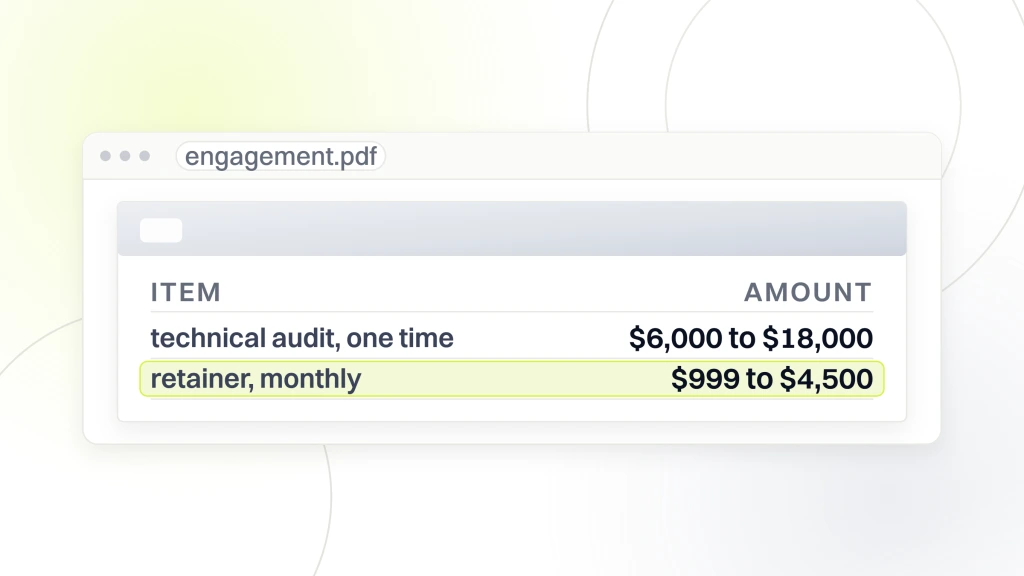
Retainer versus project engagement depends on the SEO problem you’re solving. Technical audit as a one-time project runs $6,000 to $18,000 and delivers a prioritized action list plus 30 to 60 days of implementation support. Best fit for brands with strong in-house SEO teams that need an outside audit. Retainer engagement runs $999 to $4,500 per month at Redefine Web and delivers ongoing technical health, content creation, backlink outreach, and reporting. Best fit for brands without in-house SEO capacity that need the engine outsourced. Category specialists offer both, matching engagement type to client capacity.
Project engagements make sense for one-time work like a site migration SEO plan, a schema deployment across a legacy recipe hub, or a competitor gap analysis before a category expansion. Retainer engagements make sense for ongoing work like monthly content creation, quarterly backlink campaigns, ongoing Core Web Vitals monitoring, and monthly reporting. Mixing the two on the same account (retainer plus periodic projects) works when the retainer scope is narrow enough that projects don’t overlap. Watch for shops that pitch retainer plus included projects that turn out to have separate SOWs when the invoice arrives.
Reporting cadence category specialists follow every month
Reporting cadence runs on a monthly plus quarterly rhythm. Monthly reports cover technical health, ranking deltas, revenue attribution, and priority actions for the next 30 days. Quarterly reports add strategy review, competitive positioning shifts, and retainer scope adjustments if the numbers indicate shifts. Weekly async updates on active projects (schema deployment, content publishing, backlink outreach) go through shared Slack or Notion so the client isn’t waiting for the monthly to see what launched. Anything less under-reports.
Report format matters more than the tool. Dashboards inside GA4 or Looker Studio pull the numbers directly and never fabricate. Slide decks summarize the story around the numbers for stakeholders who don’t live in analytics. PDFs archive quarterly snapshots for later comparison. Real food SEO firms deliver all 3 formats without asking. Shops that send a single-format monthly report skip either the numbers or the story, and the retainer relationship weakens over time as stakeholders lose visibility.
Onboarding checklist for a food SEO retainer
Onboarding runs through the first 30 days with named milestones. Kickoff call with founder, marketing lead, content lead, and web developer. Access provisioning across Search Console, GA4, Ahrefs, Semrush, Shopify or WooCommerce admin, and the content management system. Technical audit scoped and started inside week 1. Competitor analysis with 3 category competitors named. Keyword cluster map draft delivered by end of week 2. Editorial calendar draft delivered by end of week 3. First deliverables (schema deployment, content pages, technical fixes) started by end of week 4. The best SEO companies for food and beverage brands run this checklist so the first month never stalls.
Onboarding missteps cost time and momentum. Access provisioning that stalls at week 2 delays every deliverable downstream. Kickoff calls without a documented brief create scope ambiguity. Competitor analysis that skips category-specific competitors misses the actual ranking targets. Category specialists document the onboarding process at kickoff and share the timeline with the client on day 1. Shops that skip documentation surface friction at week 3, when the client wonders why nothing has gone live. Fix the process before the retainer, not during it.
Contract terms food SEO retainers should include
Contract terms run 6 months minimum for retainer engagements, with quarterly review points and mutual termination clauses. 6 month minimums exist because SEO compounding doesn’t show meaningful revenue gain before month 6 on food brands. Shorter contracts are usually a red flag that the shop expects mismatch and wants a fast exit. Quarterly review points give both sides a decision moment (continue, adjust scope, or terminate with 60 days notice). Termination clauses that require 90 plus days notice or full retainer payment through the notice period tilt in the shop’s favor and warrant negotiation before signing.
Content and IP ownership clauses should give the brand full ownership of all created content, dashboards, and analytics setups. Data portability at contract end matters more than most founders realize until they’re leaving. Category specialists hand over Search Console access, GA4 access, Ahrefs project files, Semrush project files, keyword clusters, backlink outreach records, and content publishing calendars at the transition point. Shops that retain access or refuse to share source files create expensive rebuilds for the next agency. Check the data portability clause at kickoff, not at the transition.
Making the pick from best SEO companies for food and beverage brands
Pick the specialist if you need recipe schema, cluster architecture, PDP internal linking, or editorial backlink outreach into food publications. Pick a generalist SEO shop if the site is a straight brochure with no recipe hub, no subscription, and no wholesale channel. Run both on scope split if you’re above $25 million in revenue and can divide technical work (specialist) from broad content work (generalist). Skip SEO entirely and focus on paid channels if you’re under $500,000 in revenue and product-market fit is still open. The retainer math doesn’t pay back at that stage on any food brand SEO engagement, no matter how good the shop.
The last piece of advice is simpler than the whole guide. Have the sales call, ask the 6 screening questions, watch for a live schema demo, review the Search Console screenshot, and trust the answers. Category specialists demonstrate. Generalists circle back. The circle back is the tell. Redefine Web runs food and beverage SEO retainers at $999, $1,499, $2,499, and from $4,500 per month, and every tier covers weekly rank tracking, monthly reporting inside client-owned dashboards, and a semi-annual strategic review with the founder or marketing lead. Read our manufacturing SEO strategy writeup for the industrial adjacency where the same screening framework applies, and see our food service digital marketing agency comparison for the restaurant and delivery-side scoping.