
DSO meaning dental owners keep asking about is the shortest question with the longest answer in dentistry today. DSO stands for Dental Support Organization. It is the business entity that runs the non-clinical side of a dental practice or a group of practices. Marketing, billing, HR, IT, procurement, and finance sit inside the DSO. Clinical work stays with the licensed dentist. Roughly 30% of US dental practices already sit inside a DSO in 2026, and the count climbs every quarter.
This guide is the honest read on the topic before any recruiter calls. You get the direct definition, the structural map, the revenue math, the industry heavyweights by size (see the top DSO dental companies ranked by office count), and the 5 questions to answer before a term sheet lands on your desk. For the buyer side of the table, read how a DSO buys dental practices step by step. Study the DSO options carefully before deciding either way, and bring the same rigor to any first vendor call. Read straight through in about 10 minutes.
DSO meaning dental industry uses in plain terms
Start with the plain answer. DSO meaning dental owners search for boils down to Dental Support Organization. The DSO owns and runs the business side of a dental practice. The dentist owns the clinical side and the license. A management services agreement (MSA) links the two entities. The DSO takes 15 to 25% of collections as a management fee. That’s the whole model in 6 sentences.
Every state’s corporate practice of dentistry law forces this split. Only a licensed dentist may own a dental practice in most states. So the DSO can’t legally own the clinical entity. Instead it owns the back office and contracts with the dentist for the business services. That structural workaround, covered in depth in the dental service organization structure guide, is why DSOs replaced dental chains in the mid-2000s and now dominate corporate dentistry. For context on how the model evolved, see the ADA News coverage.
What a DSO is not
The dso meaning dental teams overhear on webinars often gets confused with other structures. A DSO is not a dental chain that employs every dentist. It’s not a group practice where two partners share overhead. It’s not an insurance company that owns offices. Each of those counts as corporate dentistry too, but with a different legal structure. The management services agreement is the specific feature that defines a DSO. Without an MSA between a corporate parent and a dentist-owned PC, the arrangement is not a DSO. Small distinction. Big legal weight.
Why the term spread so fast
Twenty years ago, dental chains ran the corporate dentistry conversation. State dental boards pushed back. The corporate practice laws tightened. DSOs offered a legal path that kept the clinical license with the dentist and pulled business services into a corporate parent. That structure gave private equity a way in. Once PE showed up, the roll-up model scaled the DSO count from a few dozen groups to more than 400 platforms. The term spread so fast for one reason. The funding spread.
The dental DSO meaning across the corporate structure
The dental dso meaning gets clearer once you map the org chart. The corporate parent sits at the top. It employs a CEO, a Chief Dental Officer, VPs of operations, marketing, HR, IT, and finance, plus an acquisition team scouting new practices. Regional operations managers sit under that layer, each covering 8 to 20 offices. The affiliated practices sit at the bottom, each still legally owned by a licensed dentist.
A mid-size DSO with 40 practices carries about 35 corporate staff and 350 clinical staff. The corporate side runs on private equity capital and revenue from management fees. The practice side runs on patient collections, keeps a set percentage under contract, and pays the balance up to the DSO. That two-sided structure is why an affiliated dentist earns different economics than a solo owner doing the same clinical work day to day.
| Entity | Legal role | Owns | Earns |
|---|---|---|---|
| DSO parent | Corporate LLC or Inc | Systems, brand, capital | Management fees plus enterprise value |
| Regional operations | Employee layer | Nothing | Salary plus bonus on region KPIs |
| Practice PC | Professional entity | License and records | Collections minus fees and overhead |
| Owner dentist | Sole shareholder of PC | Clinical judgment | Compensation plus equity in DSO parent |
The management services agreement in detail
The MSA is the contract that makes the dso meaning dental owners hear on calls actually legal. It lists every service the DSO provides. Marketing, billing, HR, IT, compliance, procurement, real estate, finance, and often a regional operations layer. It states the management fee formula and any variable pieces. It defines the term, typically 20 to 40 years, with renewal options. And it names the exit conditions for both parties. Read the MSA twice. Then read it a third time with a transaction attorney.
The regional operations layer that carries most of the culture
Regional managers decide whether the DSO feels like a real partner or a call center. A strong regional lead visits every practice on a rotation, sits with the owner, watches a full day of ops, and takes real problems back to corporate. A weak regional lead sends spreadsheets to your office manager and never picks up the phone. Ask the DSO who your regional lead would be. Ask them what their tenure is. Ask them to name 3 problems they solved for a similar practice in the last quarter.
DSO meaning in dental revenue math worked out on a real practice
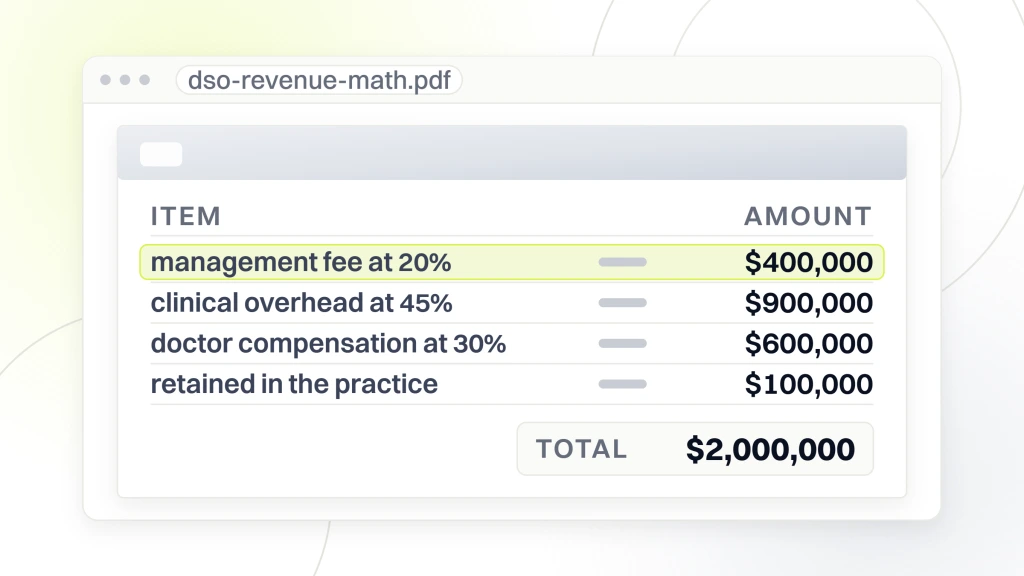
The dso meaning in dental practice terms shows up sharpest in the revenue math. Take a $2 million per year practice inside a DSO. The DSO takes a 20% management fee, so $400,000 goes up the chain. Clinical overhead runs 45%, or $900,000. Doctor compensation, at 30% of collections, pulls $600,000. The remaining $100,000 stays in the practice as retained cash for equipment and unexpected expenses.
The equity rollover on affiliation changes the math entirely. Most deals ask you to roll 20 to 40% of sale proceeds into DSO parent equity that vests over 2 to 5 years. If the DSO doubles enterprise value and sells at a higher multiple, that equity often returns 2x to 3x. If the DSO struggles, the equity is worth what the next buyer says. The upside case makes affiliation attractive. The downside case gets ignored on most sales calls. Both cases deserve equal review before you sign.
For real-world scale, one PE-backed group we work with runs 50+ dental offices across Central Florida and Tampa Bay under a single DSO umbrella. Our team at Redefine Web cut their cost per call 30% and grew PPC conversion rate 20% by restructuring paid media per location. Numbers like these tell you what a functioning DSO marketing engine should look like once affiliation closes.
Management fee structures vary more than you think
Some DSOs charge a flat percentage on collections. Others take a lower percentage on collections plus a fixed dollar amount per operatory. Others structure a graduated fee that drops if the practice hits growth targets. Read the fee formula carefully. Small differences in the formula translate into $30,000 to $80,000 per year on a mid-size practice. That’s real money and it compounds across the length of the MSA. Ask for 3 years of projected fees under the formula, not just the year-one number.
Doctor compensation structures worth comparing
Owner dentists in an affiliation deal typically earn 30 to 35% of collections plus DSO parent equity. Associate dentists earn a base salary of $150,000 to $220,000 plus a production bonus of 25 to 30% above a daily threshold. Some DSOs cap production comp at a ceiling. Others let it run. The comp structure matters more than the headline number. A high base with a low ceiling caps your earnings on a big year. A lower base with an open ceiling rewards you during peak seasons.
Define DSO dental industry heavyweights and the tail behind them
To define DSO dental industry scale and put the dso meaning dental owners study into hard numbers, start with the top platforms. Heartland Dental runs about 1,700 offices across 38 states. Aspen Dental Management runs about 1,000. Pacific Dental Services runs about 950. Smile Brands, Great Expressions Dental Centers, MB2 Dental, and Dental Care Alliance each run several hundred. Put together, the top 10 DSOs cover about 6,000 practices, close to half of the DSO segment total. But the tail is long. About 400 mid-tier DSOs run 15 to 60 offices each.
Most dentists thinking about affiliation end up talking to a mid-tier DSO, not one of the giants. That segment is where private equity actively invests, where growth ambition is highest, and where the equity rollover math tends to work out best. The tradeoff is that a mid-tier DSO has less brand equity, less operational maturity, and more variability in execution. Ask for references from 3 affiliated dentists at similar production levels. Talk to all 3 before you take the term sheet seriously.
Heartland Dental as the platform model
Heartland shows the dso meaning dental industry can execute at its best. It runs its DSO on a support-team model. Every practice keeps its brand name. The corporate side provides marketing, IT, HR, procurement, and finance. Owner dentists retain a portion of equity and get a formal partnership track. Heartland is the most recognized DSO in the industry and often shows up as a benchmark for how the model can work when executed well. That benchmark is worth studying, no matter how small the DSO in front of you. The best mid-tier DSOs borrow from the Heartland playbook.
Aspen Dental as the branded model
Aspen shows a different version of the dso meaning dental space uses. Aspen runs a different playbook. Every practice carries the Aspen brand. Marketing is fully centralized. New patients search for Aspen Dental in their metro and land on a shared website with location-specific pages. The upside is national brand recognition. The tradeoff is less flexibility on local branding for a dentist who wants to keep the practice name they built. Aspen is a fit for growth-oriented dentists comfortable trading brand equity for the marketing engine that comes with it.
DSO definition dental owners often miss on the first read
The dso definition dental owners often miss is that a DSO is not a single company. It’s a legal structure that any number of companies can use. Two DSOs can look identical in a pitch deck and run completely differently in practice. One might be dentist-founded with a slow growth model. Another might be PE-backed with aggressive quarterly targets. Same structure, opposite operating culture. Every affiliation decision hinges on the specific DSO, not on the general DSO category.
Look at 3 things when evaluating a specific DSO. First, who owns the parent, and what their return horizon is. PE-backed DSOs move faster on growth and harder on production numbers. Second, what the operating culture is on the ground. Talk to affiliated dentists off the record. Third, how the marketing engine truly runs. A DSO with weak per-location marketing costs you 15 to 25% of new patient volume compared to a competent solo operator in the same market.
- Ownership structure of the DSO parent and current investor
- Time since the last recap, the most recent recapitalization event
- Affiliated practice count and rate of growth per quarter
- Operating culture as reported by affiliated dentists
- Per-location marketing execution across similar practices
- Regional manager tenure and stability in your area
PE-backed vs dentist-led DSOs
The dso meaning dental owners get from a PE-backed group differs sharply from a dentist-led one. PE-backed DSOs move fast. Growth targets get set quarterly. Acquisitions happen every month. Marketing gets funded. Regional managers change every 18 to 24 months as the platform scales. Dentist-led DSOs move slower. Growth is deliberate. Regional managers stick around. The tradeoff is less capital and less operational sophistication. Neither model is wrong. The right choice depends on whether you want speed and scale or continuity and slower growth. Match the DSO model to your own 5-year plan.
Culture signals worth catching early
The dso meaning dental teams pick up on ground level shows in production talk. The clearest culture signal shows up in how the DSO talks about production. A DSO that leads with clinical outcomes and patient satisfaction is telling you where their operating focus sits. A DSO that leads with production targets and monthly quotas is telling you the same thing from the other side. Neither is inherently wrong. Both cultures work for different dentists. Just make sure the culture you sign into matches how you want to practice for the next 5 to 10 years.
Weighing the pros and cons after you understand the DSO meaning dental industry uses
Now that the dso meaning dental world uses is clear, the honest question is whether to affiliate. The pros are real. Payroll, hiring, insurance credentialing, and CE reimbursement stop being your problem. Purchasing power drops supply costs 20 to 35%. Marketing shows up on a monthly report. Practice management software gets patched by someone else. Liquidity from the sale lets you buy a second house or retire debt years earlier than a solo exit would.
The cons are real too. Clinical autonomy gets pressured when regional targets miss. Team turnover often ticks up in the first 6 months as the culture changes. Practice sale multiples in your market get anchored by the DSO buyer. Skip the affiliation window and your solo exit price often lands 20 to 30% lower 5 years later.
Who benefits most from a DSO deal
Practices most likely to be happy inside a DSO are producing $1.5 million to $6 million a year, run 3 or fewer operatories, want out of operational headaches, and have an owner within 10 years of retirement. That profile fits the DSO model’s operating strengths and the exit timeline the PE math wants. If your practice matches all 4 criteria, the affiliation math tends to work in your favor as long as the specific DSO checks out on culture and execution.
Who should stay solo
The dso meaning dental owners at smaller practices should hear is short. Practices producing under $900,000 rarely find a DSO deal worth signing. The management fee eats too much of the collections. Practices with a strong personal-brand owner risk losing patients when the front desk energy changes. Specialists in niche procedures the DSO does not staff for get pushed toward generalist targets that hurt clinical outcomes. If any of those describe your practice, stay solo and grow a different way, or wait for a specialty-focused DSO better suited to your profile.
The marketing side of the DSO meaning dental owners never see
The dso meaning dental owners rarely see up front is how much of the value depends on marketing execution at the corporate level. A DSO with a working marketing stack pulls 20 to 40% more new patients per location than a comparable solo practice in the same market. A DSO with a broken marketing stack costs the affiliated dentist 15 to 25% of the new patient volume they would have generated running solo. Marketing execution is the single largest hidden variable in DSO economics.
Working stacks share 5 features. Shared brand equity across locations with per-location subpages that carry local trust cues. Google Business Profile (GBP) management run by someone who has worked map pack rankings before. Location-specific paid search built at the office level, not the metro level. Awareness and consideration paid social layered across the market. And call tracking that scores every ring by whether it booked. Skip any one and the new patient count underperforms. For a full breakdown of what this stack should include, see our dental SEO services writeup.
Per-location detail that decides map pack rankings
The dso meaning dental owners see in map pack results comes down to office-level detail. Map pack rankings live on office-level detail. Named front-office manager on the location page. Real staff photos, not stock. Neighborhood mentions the local search index picks up. Reviews collected office by office with real patient names. Citations in the same NAP format across every directory. Every one of those is per-location work. A DSO marketing team that treats 40 offices as one program can’t deliver map pack coverage. A DSO marketing team with per-office ownership can.
Call tracking as the truth layer
The dso meaning dental teams get from call tracking is measurable. Call tracking is the single feature that separates a real DSO marketing program from a spreadsheet exercise. Every call scored on booked or not booked. Every source tagged. Every campaign judged on cost per booked new patient. A DSO without call tracking has no way to defend its marketing budget on a board call. A DSO with call tracking can rebalance spend across offices weekly and push budget to the markets returning the strongest new patient numbers. Non-negotiable at scale.
Real-world case for the DSO meaning dental teams should study
North County Dental Care in Vista California ran a 20-year practice with a strong offline reputation and almost no digital presence. Zero top-10 search positions. Inconsistent directory listings. Weak Google Business Profile. Marketing split across several agencies with no clear plan. New patient acquisition from digital was flat.
Our team at Redefine Web built a secure mobile-first site, cleaned up citations and NAP consistency, ran a GBP overhaul, launched a targeted GBP PPC campaign, and layered a local video program on top. Patient volume gained 1,000%. Organic traffic gained 385%. Marketing ROI hit 500%. The practice booked 12 to 16 new patients per month from digital, up from 1 to 2 before the program. Every one of those numbers translates cleanly to what a DSO marketing program should deliver at scale. If a DSO can’t show similar per-location numbers, the marketing engine is not working.
The stack that moved the numbers
The stack that moved North County Dental Care’s numbers shows the dso meaning dental owners should aim for. Secure HTTPS site rebuild with mobile-first design. Service pages built for the highest-margin procedures. Local SEO with citation cleanup and NAP alignment. GBP overhaul with real photos, real hours, and real service descriptions. Targeted GBP PPC campaign for high-intent patient searches. Local video for community credibility. Every piece worked so well since the pieces reinforced each other. Skip the citation cleanup and the map pack never ranks. Skip the site rebuild and the paid traffic bounces. The stack is the whole program, not any one lever.
Lesson for any dentist studying DSO options
Before signing a DSO deal, run the same marketing stack solo for 6 months. If your practice can produce numbers that look like North County Dental Care’s rebuild, you have more pull in the affiliation negotiation. Term sheets get better when the seller has demonstrated growth. If your practice can’t generate that growth solo, the DSO’s marketing engine is one of the strongest arguments for affiliation. Either outcome is useful information. Both come from the same 6 months of focused work before the term sheet arrives.
Study the DSO meaning dental questions before any affiliation call
The dso meaning dental owners study before any affiliation call comes down to 5 specific questions. Ask each one on every first vendor conversation. A DSO that fumbles 2 of them is off the shortlist. A DSO that answers all 5 cleanly is worth a second call. Bring your accountant to the third call. Bring a transaction attorney to the fourth. Read the MSA before the fifth. Nothing about this process should feel rushed. Rush signals in the negotiation almost always favor the DSO.
The 5 questions cut through the sales script. What is the management fee formula in year one, year 3, and year 5. Who owns the DSO parent today and what is the exit horizon. What percentage of proceeds do you want rolled into equity, and on what vesting schedule. How does the marketing team run per-location work across affiliated practices. And who would be my regional operations lead. Ask each question on the first call. Note the answers verbatim. Compare across 3 DSOs before you signal serious intent to any of them.
- Management fee formula for years 1, 3, and 5
- DSO parent ownership and stated exit horizon
- Equity rollover percentage and vesting schedule
- Per-location marketing execution model in detail
- Named regional operations lead for your area
- Sample tenure of practices in the network
- Three named references from affiliated dentists
Attorney review that pays for itself
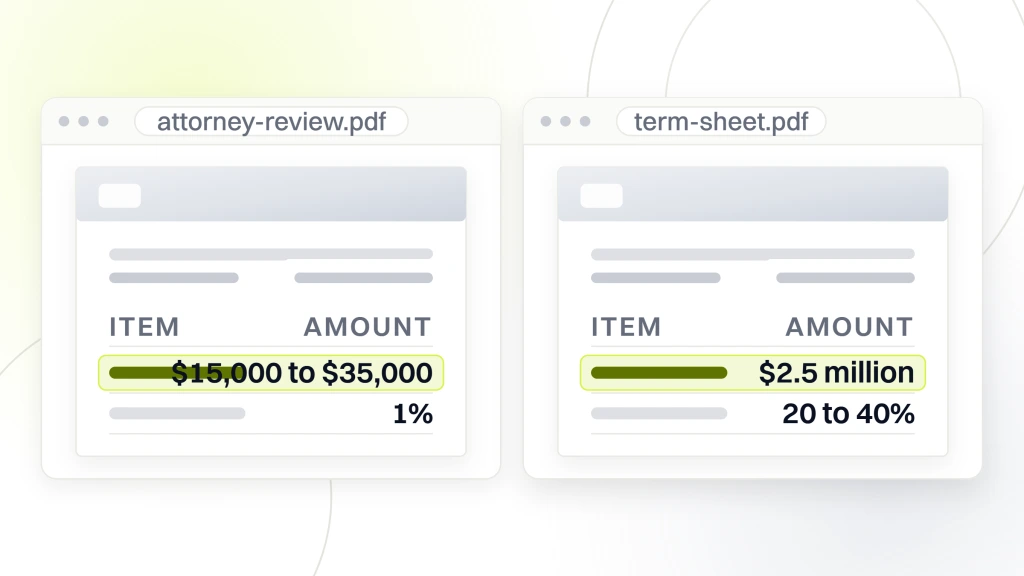
The dso meaning dental owners land on always includes lawyer money. A transaction attorney familiar with DSO deals costs $15,000 to $35,000 for a full affiliation review. That fee looks large until you compare it to the size of the deal. On a $2 million practice affiliation at a 6x EBITDA multiple, the transaction value is $2.5 million or more. The attorney fee is 1% of the deal size and often catches a term-sheet issue worth 5 to 10% of the price. That math makes the review the cheapest professional service in the entire process. Skip it and you spend the next decade regretting it.
Post-close plan you write yourself
Write your first-year plan before you sign. Which team members do you want to keep. Which vendor relationships stay. Which of your clinical protocols are non-negotiable. What patient communication goes out on close. The DSO will hand you an integration playbook. Read it. Then write your own. The two overlap on 80% of the tasks. Your version covers the 20% the DSO’s playbook missed. That 20% is what protects the practice culture through the transition.
Building a decision frame around the DSO meaning dental owners land on
Landing on the dso meaning dental owners can use requires a decision frame that goes beyond the term sheet. Three axes matter. Time horizon, or how long do you plan to practice chairside. Growth ambition, or do you want to run one office or ten. Autonomy tolerance, or how much operational control can you give up without losing sleep. Score yourself on each axis honestly. The DSO decision is a function of those 3 answers, not of the specific offer in front of you.
A dentist 5 years from retirement, comfortable trading autonomy for cash, and content owning one strong office should study every DSO offer on the table. A dentist 20 years out, ambitious to build a group, and unwilling to give up any operational calls should build the group solo and revisit affiliation once the group hits 4 or 5 offices. Everyone in between should run their own numbers, talk to affiliated dentists at similar profiles, and make the call with clear eyes. Consult our dental marketing retainer for what a strong solo growth engine costs. And Google Search Central is the reference for schema markup a DSO site needs across every location.
The three-axis score in practice
The dso meaning dental owners settle on lives inside a scoring frame. Score each axis 1 to 5 in your journal before the first DSO call. A total score of 10 to 15 makes affiliation worth serious study. A total of 5 to 9 makes solo growth the stronger path. Under 5 and you should build slower or hand the practice to a partner instead. Over 15 and you’re ready to move fast. The exercise takes 20 minutes. It saves the 6 months of ambivalence most dentists spend trying to decide without a scoring frame.
Revisit the score every year
Your three-axis score changes as the practice and your life change. A new associate hire changes the growth axis. A back injury changes the time horizon axis. A rough regulatory year changes the autonomy tolerance axis. Score yourself annually. If the total moves 5 points in either direction, the affiliation question is back on the table. Most dentists benefit from the discipline of asking the question every year and answering it honestly, whether they act on it or not.
Next steps if the DSO meaning dental math still points toward affiliation
If the dso meaning dental math points toward affiliation for your practice, start with 3 specific actions. Pull 3 years of tax returns and prepare a quality-of-earnings package. Talk to 3 DSOs and collect comparable term sheets. Talk to 2 affiliated dentists inside each DSO off the record. Those actions cost you nothing but time and set up the negotiation cleanly. Rushing past them costs you pull at the table and often costs you 5 to 10% of the sale price.
The dso meaning dental math becomes negotiable once the term sheets arrive. At that point, involve a transaction attorney familiar with DSO deals. Compare fee structures, comp formulas, equity rollover terms, noncompete radii, and exit clauses side by side. If two DSOs come in inside a 10% band, the deal is fair. If one is 25% above the others, ask what they see that the others miss. If one is 25% below, walk. When you’re ready to look at the marketing side of what a strong dental group runs, our dental marketing agency hub covers the full engagement. For paid media detail, our dental PPC management writeup covers what a growth practice should run.