
Pet sitting web design is the tight stack of on-page moves that turns a nervous dog mom scrolling at 9 p.m. into a confirmed booking before she closes the tab. A homepage that reads like a resume, a phone number tucked into the footer, and a contact form that asks for a mailing address will hand that booking to the next Rover profile in the search results. Pet parents vet a sitter the same way they vet a babysitter, and the site has about 40 seconds to earn the trust before the thumb swipes back to Google.
This guide walks the layout, the booking flow, the trust signals, and the numbers that turn a pet sitting site into a booking engine for solo sitters, franchise operators, and multi-market brands. You will see the exact above-the-fold stack that converts, the widget setup that outbooks a contact form, the radius map that answers the where-do-you-sit question before the visitor asks, and the testimonial pattern that reads real to a pet parent, not scripted. The stack holds up whether you run one ZIP code or a 40-city franchise map.
Pet sitting web design in one page
Pet sitting web design is the full stack of layout, copy, imagery, booking flow, and trust signals that convert a pet parent’s search into a confirmed sit. The core stack has five parts. A hero with a bonded-and-insured line above the fold, a live booking widget that shows real availability, a service radius map, a wall of pet-parent testimonials with pet names, and a sitter bio page that reads like a person, not a corporate profile.
What the site is not
A pet sitting site is not a brochure. Every page carries a booking call to action within a thumb’s reach on mobile, and every service page answers the four pet-parent questions in order. Are you insured. What’s your radius. Do you handle my dog’s meds and quirks. How do I book. If the site answers those four in under 60 seconds of scrolling, the booking widget catches the intent. If the site opens with a founder story before answering any of the four, the tab closes and the pet parent picks the next result on the page.
Pet parents book the site that removes the anxiety fastest
A pet parent leaving a golden retriever with a stranger for five nights is not shopping on price. They’re shopping on the specific fear that something bad happens while they’re on a plane and they can’t get back in time. Every element on a pet sitting site either lowers that fear or raises it. There is no neutral copy on this vertical. A blurry photo, a broken form, a stale review from 2019, all of it reads as risk, and risk closes the tab.
What anxious pet parents look for in 40 seconds
On this vertical the 40-second scan hits the hero, drops to the review count, checks for a phone number that dials on click, jumps to the service area, and lands on the book-now button. Every one of those five elements has to be visible, obvious, and truthful. Rover and Wag pulled the industry standard up. A solo sitter or an indie franchise now competes with a marketplace app that shows 89 sitters in the same ZIP code with photos, prices, and 400 reviews each. The site that wins is the one that answers the anxiety questions faster than the marketplace does, without the marketplace fee.
Bonded, insured, background checked belongs in the H1
Bonded, insured, and background checked are the three words that carry the most conversion weight on a pet sitting homepage. Put them in the hero, in the trust bar, in the sitter bio, and in the footer. Not once. Every time. A pet parent scanning three sitter sites at 10 p.m. picks the one that repeats the trust language in three places over the one that hides it in an about page. The Pet Sitters International professional standards page lays out the same trust markers as table stakes, not add-ons, so aligning the copy with the industry association language reads authentic to the pet parent doing the homework.
The above-the-fold layout that books sits on the first scroll
The pet sitting web design above-the-fold hero section is the whole conversion argument compressed into one screen. On mobile that’s about 640 vertical pixels. On desktop it’s about 800. Every pixel above the fold has a job, and the visitor decides whether to keep scrolling or bounce inside the first three seconds. The layout pattern that converts stacks the elements in a specific order for a reason.
The nine above-the-fold elements a pet sitting hero needs
Logo at top left. Click-to-call phone at top right. A one-line H1 that names the service and city (In-Home Pet Sitting for Austin Dogs). A subhead that repeats bonded, insured, background checked. A star rating with the Google review count. A book-now button that opens a real widget, not a contact form. A hero image of the real sitter with a real client dog. A service area line naming ZIPs or neighborhoods. And a trust bar with Checkr, the bonding carrier, and NAPPS or PSI.
Where most pet sitting sites break the hero
Most pet sitting sites break the hero in the same three spots. First, the hero image is a stock golden retriever from Unsplash that clashes with the real dogs pictured in the testimonials. Fix it by shooting five client dogs on a phone this weekend and rotating them into the hero slot. Second, the CTA reads Contact Us instead of Book Now. Fix it by wiring the CTA button straight to a live availability widget. Third, the service area sits in the footer or reads as We serve Austin and surrounding areas. Fix it by pinning the ZIP list into the hero and the polygon map onto the services page. Every one of those fixes is a same-day change, and every one moves booking rates by two to five points on the same traffic. Redefine Web builds these systems as part of our pet business web design program for sitters, groomers, and pet brands that need the booking flow wired end to end.
Real-time booking widget beats a contact form every single week
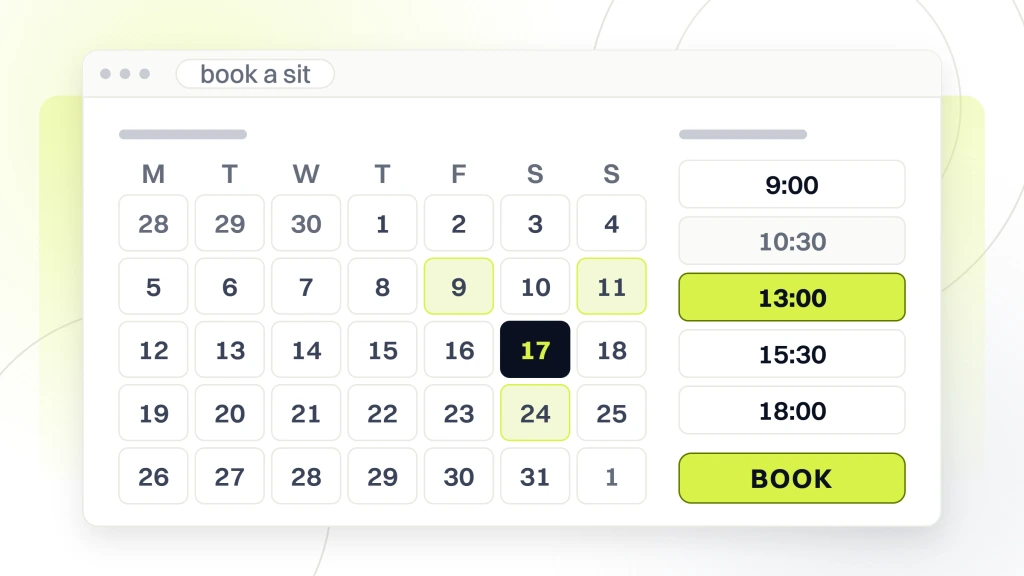
A real-time booking widget on a pet sitting web design is the single biggest conversion lever on a pet sitting site. A contact form asks the pet parent to describe their trip, wait for a reply, coordinate a phone call, and then confirm dates. A booking widget shows availability the same second the pet parent lands on the page. Conversion rate on widget-first sites runs two to four times higher than on form-first sites, per public conversion data from pet care platforms like Time To Pet and Precise Petcare.
Three widget platforms worth wiring in
Time To Pet handles the full sitter workflow, from booking to invoicing to visit reports with GPS check-ins. Precise Petcare covers the same ground with a lighter interface and a solid sitter app. Scout for Pet Sitters runs the newer, cleaner UI and pairs well with Stripe for card capture at the moment of booking. All three drop an embeddable widget into WordPress or Framer without a developer. Pick the one your ops team will open every morning without complaint. A widget nobody uses is worse than no widget at all, because the pet parent gets a confirmation email and then a manual reschedule request from an ops person who missed the booking in the queue.
What the widget flow should ask, and what it shouldn’t
Step one asks for dates, service type, number of pets, ZIP code, and contact info. Meds, feeding schedule, vet contacts, and access instructions belong on step two after the sit lands on the calendar and a card is on file. A two-step flow with card capture runs a 60 to 75% completion rate. A one-step form with 12 fields runs 8 to 12%. The widget is the difference between a booked sit tonight and a follow-up email nobody opens tomorrow.
Background-check trust badges carry the conversion weight
Background-check trust badges are the single highest-impact element on a pet sitting web design. They live in the hero trust bar, on every sitter bio page, on the pricing page, and in the footer. A Checkr badge, a Sterling badge, or a state-level fingerprint clearance from a licensed vendor answers the biggest silent question a pet parent asks. Who is going to be alone in my house with my dog for five days. If the answer is invisible, the booking goes elsewhere.
The seven trust badges pet sitting sites should show
The trust bar should include the background-check vendor logo, the bonding and insurance carrier logo, the pro-association crest (NAPPS, PSI), the CPR and first-aid badge (Pet Tech, PetSaver), the payment security badge (Stripe or Square PCI), the Google review widget with count, and the BBB badge if you have one. Seven is the cap. More looks like a certification farm.
Where to place the trust badges for maximum impact
Place four badges in the hero trust bar right under the H1. Place all seven in a dedicated trust section between the services grid and the testimonials. Place three in the footer above the copyright line. Place the background-check and insurance badge on every sitter bio card in the team page. That’s four placements on the site. Every placement compounds. A pet parent might miss the hero bar on a fast scroll, catch the trust section on the way down, and then reconfirm the insurance line on the sitter bio before hitting book now. That’s the pattern that turns anxious scanning into a booked sit. See the pet products marketing hub for the wider view across pet care verticals.
Service radius maps answer the where-do-you-sit question before it’s asked
Service radius maps are the second-highest conversion element on a pet sitting web design after the booking widget. A pet parent in Round Rock searching Austin dog sitter needs to see a map that either includes Round Rock or does not, in three seconds, without scrolling to a footer. The map lives on the services page, the pricing page, and inside the widget itself. Every service page carries a map. Every service page.
Three map patterns that convert
Pattern one, a Google Maps or Mapbox embed with a filled polygon overlaid on the service area. Pattern two, a static SVG map with color-coded ZIP codes for primary, secondary, and outer service zones. Pattern three, a searchable ZIP input that returns a yes-we-cover-that or no-we-don’t response with a friendly explanation. Pattern three converts best on multi-market franchise sites because it turns the map from a passive visual into an active qualification step. A pet parent who types in a ZIP and gets a green check has already cleared the biggest doubt standing between them and a booked session.
Franchise operators need location switchers, not one shared map
A franchise pet sitting brand with 20 markets cannot show one national map. Each market gets a dedicated city page with a local map, a local sitter roster, market-specific reviews, and a local phone number. The homepage carries a city selector that either detects location or asks the pet parent to pick a market from a list. That pattern grows booking rates 25 to 40% versus a single national contact page. Read the Google Maps developer blog for the technical patterns behind the polygon overlays and geocoded ZIP lookups. Redefine Web’s pet business SEO program handles the city page architecture for multi-market pet brands.
Meet-and-greets are the pre-booking flow the site must schedule
A meet-and-greet is the 20 to 30 minute in-home visit where the sitter meets the pet, the pet parent hands over the house key and the vet paperwork, and both sides decide the fit is right. Almost every serious pet parent asks for one before the first overnight sit. If the site does not schedule the meet-and-greet directly through the widget, the booking stalls in email tag and a competitor sitter closes the sit before Friday. A site that treats the meet-and-greet as a first-class booking step grows first-time client conversion 30 to 45% versus a site that only accepts service bookings.
How the meet-and-greet slot lives inside the widget
Wire the widget so meet-and-greet is a distinct service type on the dropdown, priced at zero dollars or a small refundable fee, with a shorter 20-minute time block and a note that a card is captured but not charged. The pet parent picks a slot on the sitter’s real calendar, gets an SMS confirmation, and receives a pre-visit checklist that asks about dog temperament, medications, feeding times, and gate codes. Time To Pet, Precise Petcare, and Scout all support a two-step meet-and-greet flow natively. On WordPress sites without one of those platforms, a WooCommerce Bookings plus a Twilio SMS trigger will replicate the flow for a solo sitter running under 20 sits a week.
What the post-meet-and-greet email should carry
Send a same-day follow-up email after every meet-and-greet with three parts. A short recap of the pet’s routine as the sitter heard it (feeding schedule, walk cadence, quirks). A link back into the booking widget pre-loaded with the pet’s profile and the dates the pet parent mentioned. A one-sentence trust line that repeats the bonded, insured, and background-checked language. First-time client conversion on that same-day follow-up runs 55 to 70% versus a 15 to 25% conversion rate on a next-day plain-text email. Speed matters. The pet parent is still in decision mode for about six hours after the sitter walks out the front door.
Testimonials from real pet parents beat five-star ratings alone
Testimonials from pet parents are the closing argument for a booking. A four-star rating with 200 reviews on Google is the opening credential. A wall of specific, named, dog-and-cat-included testimonials is what turns the browsing pet parent into a customer. The pattern that reads real to a pet parent has three parts. The pet parent’s first name, the pet’s name and breed, and one specific detail the sitter handled well.
Copy pattern that reads authentic to a pet parent
Sarah left her senior Lab, Biscuit, with Marcus for a long weekend. Marcus sent a photo every morning, remembered Biscuit’s arthritis meds at 8 a.m. and 8 p.m., and left the house cleaner than he found it. That reads as a real experience. Marcus was professional and caring reads as filler and pet parents skim past it. Name the pet. Name the specific detail. Name the small human moment. Pull the review from Google or Yelp with permission and quote it verbatim. Do not clean up the grammar. The rough edges are the proof the review is real.
Where to place testimonials for the highest impact
Place three testimonials above the booking widget on every service page. Place a wall of 12 to 20 on a dedicated reviews page linked from the primary nav. Place one testimonial inside the booking widget flow itself, right before the payment step, so the pet parent gets a last reassurance before card capture. Place video testimonials on the homepage if you have them. A 20-second phone video of a pet parent talking about their dog outperforms a paragraph of written copy for booking rate, and the phone video reads more authentic than a produced testimonial with a lower third. See Trustpilot’s review widget documentation for the technical placement patterns and schema markup.
Sitter bio pages carry the conversion weight for solo and team operators
Sitter bio pages on a pet sitting web design are where a pet parent decides whether to trust a specific human with the house key. A solo sitter has one bio page. A team of 12 has 12 bio pages, one for each sitter, all linked from a team overview. The bio page is not a resume. It’s a photo, a background story, three certifications, one specific thing about pets the sitter loves, and a booking button that pre-fills the sitter’s name on the widget.
Eight elements every sitter bio needs
A clear headshot with a real client dog, not a stock photo. A short bio paragraph in the sitter’s own voice. Background check, insurance, and bonding badges specific to this sitter. Pet CPR and first-aid certification with the vendor logo. Years of experience with a number, not a range. The sitter’s home ZIP code or coverage area (yes, pet parents check for local match). Star rating and review count from Google or the platform. A book-now button that opens the widget with the sitter pre-selected. A short answer to the question, why do you do this work.
Where sitter bios kill the booking
Bios kill the booking when they read like corporate profiles. Words like passionate, dedicated, and reliable are filler that every sitter uses and none of them prove. A pet parent scanning three sitter bios is looking for signals of specific competence. Bio one says I’ve been walking dogs for six years and I’m certified in Pet Tech first aid and I once carried a 90 pound Great Pyrenees down three flights of stairs to a vet ER at 2 a.m. That reads specific. Bio two says I love animals and have a passion for pet care. That reads like a template. The specific bio books the sit. The template bio does not. Write bios in the sitter’s actual voice, and edit for clarity, not for corporate polish.
Repeat-client dashboards turn one-off sits into monthly recurring bookings
A repeat-client dashboard is the logged-in view a returning pet parent hits after the first sit lands. Instead of re-entering the pet name, the vet contact, the meds, and the house access code, the returning client sees a saved profile, a one-click rebook button, and a booking history with the sitter’s notes from prior visits. That single flow grows repeat-booking rate 25 to 45% because the friction between the sixth sit and the seventh sit drops from ten minutes to about twenty seconds. Every sitter operation serving more than 40 clients a month needs this dashboard.
Six dashboard elements that grow lifetime value
A rebook button that pre-loads the last sit’s details for a one-click new booking. A pet profile card the client edits without a call to the office (weight change, new medication, updated vet contact). A booking history showing the last 12 sits with dates, sitter name, and any sitter notes marked visible to the client. A stored payment method with an easy swap flow. A referral link with a small credit to the client’s next sit. And a preferred-sitter tag that routes new bookings to the same sitter when available. Time To Pet and Scout both offer a variant of this dashboard. On a custom WordPress build, MemberPress plus a WooCommerce Bookings extension covers the same ground.
Service pages a pet sitting site needs, and the ones it does not
If you also run grooming or add-on services, our SEO for pet groomers guide maps the extra pages that book local clients.
A sitter site with the right service pages ranks in the map pack for the queries that book. A site missing those pages loses traffic to Rover, Wag, and PetSmart. The core service pages are drop-in visits, overnight in-home sits, dog walking, cat sitting, and boarding if you offer it. Each page targets a specific search intent and a specific pet-parent worry. Bundle them all into one services page and you rank for none of them.
The five service pages that carry the ranking
Drop-in visits page targets 30-minute visits for feeding, potty breaks, and quick play. Overnight in-home sits page targets multi-night stays where the sitter sleeps at the client’s house. Dog walking page targets recurring weekday walks for working pet parents. Cat sitting page targets vacation coverage for cat owners who do not want a boarding facility. Boarding page (if applicable) targets pet parents who prefer a facility over an in-home sit. Each page carries a service-specific H1, a service-specific FAQ, a service-specific price range, a service-specific map or radius, and the same booking widget wired to the correct service type on step one.
The pages that do not move the needle
A blog with generic posts like top five signs your dog needs a sitter does not move the booking needle. Cost pages that name real dollar amounts do. Comparison pages like professional pet sitter vs Rover, or in-home pet sitting vs boarding facility, rank for high-intent research queries and book pet parents actively comparing options. Skip the fluff blog. Write the specific cost and comparison content that a pet parent Googles at 10 p.m. the night before a trip. Redefine Web keeps the content stack lean and booking-focused inside our pet business website maintenance plan, so operators do not spend budget on posts that never rank.
Mobile speed and Core Web Vitals decide the booking
A pet parent Googling emergency dog sitter Austin tonight is on a phone with two bars of signal outside a restaurant, tapping through three sites in a minute. If your site takes four seconds to paint, they are gone. Mobile speed is not a technical vanity metric. It is a booking multiplier every single week, and it is cheap to fix once someone with browser dev tools opens the site and audits the payload.
Core Web Vitals targets for a pet sitting site
Largest Contentful Paint under 2.5 seconds on 4G. Cumulative Layout Shift under 0.05 so the booking widget does not jump around while the page loads. Interaction to Next Paint under 200ms so the click on book now feels instant. First Input Delay under 100ms. These are Google’s public thresholds, and Google Search treats sites that miss them as lower ranking on mobile local queries. Read the Core Web Vitals reference on web.dev for the exact measurement methodology.
Six same-week performance fixes for pet sitting sites
Compress the hero to under 200KB in WebP or AVIF. Lazy-load every image below the fold. Defer the widget script until the visitor scrolls into the CTA. Cache the map tile. Turn on HTTP/2 or HTTP/3. Kill Facebook, Instagram, or TikTok pixels that fire on every page load and eat 400ms of INP. Six fixes, one afternoon, three to five booking points on the same traffic inside two weeks.
Pricing pages that publish real numbers book more sits than pricing hidden behind a call
A pet sitting web design pricing page that names real dollar figures books more sits than a page that says contact us for a quote. Pet parents comparing three sitters at 10 p.m. want the number now, and the sitter that hides the price loses the booking to the sitter that publishes it. Real dollar figures also filter out price shoppers who were never going to book at your rate, and that saves the ops team from quoting into the wind on inquiries that die on the reply.
Three pricing display patterns that convert
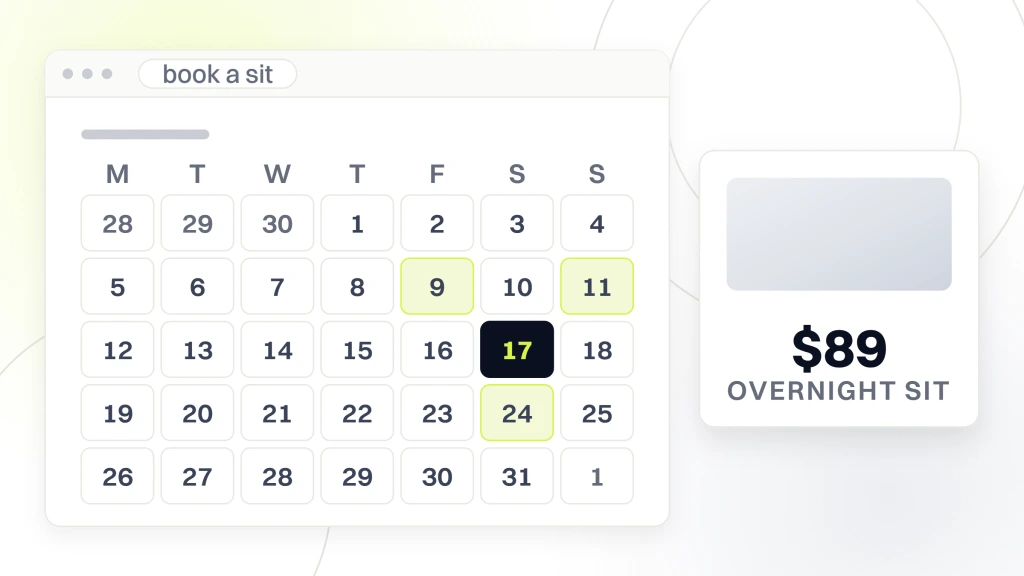
Pattern one, a simple table with service on the left and starting price on the right. Drop-in 30-minute visit from $28. Overnight in-home sit from $89. Dog walk 60-minute from $34. Starting price language handles the multi-pet, holiday, and add-on modifiers without a footnote. Pattern two, a three-tier pricing card with basic, standard, and premium tiers per service. Pattern three, a live calculator inside the booking widget that quotes the exact price based on dates and services. Pattern three is the highest converter for tech-forward pet sitting operators.
What the pricing page should also include
The pricing page needs the same trust bar the homepage carries, three service-specific testimonials, a link to the FAQ, a link to the booking widget, and a small note on holiday and last-minute booking surcharges. Publish the surcharge policy. Pet parents scheduling a Christmas-week sit want to know the Christmas-Day rate before they book, not after. A transparent surcharge policy in the same table as the base rate builds trust. A hidden surcharge that shows up on the confirmation email breaks it. See the pet business marketing retainer starting at $1,499 per month for the ongoing pricing page updates as your service mix shifts.
Rover and Wag alternatives on your own pet sitting web design
Rover and Wag take a 15 to 25% cut of every booking and control the client relationship at renewal. A site built to compete as a Rover and Wag alternative keeps the full booking value, the direct client email, and the repeat-booking data. Winning the same searches without paying the marketplace tax is straight-forward. Match the marketplace on trust density, beat it on local specificity, and undercut the effective price after the marketplace fee is stripped out.
Three signals that flip the Rover comparison on the same page
Signal one, a headline that names the marketplace directly and does the math. Book a bonded local sitter for $65 an overnight sit, not $89 after the Rover service fee. Signal two, a trust bar that stacks background-check, insurance, bonding, and CPR badges next to the pro association crest, so the pet parent sees more independent credentials than a Rover profile carries. Signal three, a real sitter face and name above the fold, not a marketplace grid of 89 profiles. Marketplaces trade specificity for scale. A direct site trades scale for the one signal marketplaces cannot fake, which is the individual sitter the client is actually hiring.
How to rank the alternative page for the marketplace query
Build a dedicated comparison page titled Pet Sitter vs Rover in [City] or In-Home Dog Sitter Alternative to Wag in [City]. The page carries a side-by-side table (price after fees, insurance coverage, cancellation policy, direct-communication access, repeat-sitter guarantee), three testimonials from clients who switched off the marketplace, and a book-now button wired to the same widget. Pages built this way rank inside three to six months for a moderate-competition metro because the marketplace itself rarely publishes a direct comparison, and the pet parent explicitly searching for a Rover alternative is deep in the purchase funnel. For the full account strategy on ranking against marketplaces, our pet business PPC program layers paid search on the same intent while the organic page climbs.
Solo sitter vs franchise site architecture
A solo pet sitter running one city and a franchise brand running 40 cities need different site architectures, but the conversion elements are the same. Both need the booking widget, the trust badges, the map, the testimonials, and the sitter bios. What changes is the page count, the city page pattern, and the way the map switches. The table below breaks down the design pattern by operator size, with real numbers from pet care operators the Redefine Web team has worked with over the last three years.
| Operator size | Page count | Booking widget | Map pattern | Monthly site cost |
|---|---|---|---|---|
| Solo sitter, one city | 7 to 10 pages | Embedded on 3 pages | Single polygon overlay | $150 to $400 |
| Small team (2 to 5 sitters) | 12 to 18 pages | Embedded on 5 pages plus sitter bios | Polygon plus ZIP lookup | $400 to $900 |
| Multi-market (3 to 8 cities) | 25 to 50 pages | City-specific instances | City switcher plus per-city polygons | $900 to $2,200 |
| Franchise (10+ cities) | 100+ pages | Location-aware routing | Nationwide switcher plus dynamic polygons | $2,200 to $6,500 |
Client work that backs the pet sitting web design pattern
Redefine Web has run the same conversion pattern across four pet-industry accounts, and the numbers travel into a sitter web build engagement. Pet Insurance Australia came in with a strong product, weak conversion paths, and paid media outspent by larger insurers. Inside five months the account produced 455 qualified conversions, an 8.87% click-through rate against a 1 to 3% benchmark, a 31.06% conversion rate against a 2 to 5% benchmark, and a 1132% return on ad spend. Pet parent psychology is identical. Trust the human, trust the process, book the service.
Mission Pet Health grew leads 54% across 400+ veterinary clinics
Mission Pet Health is a veterinarian-owned network of over 400 animal hospitals. The account came in with fragmented paid media, spend that was not tied to appointment availability, and reporting scattered across markets. Redefine Web restructured the paid framework, consolidated the account, integrated conversion tracking across the network, and layered Performance Max and Local Services Ads on top. The 12-month result was 54% year-over-year lead growth, 74% over the annual ROAS goal, and an 11% ROAS efficiency gain at scale. For a pet sitting franchise thinking about lead volume per market, the same account-consolidation logic and capacity-aligned budget pattern applies. Sitters that show up with a Local Services Ads presence next to a live booking widget compound the conversion gains from both channels.
Pet Shop retail work translates to pet sitting local search
Pet Shop, an independent UK retailer, was losing local pet parents to chains and Amazon. Redefine Web rebuilt the site mobile-first around local conversion, tuned the Google Business Profile for pet shop near me, and ran a daily Instagram and Facebook cadence. Inside one quarter, local calls and WhatsApp inquiries grew 158%, click-and-collect orders grew 212%, and repeat customers grew 47% on the same spend. A local sitter competing against Rover benefits from the same mobile-first rebuild, GBP work, and weekly content cadence.
Passion Built shows what a full rebuild produces in 12 months
Passion Built is a Sydney home-renovation specialist that came to Redefine Web with two underperforming sites. The rebuild was a single WordPress and Elementor site, SEO-driven copy, an optimized Google My Business profile, and targeted Google Ads. Inside 12 months the account ranked for 300+ keywords, generated $60,000+ in bookings, and pulled 800+ monthly visitors. A sitter planning a 12-month rebuild should expect the same effect: rankings climb quarter by quarter, bookings follow by four to six weeks, and repeat clients compound by month nine.
Schema markup and local SEO for sitter sites
Schema markup on a pet sitting web design is the machine-readable layer that tells Google what your pet sitting site is, where you operate, what services you offer, and what your reviews look like. A site with clean schema shows up in the map pack, the rich review snippets, the FAQ dropdowns, and the service listings inside Google Search. A site without schema sits below the fold on every one of those SERP features, and the missing schema is why.
The five schema types every pet sitting site needs
LocalBusiness schema with the service radius, hours, and contact info. Service schema for each of the five service pages (drop-in, overnight, walking, cat sitting, boarding). Review schema for the aggregate rating and individual testimonials. FAQ schema on the pricing page and service pages. BreadcrumbList schema for the site navigation. Add HowTo schema on any process page (how in-home pet sitting works, for example) and Person schema on each sitter bio. Google reads the schema, and the site jumps up the SERP for local pet care queries.
Local SEO signals beyond schema
Read our companion post on local SEO for pet sitters that wins direct bookings for the map pack work that pairs with this site build.
For the broader category, see our local SEO for pet businesses map pack breakdown.
Schema alone does not rank a pet sitting site. The site also needs a claimed Google Business Profile with the narrow primary category (Pet Sitter, not Pet Service), consistent NAP data across Yelp, Bing Places, Apple Maps, NextDoor, and the pro associations, plus a steady flow of recent Google reviews that mention pets and services by name. A review that says Marcus watched Biscuit for five days ranks higher for Austin pet sitter than a review that says great service. Read the Google structured data reference for local business schema for the JSON-LD templates. Redefine Web layers the full schema and local SEO stack inside the pet business services described on the industry hub.
Five numbers to track monthly
Track five numbers month over month. Bookings, cost per booking, average booking value, repeat booking rate, and site-to-Google-Business-Profile crossover rate. Everything else folds into those five. If the five move up, the site is earning its keep. If they do not, the widget, the copy, or the traffic is the culprit, and the fix sits on one of those three levers. Vanity metrics like time on page and bounce rate do not book a Thanksgiving sit.
Build the site once, then iterate every 90 days
A sitter site is not a project. It is a system that gets iterated every 90 days as bookings, testimonials, sitters, and service areas change. Build the site once with the five pillars in place. Then run a 90-day review cycle where the ops team looks at the conversion data, refreshes the testimonials, adds new sitter bios, updates the map, and rewrites any copy that is not pulling weight. That rhythm is the difference between a site that grows with the business and a site that gets replaced every three years.
The 90-day iteration checklist
Pull the 20 best Google reviews from the last 90 days and rotate three onto the homepage. Add new sitter bios and archive any who left. Update the service radius if you expanded. Refresh the hero with a new client dog photo. Rewrite the H1 if the CTR is soft. Check the widget for dropped fields. Run a Lighthouse audit on mobile. Publish one cost or comparison page targeting a new query. Half a day of ops work every quarter.
When to rebuild instead of iterate
Rebuild the site instead of iterating when the business model changes (solo sitter to team, single city to multi-city franchise), the booking platform changes (Time To Pet to Scout, for example), or the site’s tech stack is holding back Core Web Vitals no matter what you strip out. A WordPress site on shared hosting from 2018 with 12 outdated plugins is a rebuild candidate. A clean WordPress site on managed hosting with a solid theme is an iteration candidate. Know which side of the line you are on before spending $8,000 on a rebuild you did not need. Redefine Web scopes the rebuild-or-iterate call as part of the intake for every pet business web design engagement.
Pet sitting web design pricing tiers Redefine Web offers
Redefine Web builds pet sitting web design projects across three fixed-price small business tiers plus a pay-monthly path for solo sitters and single-market operators. The starter tier at $2,500 covers a solo sitter with the seven-page core, a booking widget wired to one platform (Time To Pet, Precise Petcare, or Scout), a single-polygon service map, and a launch-ready trust bar with three badges. The growth tier at $4,500 covers a small team with sitter bio pages, ZIP-lookup service map, five service pages, and Google Business Profile setup. The scale tier at $7,500 covers a multi-market operator with city page templates, city-switcher navigation, per-city sitter rosters, and full schema markup across every page.
Pay-monthly options for solo and startup sitters
The pay-monthly track runs $199 and $349 per month for solo sitters and startup operators who need cash flow room during the first year. The $99 tier covers a five-page starter site with the widget embed and one map. The $199 tier covers the full seven-page core with sitter bio and trust bar. The $349 tier covers a small team build with up to three sitter bios and a ZIP-lookup map. Every pay-monthly tier includes hosting, SSL, weekly backups, and the same 24-hour edit turnaround the fixed-price tiers get.
Ongoing maintenance keeps the site earning past launch
Maintenance plans at $199, $299, and $499 per month cover the ongoing work that keeps a pet sitting site converting past launch week. The $199 tier covers hosting, plugin updates, monthly backups, and one round of small copy edits. The $299 tier adds monthly performance audits, Core Web Vitals monitoring, and quarterly testimonial rotation. The $499 tier adds monthly SEO reporting, GBP post cadence, monthly review outreach workflow, and priority ticket response. Pet sitting operators running maintenance from month one grow bookings 15 to 30% faster in year two versus operators who launch the site and stop investing.
Ready to build the pet sitting web design that books more sits
Pet sitting web design is a small stack of design and conversion moves done well. A hero with real trust language above the fold. A booking widget wired to real availability. Background-check badges, insurance proof, and pro association crests in the trust bar. A service radius map that answers the where question in three seconds. Testimonials that name the pet and the specific detail. Sitter bios in the sitter’s own voice. Five service pages that rank in the map pack. Pricing that publishes real numbers. Schema and local SEO that Google can read. And a 90-day iteration cycle that keeps the site current with the business.
If you want the whole build stack constructed and operated for you, Redefine Web builds sites from solo sitters to franchise brands. Start with a look at the pet products marketing hub, then get in touch for a working plan sized to your city count, sitter roster, and booking goal.