Teeth whitening marketing is the fastest cosmetic entry point in a dental practice. One in-office whitening session runs 45 to 75 minutes on the chair, costs $18 to $32 in materials, and books at $299 to $650 at the register. That is an 80% to 92% margin on a service the patient books after a friend, a reel, or a wedding invitation pushed them to say yes today. Every cosmetic-minded practice uses teeth whitening marketing as the front door. The ask is small, the margin is fat, and the follow-up window is wide open for veneers, bonding, and full smile makeovers.
This guide walks through the plays that book repeat whitening cases without training price-only shoppers. You get the offer stack that filters buyers in the right direction, the ad angles that work on Google, Meta, and TikTok in 2026, the retention sequence that carries a first whitening into cosmetic dentistry, the pricing math that protects the margin, and the mistakes that quietly waste ad budget month after month. 12 minutes end to end.
Whitening is one of the largest cosmetic dentistry categories in the US and demand keeps climbing, which is why the competition for these patients is heavy. Roughly 38 million US adults use whitening products in a given year. That demand walks into your operatory only if the offer, the ad, and the follow-up match the way they buy.
Teeth whitening ads on Google, Meta, and TikTok
Teeth whitening ads earn the best return on Meta and TikTok. Whitening sells on visuals. A before-and-after clip is the whole creative. Google Search still catches high-intent queries but delivers smaller volume, since most whitening buyers do not sit down and type teeth whitening near me. They scroll Instagram, catch a reel, and click. Practices that respect that behavior land on a channel split around 60% Meta and TikTok, 30% Google Search plus Local Services Ads, and 10% email retention against their patient list.
| Channel | Monthly spend | Cost per booked session | Best angle |
|---|---|---|---|
| Meta Facebook and Instagram | $800 to $2,800 | $65 to $140 | Before and after reel |
| TikTok | $400 to $1,600 | $55 to $110 | Native provider content |
| Google Search plus LSAs | $500 to $1,800 | $85 to $180 | Teeth whitening near me |
| Email retention | $89 to $199 tool cost | $8 to $18 | Repeat and reactivation |
Meta ad creative that stops the scroll
The teeth whitening marketing creative that consistently wins on Meta is a 15 to 30 second vertical reel of the actual whitening process. Patient smile at the top. Provider applying the treatment. Timer counting. Patient smile at the end with a real reaction. No stock. No overproduced editing. Just real footage from the operatory. Practices running this format sit at $65 to $95 per booked session. Polished before-and-after grids that look like ads land at $130 to $190. Meta rewards native-feeling content and watch time is the primary ranking signal in the auction. Our dental facebook ads that work post covers the creative rotation cadence.
TikTok whitening ads and the compliance line
TikTok hits the lowest cost per booked whitening session in 2026 when the content cadence stays honest. Native creator content from the dentist or hygienist beats polished agency work by 4 to 8 times. Compliance guardrails match Meta. No before-and-after imagery without a signed HIPAA release. No claims about pain-free results or guaranteed shade jumps. A dental practice in Austin ran a 22-second hygienist-led TikTok explaining the shade guide and booked 34 whitening sessions in 6 weeks at $58 blended.
Google Search and Local Services Ads for whitening buyers
Google Search catches the highest-intent whitening buyers, the ones who already typed teeth whitening near me after a specific event pushed them to book. Volume is smaller than social, yet conversion is 2 to 3 times higher when the landing page and the calendar are ready. Local Services Ads sit above the map pack and charge per booked lead. Cost per session stays inside $85 to $180 for practices with a 4.6-plus review average. Practices below 40 reviews should fix reviews first. Every other paid channel gets 30 to 50% cheaper once you clear that bar.
Landing pages that book whitening clicks into sessions
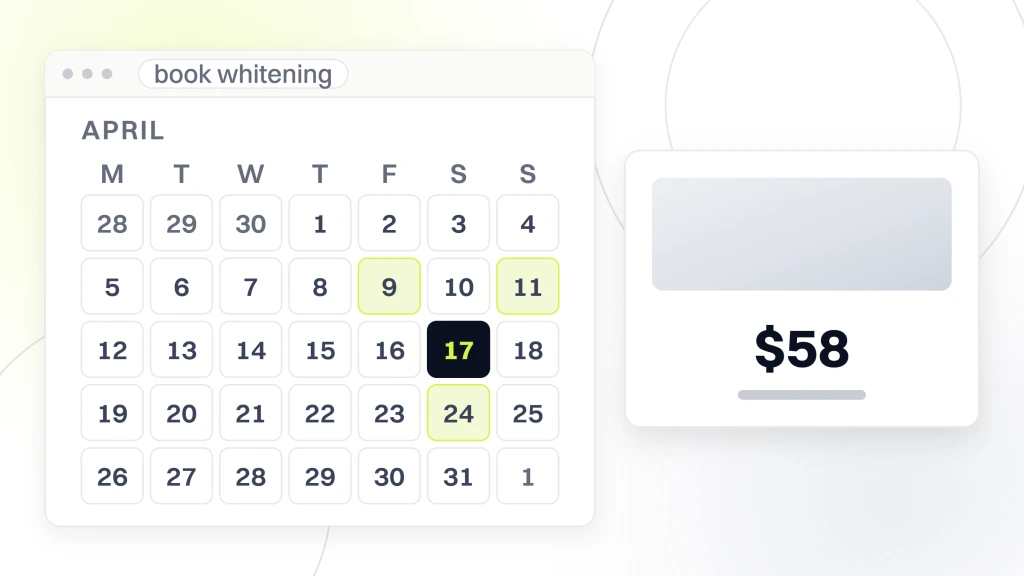
The whitening landing page is short by design. Anything past 800 words hurts conversion. The buyer is emotional and impulsive, not researching. The page carries an above-the-fold offer restated from the ad, a 3-field form or click-to-call, a real before-and-after gallery, transparent pricing, and a same-week availability calendar. Everything else lives below the fold or gets cut entirely.
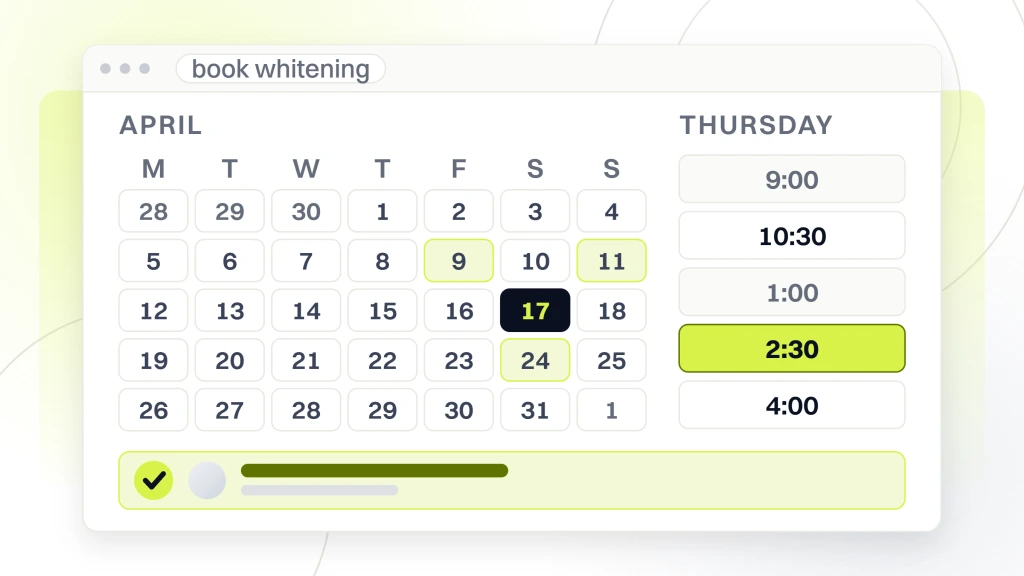
The single largest conversion lever on a whitening page is a live calendar showing tomorrow, the next day, and the day after as bookable slots. Whitening buyers decide fast. Any friction that reads as fill out this form and we will follow up within 24 hours loses 40% to 60% of clicks to a competitor with an open slot on screen. Practices that swap the form for a live calendar widget watch conversion climb from 6% or 8% up to 14% or 22% inside a week. Our dental ppc landing pages post covers the widget stack.
Before and after gallery that carries the sale
Show 6 to 12 before-and-after photos with signed releases, treatment type tags, and shade improvement notes. Real patients from the actual practice. No stock photography, no manufacturer sample images. The gallery lives on a horizontal scroll for mobile so the visitor can flick through without scrolling the whole page. Practices that populated the gallery with 12 real patients over 6 months saw whitening conversion climb 30 to 55%. The visitor could see results from real people in the same city.
Price transparency without discount fatigue
Publish the standard rate and the seasonal special rate together. $349 standard in-office whitening. $199 spring wedding season special. This mirrors the pattern in dental new patient specials. That structure signals a real deal without training the market to expect ongoing discounts. Practices that hide the standard rate and lead with the discount alone see repeat conversion drop 25 to 40%. Patients think the discount is the actual price. Show both. Anchor the value. Move on.
Whitening specials tied to a real event calendar
Whitening specials work when the discount ties to an event on the patient’s calendar. Spring wedding season, prom week, senior photo season, holiday photos, and New Year all pull 3 to 5 times the conversion of a standing 20% off promotion. The strongest whitening specials name the event in the ad headline and cap the offer at 4 to 6 weeks. That scarcity converts. Practices running 4 event-tied whitening specials per year book 60 to 90 whitening cases across the special windows and spend 30 to 45% less per session than year-round discount runners.
Retention flow that turns whitening into cosmetic cases
Retention is where whitening marketing pays for itself. A first whitening patient who leaves without a follow-up plan books cosmetic dentistry at a 6% to 12% rate. A first whitening patient who moves into a structured retention flow books cosmetic dentistry at a 25% to 45% rate across the next 12 months. The sequence does the quiet work and the patient watches their new smile in the mirror, starts noticing what else they want to fix.
The 5 touches. Day 3 post-whitening, text asking how the smile feels. Day 14, email with a photo gallery of cosmetic cases from the practice. Day 45, email with a specific cosmetic consult offer at a modest discount. Day 90, text checking in on maintenance and recall. Day 180, email with a smile makeover consultation invitation. Each touch is short, personal, and builds the case for the next step. See our dental email marketing guide for the flow-building tool stack.
Upsell timing that respects the patient
The mistake most practices make on the retention flow is upselling too early. A day-2 email asking about veneers reads as pushy and cuts trust. The patient needs 10 to 21 days with the new smile to notice what they want to improve next. Day 14 is the earliest a cosmetic touch converts well. Day 45 is the peak, once the patient has shown off the smile at work, at family gatherings, and on social media, and is thinking about the next upgrade. Timing the upsell to the patient’s own realization, not the practice’s revenue goal, doubles conversion.
Maintenance programs that book quarterly
Offer a whitening maintenance program at $89 monthly or $349 annually that covers a touch-up tray refill and a check-up cleaning quarterly. Patients who join the program spend $1,068 to $1,296 per year on whitening plus routine care. Practices that convert 25 to 40% of first-time whitening patients into a maintenance program see whitening revenue triple inside 12 months once the annuity math kicks in. That single program is the reason some practices run whitening as a lead offer and some run it as a one-time transaction.
Whitening marketing automation stack
Whitening runs on automation. The volume is high and the touchpoints are predictable. Any practice past 15 whitening cases per month needs a stack that handles the seasonal offer calendar, the retention sequence, review generation, and reactivation for lapsed maintenance members. Running these workflows by hand eats 8 to 14 hours of front-desk time per week, hours that belong to patients on the schedule right now.
The stack is 4 tools. A CRM or marketing automation platform, $89 to $199 monthly. A texting tool that handles patient consent and short-code compliance, $49 to $99 monthly. A review generation tool, $69 to $149 monthly. A landing page builder that supports live calendar embeds, $29 to $79 monthly. Total tool cost $236 to $526 monthly. Practices that install the stack save 12 to 18 hours of front-desk time and produce 20 to 45% more whitening bookings from the same marketing spend. Our dental marketing automation post covers each tool tradeoff.
Review generation specific to whitening
Send the review request 3 to 7 days after the whitening session, not immediately after. The patient needs time for friends and family to notice the result. That noticing is what triggers a great review. Practices that send day-of-appointment review requests get positive but generic 5-star reviews. Practices that send day-5 review requests get glowing multi-sentence testimonials mentioning specific compliments the patient received. The multi-sentence reviews rank higher on Google and convert 20 to 35% more traffic to bookings.
Referral incentives that stay ethical
A whitening patient who loved the result refers 1.4 friends on average within 6 months. A structured referral incentive can raise that to 2.2 to 3.1 referrals. The ethical structure is a free take-home touch-up kit for the referring patient once a new patient books. Not cash. Not a discount on future services that pressures the patient. Just a small tangible thank-you that respects the referral. Practices that run this incentive add 4 to 8 referred whitening cases per month at zero marginal cost.
Teeth whitening marketing mistakes that burn budget
5 teeth whitening marketing mistakes show up over and over across paid accounts. Cleaning them up moves cost per booked session by 30% to 55% without touching ad spend. Read the list, then run the audit against the current setup this week.
- Bundling in-office and take-home offers on one landing page, splitting the intent audience
- Running whitening ads year-round instead of tying them to seasonal event triggers
- Setting the discount too deep at 30 to 40% off, attracting price-only shoppers
- Skipping the retention flow and losing the cosmetic upsell opportunity
- Sending patients to the homepage instead of a whitening-specific landing page
Seasonal versus year-round timing
Whitening ads run year-round produce steady but low-conversion traffic. There is no urgency in the message. Whitening ads, like the broader patterns covered in dental ads, run in tight seasonal windows with event-tied copy produce 3 to 5 times the conversion in the same 4 to 6 week window. The math favors seasonal by a wide margin. Practices should run 4 seasonal windows totaling 20 to 24 weeks per year, and go dark on paid whitening for the remaining weeks. The dark weeks feel counterintuitive, yet they preserve the urgency that makes the seasonal windows work.
Discount depth and buyer quality
A 30% discount attracts a different patient than a 55% discount. Deep discounts pull patients whose primary motivation is price. They book, they whiten, they never come back for cosmetic. Shallow discounts pull patients whose primary motivation is the result. They book, they whiten, they come back for veneers. Practices that ran both structures in test found deep-discount patients convert to cosmetic at 6 to 10%. Shallow-discount patients convert at 25 to 40%. That difference is worth $18,000 to $42,000 in cosmetic revenue per 100 whitening patients.
Whitening marketing case study inside a cosmetic practice
iSmile Dental Spa in Carmichael, California built an integrated cosmetic marketing program with teeth whitening carrying the front-end offer. Before the rebuild the practice averaged 1 to 2 new digital patients per month. 6 months in, iSmile held page one for 75 keywords, organic traffic grew 800%, new patient acquisition jumped 900%, and digital averaged 12 to 14 new patients per month. Whitening was the top-of-funnel offer that fed the cosmetic pipeline everything downstream.
The rebuild combined a secure HTTPS mobile-first site, specialized service content for sedation, periodontal, and cosmetic including whitening, local SEO and citations cleanup, targeted Google Ads for high-intent whitening and cosmetic queries, custom video production for provider trust, and Google Business Profile review generation. The whitening lead offer produced the front-end volume that the cosmetic upsell converted into full-arch veneer and smile makeover cases. Total marketing ROI hit 500% across the multi-year program.
| iSmile Dental Spa metric | Baseline | After 6 to 12 months |
|---|---|---|
| Patient growth | 1 to 2 per month | +900% |
| Organic traffic | Minimal | +800% |
| Page-one keywords | 0 | 75 |
| Marketing ROI | Undefined | +500% |
Whitening as the lead offer
Whitening booked the front-end volume at $199 to $349 per session. The retention flow converted 30 to 40% of those patients into cosmetic consults over the following 6 months. Cosmetic case volume tripled inside a year and the paid ad budget stayed flat. That is the compound math of running whitening as a lead offer instead of a service line. The upfront margin funds the paid spend, and the backend cosmetic conversions fund the practice.
Video trust building
Custom provider video was a bigger conversion lever than any single ad angle. 2 90-second explainer videos, one on the whitening process and one on cosmetic dentistry philosophy, ran on YouTube pre-roll inside the 12-mile radius. New patients arrived at consultation already convinced, cutting consult-to-close time by 30 to 45%. The American Academy of Cosmetic Dentistry patient resources and the ADA Action for Dental Health are the citation backbone for provider-facing cosmetic content.
Teeth whitening marketing plan for a small practice
A practice with 2 to 5 chairs, 400 to 900 active patients, and $1,200 to $3,000 monthly marketing budget can produce 15 to 35 whitening cases per month across paid, retention, and referral combined. The mix that lands those numbers weights Meta at 60%, Google Search plus LSAs at 25%, and marketing automation and email retention at 15%. Shift the split with the calendar. Heavier Meta during wedding season. Heavier email retention through the quieter summer weeks.
The 90-day launch plan. Weeks 1 and 2, offer structure, landing page, calendar widget, retention flow build. Weeks 3 and 4, ad account setup, creative production, LSA verification. Weeks 5 through 12, launch with weekly optimization on Meta, monthly optimization on Google, and daily front-desk workflow review. Practices that stick to the plan hit 15 to 20 whitening cases per month by day 60 and stabilize at 25 to 35 by day 90. See our dental marketing plan post for the wider quarterly template.
Seasonal budget shift
March through June, push Meta budget to 70% of the mix and wedding season pulls the highest volume. July and August, hold steady. September through October, shift 15% toward Google Search as parents book confidence-boost whitening after school starts. November through mid-January, push Meta back to 70% for holiday and New Year. Practices that hold a flat monthly split across the year leave 25 to 40% of possible bookings on the table after they underspent during peak windows.
Chair capacity and demand pacing
Whitening runs 45 to 75 minutes of chair time per session. A practice with 3 chairs and 8-hour days can handle 12 to 18 sessions per day if it flexes hygienist time. Booking past that rushes the patient experience and cuts repeat and referral rates by 20 to 35%. When paid demand exceeds capacity, don’t throttle the ads. Add evening hours or a Saturday shift. Practices that catch demand grow. Practices that limit ad spend to preserve pace stay flat.
Teeth whitening metrics worth tracking weekly
4 numbers matter on teeth whitening marketing week over week. Cost per booked session by channel. Cosmetic upsell conversion rate from whitening patients. Review generation velocity. Repeat maintenance rate on the prior whitening cohort. Everything else on the dashboard is decoration. These 4 numbers decide whether the whitening channel is compounding into cosmetic revenue or quietly losing ground.
Healthy cost per booked session on paid stays inside $75 to $115 blended. Healthy cosmetic upsell conversion sits at 25 to 45% over 12 months. Healthy review generation velocity runs 3 to 6 whitening-specific reviews per month. Healthy repeat maintenance runs 25 to 40% of first-time whitening patients booking a maintenance plan or a second session within 12 months. Any single number falling below its band for 2 consecutive months triggers an audit. All 4 falling at once means the offer or the follow-up is broken and needs a rebuild.
Upsell conversion rate as the north star
Cost per booked session tells you the funnel is efficient. Upsell conversion tells you it is profitable. A practice booking whitening at $65 and converting 8% into cosmetic cases is underperforming. Practices that also run Invisalign marketing compound the same cosmetic pipeline. A practice booking at $95 and converting 35% into cosmetic cases is compounding. The upsell number decides whether the practice can afford to spend more on paid whitening acquisition next quarter. Prioritize it on every weekly report.
Maintenance and repeat rate
Every patient who returns for a second whitening or joins maintenance is worth 3 to 6 times the first-visit revenue over 12 months. Repeat rate below 25% means the retention flow is not landing. Repeat rate above 40% means the practice has a real annuity business inside the whitening service line. Track this number monthly and rebuild whichever touch, day 14, day 45, or day 90, is under-converting.
Start your teeth whitening marketing program this quarter
Teeth whitening marketing rewards practices that treat whitening as a lead offer, not a service line. Run the 90-day plan. Split the budget 60% Meta and TikTok, 30% Google, 10% email retention. Anchor the standard price above the seasonal special. Send review requests on day 5. Run the 5-touch retention flow so day 45 catches the cosmetic upsell at peak intent. Practices that stick to this stack book 25 to 35 whitening cases per month and convert 25 to 45% into cosmetic revenue over 12 months.
Redefine Web builds whitening funnels, cosmetic upsell flows, and paid programs for cosmetic-minded dental practices across the US. If you want the offer stack, the ad creative, the calendar widget, and the retention sequence built once and running by day 60, book a call. We’ll walk through the mix that fits your chair capacity, your active patient list, and your current cost per booked session.