A realistic website maintenance cost for a small business site runs from about $50 a month to about $1,000 a month, and the width of that band is the actual story. Five pages ranking for this question were opened and read on the day this was written, and no two of them agree on what a business your size should pay.
That disagreement is why the top of this search is not an agency or a guide. It is two Reddit threads and two Quora threads of people asking strangers what they pay, because the published answers cancel out. This page tries to give the answer those threads were looking for. What the work actually is, what each price level covers, what a cheap plan leaves out, and when you should keep your money. If you want our own numbers before the reasoning, they are on our monthly website maintenance packages page and they are repeated further down.
What a website maintenance cost actually pays for
Maintenance is not one thing, which is the root of every pricing argument in this market. It is a bundle of six jobs that happen to recur, and a quote is really a statement about which of the six somebody is willing to own.
The first is patching. Your content management system, its theme and every plugin ship security and feature releases on their own schedules, and running an old version is how most small sites get compromised. The second is backups, meaning a copy of the files and the database taken often enough that losing a day is survivable. The third is monitoring, which is a machine checking that the site answers and that the certificate has not expired. The fourth is security, the scanning and firewall layer that sits in front of all of it.
The fifth is edits, the small content changes you will want during the month, and this is the one that varies most between plans. The sixth is response, which is somebody answering when the site is down. Five of those six are automatable. Only the last two involve a person, and that is almost entirely what you are paying for as the price climbs.
Notice what is not on that list. Rankings, content strategy and link work are a different retainer with a different deliverable, which we cover in our breakdown of SEO maintenance packages. A one time diagnostic is different again, and priced differently, as what an audit really runs sets out. If a quote mixes upkeep and marketing into one monthly number, ask for them separated first.
Why the published numbers disagree with each other so badly
Here is what five pages on this first page say about a small or medium business site, all read on the same day.
| Source | What it says a small business pays monthly |
|---|---|
| GoDaddy | $50 to $500 |
| Network Solutions | $200 to $1,000 |
| Gravitate Design | $50 to $250 in its table, $500 to $2,500 for “most businesses” in its own summary |
| Rocket.net | $500 to $1,000 |
| Wix | $5 to $25 for a personal blog, $200 to $2,000 for a corporate site |
GoDaddy’s floor is $50. Rocket.net’s floor is $500. That is a factor of ten on the same named category, published on the same search result page, by companies that both host websites for a living. Gravitate Design manages to disagree with itself inside one article, with a table band of $50 to $250 for a small business site and a headline claim that most businesses spend between $500 and $2,500 per month.
None of them is lying. They are describing different products under one phrase. A host writing about maintenance means its own automated stack, so its floor is the price of software. An agency writing about maintenance means a person with a calendar, so its floor is the price of an hour of attention. Both call it website maintenance cost and neither says which one it means. It is the same confusion that makes build quotes incomparable, which we worked through in our tier by tier look at web design packages.
What the cheapest plans actually include
At the bottom of the market, roughly the $15 to $100 a month band that Network Solutions calls basic maintenance packages and Rocket.net describes as starting at $20 to $50 monthly for simple static websites, you are buying software and nothing else.
That is not an insult. Software is genuinely good at this. An automated updater will apply plugin patches. A backup plugin will push a nightly archive to cloud storage. An uptime service will ping your homepage and email you when it stops answering. Those three cost very little, and for many sites they are most of the protection that matters.
What you do not get at this level is judgment. Nobody looks at the update before it runs. Nobody notices that the backup has been failing silently for six weeks. Nobody answers when the update breaks something, because there is no response commitment attached to the price. You are the person who notices, and who fixes it or pays somebody to.
Ask for the restore, not the schedule
Ask any plan to prove a backup restores onto a working URL, not to tell you how often it runs. Nightly backups that have never been restored are a file collection, and you find out which one you have on the worst day.
What a mid tier plan adds, and why it costs more
Between roughly $150 and $350 a month you stop buying software and start buying a small amount of somebody’s time. Three things appear at this level and each of them is a person.
Staging. Updates get applied to a copy of your site first, somebody loads the important pages, and only then does the change reach production. This single practice is the difference between a plugin update being a routine Tuesday and being an outage. It costs money because it takes a human ten minutes per site per week, every week, forever.
Included edit hours. Most plans in this band give you one to a handful of content changes a month. Read the unit carefully. One plan’s “content edits” means a swapped image, another’s means an hour of developer time, and those are not close to the same thing.
A named response window. Somebody has agreed in writing to reply inside a stated number of hours. That commitment is the most expensive line item in any maintenance quote, because it means a person has to be reachable whether or not anything is wrong.
What you are buying above five hundred dollars a month
Above $500 the money stops buying more maintenance and starts buying faster maintenance. Rocket.net puts corporate sites at $1,000 to $4,500 a month and stores at $750 to $5,000, and Network Solutions puts premium or custom services at $500 to $5,000 and up. Those are the same six jobs with shorter promises attached.
What genuinely changes is scale and stakes. A store with a payment gateway, a tax calculator, a shipping rate plugin and a subscription add-on has four separate patch cycles that can break each other, and each one sits directly on revenue. Wix puts ecommerce upkeep at $1,500 to $5,000 a month in its own breakdown, which is a different universe from its $5 to $25 personal blog band, and the gap is almost entirely the checkout.
The honest test for whether this band is yours is not your page count. It is what an hour of downtime costs you. Gravitate Design puts an hour of ecommerce downtime at $1,000 or more in lost sales. If your own number is anywhere near that, a faster response window is cheap. If your site takes three inquiry forms a week, it is not.
Count integrations, not pages
Count your logins, forms and payment integrations before you shop. That number decides whether you need weekly patching or a quarterly check in, and your page count barely affects it at all.
What a cheap plan quietly excludes
This is the part the forum threads keep circling. A plan under about $100 a month is unlikely to include any of the following, and almost none will be named as an exclusion.
- A staging environment. Updates go straight to your live site.
- Any edit hours. Every content change is billed on top, usually at an hourly rate you have not agreed yet.
- A response commitment. There is no stated time by which anybody has to answer you.
- Form delivery checks. Uptime monitoring proves the page loaded. It proves nothing about whether your contact form still reaches an inbox.
- A tested restore. Backups are taken. Whether they work is discovered during the emergency.
- Plugin license renewals. Gravitate Design puts these at $100 to $500 a year, and premium plugins stop receiving security updates when a license lapses.
- Malware cleanup. GoDaddy lists removal at $50 to $200 or more per incident, billed separately from any monitoring subscription.
- Major version upgrades. A PHP version jump or a page builder’s major release is project work, not a monthly task.
Read a cheap plan as a list of what is automated, then assume everything requiring a decision is extra. That habit predicts your real bill better than any published band. Our own guide to what belongs in a maintenance package works through the inclusion list in more detail.
Why hosting moves the number more than anything else
The largest single reason two honest quotes look nothing alike is that one includes hosting and the other does not, and neither one tells you.
The underlying numbers are not mysterious. GoDaddy publishes shared hosting at $5 to $15 a month, VPS hosting at $20 to $80, managed hosting at $20 to $150 and up, and dedicated servers at $80 to $300 and up. Wix puts shared hosting from $5 a month. Domains renew at roughly $10 to $20 a year on both pages, and a certificate runs from free to around $100 a year depending on type, with GoDaddy putting a standard one at $10 to $100.
So a bundled plan carries $20 to $150 a month of somebody else’s invoice inside its own price before a single human task is counted. Compare a bundled $299 plan against an unbundled $149 one and the gap is far smaller than it looks.
There is a second effect worth knowing. Maintenance is much cheaper to deliver on a stack the provider controls, because they already know the PHP version, the caching layer and the failure modes. That is genuine efficiency rather than a trick, and it is why bundled plans often include more labor at the same price. It is also lock in, so weigh both halves. Our comparison of hosting and maintenance packages sold together goes through the trade in detail.
Normalize for hosting before you compare
Write down whether each quote includes hosting before you compare any of them. Half of the published plans bundle it and half bill it separately, which by itself can make two honest prices look several times apart.
What it costs when you have no plan at all
The alternative to a monthly fee is paying by the hour when something goes wrong, and the published hourly rates are consistent enough to plan against. GoDaddy puts developer rates at $50 to $150 and up per hour. Network Solutions puts hourly developers or agencies at $50 to $200. Gravitate Design puts agencies and freelancers at $75 to $200. Rocket.net puts standard support at $150 to $250 an hour.
Take the middle of those and a break fix approach costs you nothing in a quiet month and roughly $400 to $600 in a bad one, once a four hour incident is diagnosed and fixed. Two bad months a year and you have spent what a $199 plan costs annually, without the monitoring that would have caught either problem early.
The arithmetic is not automatically in favor of a plan, though. If your site genuinely has one bad month every three years, hourly is cheaper and you should do that. The retainer wins on frequency, not on principle, and anybody telling you otherwise is selling. What the retainer reliably buys that hourly does not is a known phone number. Finding a developer who understands your site while it is down is its own cost, and it is the one nobody prices.
When you do not need a maintenance plan
Most pages answering this question are written by companies that sell plans, this one included. Read this section hardest.
You probably do not need a paid plan if your site is static, meaning it has no content management system running it. A hand built or generated site with no database and no plugins has almost no attack surface and nothing to patch. There is no recurring job to buy.
You probably do not need one if your site has no forms, no logins and no payments. Those three are where the risk lives. A brochure page with a phone number and an address can sit on managed hosting with automatic security updates switched on, and the realistic worst case is a few hours of downtime that costs you very little.
You probably do not need one if you are technical and the site is small. If you can read a changelog and restore a backup, the jobs in this article are an hour a month, and paying somebody $199 for an hour you can do in fifteen minutes is a convenience purchase rather than a protection one. Buy it if you value the time back. Do not buy it because you were told the site is at risk.
Where a plan genuinely earns its price is the combination of a live database, a payment or booking path, and nobody in the business who wants to own updates. If two of those three are false for you, be skeptical of the quote.
Split your auto updates
Switch automatic updates on for security releases and off for major versions. Security patches almost never break a site. Major plugin versions regularly do, and those are the ones that belong on a staging copy first.
Can you do your own website maintenance
Yes, for a small site, and it is worth being specific about what that actually involves rather than vague about whether it is possible.
The weekly job is about fifteen minutes. Log in, read what wants updating, apply security releases, and load your three most important pages afterward to confirm nothing moved. The monthly job is about thirty minutes. Download a full backup and actually open it, submit your own contact form and check it arrives, and glance at whether anything has slowed down.
The quarterly job gets skipped most often, and it is the one that matters. Check whether your PHP version is still supported, check whether any plugin has been abandoned by its author, and check that your license renewals have not lapsed. An abandoned plugin is the single most common route into a small site, and no automated updater will ever tell you about it, because there is no update to apply.
What you cannot realistically do yourself is respond fast while also running the business. That is the honest boundary. Upkeep is a time trade rather than a skill barrier, and deciding to handle it yourself is a correct conclusion, not a cheaper compromise.
If your site is a static brochure with no content management system, no forms and no logins, most of this page does not apply to you. The section above is the whole answer.
What our own plans cost, and where they stop
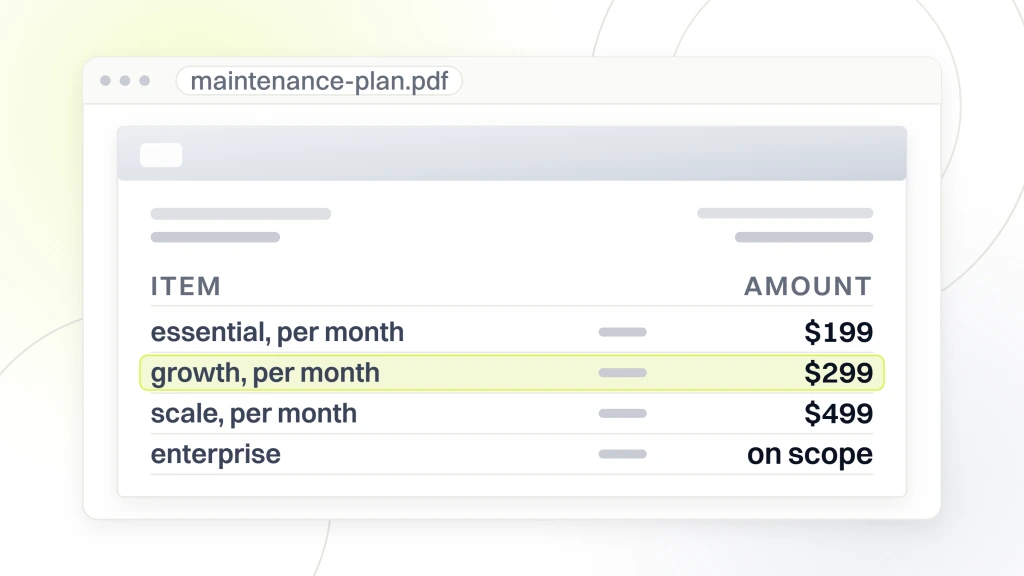
We publish our prices, so you can hold this article to its own standard. Our maintenance packages run four tiers. Essential at $199 a month, Growth at $299, Scale at $499, and an Enterprise tier priced on scope for multi location groups and franchises. Hosting is bundled into every tier, there are no setup fees, and tiers change with thirty days notice.
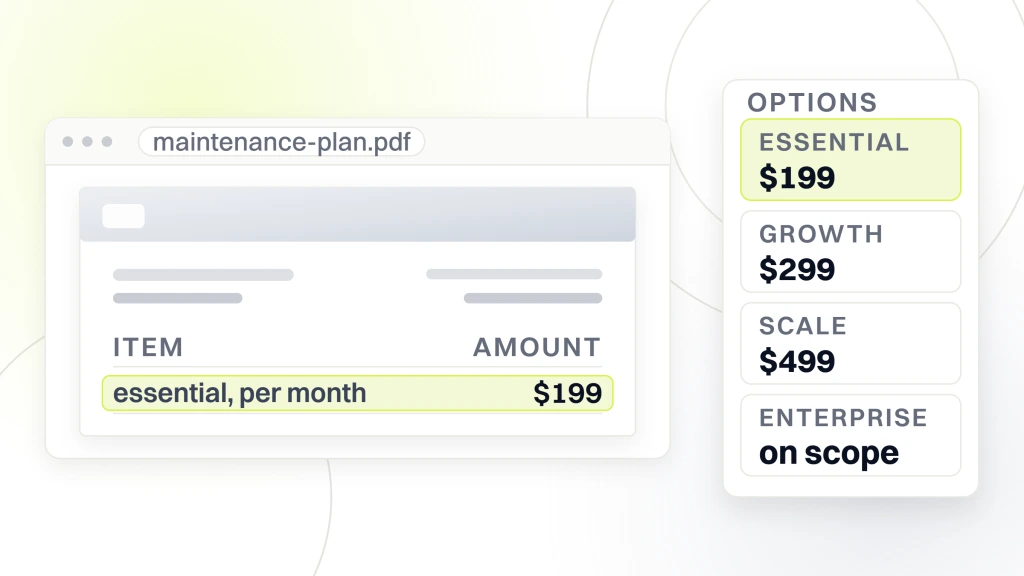
What separates them is exactly the pattern described above. All four include uptime monitoring, certificate monitoring and renewal, and core and plugin patching. Essential runs security scans and backups weekly and includes one content edit a month. Growth moves scans and backups to daily, doubles the edits, and adds monitoring of booking and scheduling integrations. Scale adds on demand backups and four edits. The difference between the tiers is frequency and human time, not a different set of jobs, and the same logic runs through WordPress maintenance packages generally.
Where that stops being a good deal is worth saying plainly. Our floor is $199, which is above GoDaddy’s entire published small business floor of $50 and well above the $15 to $100 band Network Solutions calls basic maintenance. If what you want is automated patching and a nightly backup on a brochure site, you can buy that for a fraction of our price and you should. Our tiers are priced for sites where somebody answering matters, and if that is not your site, we are the wrong purchase.
We sell maintenance plans, so an article explaining what they include is not disinterested. The section on when you do not need one is the part to weigh hardest against the rest.
What we would do first if you are shopping plans
Before you collect quotes, establish four facts about your own site. Every quote you receive is unreadable without them.
Find out who hosts you and what you pay, so you can normalize bundled and unbundled prices. Count your forms, logins and payment paths, because that is the number that decides your tier, not your page count. Work out roughly what an hour of downtime costs you, even crudely, because that is the only defensible way to choose a response window. And check when your site was last updated, because a long gap means a one time catch up cost that no monthly price includes.
Then ask every provider the same three questions. What exactly is included in an edit. What happens when something breaks outside the included work. And can you show me a backup restored onto a working URL. The answers will separate the quotes faster than the prices will. Our comparison of small business maintenance packages and our walkthrough of whether you need a package at all both go deeper on that decision.
If your site takes bookings, payments or leads and nobody in the business owns updates, buy a plan and buy the response window rather than the feature list. If it does not, put the fifteen minutes a week in your own calendar and keep the money. Either way, do it deliberately rather than because a quote arrived. If you want to know which of those two you are before you decide, our free website audit reports what your site is actually running and where it is exposed.