Dental website marketing is the difference between a 5-page brochure site that quietly loses traffic and a site that books 12 to 16 new patients a month. You spend the same $6,000 on either build. One returns the phone bill. The other returns three years of production. This guide walks through the 9 site elements we build into every dental practice site, the numbers they produce on real client builds, and the CRO checks that separate paid spend that books patients from paid spend that vanishes. Read it straight through in 12 minutes.
You’ll get the 9 on-page elements every dental site needs before it earns paid traffic, the CRO checks that catch 80% of underperforming form and phone conversions, the trust and proof elements that move a booked-call rate from 2% to 6%, the dental website marketing ideas that hold up across solo GP, cosmetic, pediatric, and DSO practices, and the exact numbers from iSmile Dental Spa and North County Dental Care where dental online marketing at the site level drove 900% and 1,000% patient growth.
What changes when dental website marketing works
Dental website marketing done right flips the site from a passive business card into an active booking engine. Passive sites list services and hours. Active sites answer three questions above the fold: insurance, next-48-hour availability, and trust. Answer those three and your call rate doubles inside a month.
The tell is the phone-to-form ratio. A passive dental site pulls 8 or 9 phone calls for every form fill, so the form gets buried and the phone number lives in the header. An active dental site drops the ratio closer to 4 to 1 because the form carries the same weight as the phone. Both channels book patients. Sites weighted too heavily toward phone lose the after-hours leads, and after-hours accounts for 40% of new-patient intent on most practices we run.
Phone-to-form ratio as the first dental online marketing metric
Track the phone-to-form ratio for 60 days before you change anything. If your ratio is 10 to 1 or worse, the form is the problem. Move the form above the fold on desktop and directly under the sub-headline on mobile. Cut the field count to name, phone, email, preferred day, and reason for visit. Watch the ratio drop to 5 to 1 in three weeks. That single change adds 8 to 12 booked exams per month for a solo GP practice at zero additional ad spend.
After-hours intent as the reason forms matter
A new patient searching “dentist near me” at 8:47 PM on a Tuesday won’t call. The phone in the header does nothing for that visitor. A form with a preferred-time picker collects the lead. The front desk calls back at 9:15 AM Wednesday. That single flow rescues 30% to 40% of intent that would walk to the next site in the SERP. Every dental website marketing site we build gets a form built for after-hours capture on day one.
9 on-page elements every dental online marketing site needs
Nine elements separate a dental site that ranks from a dental site that books. Miss any of them and one of the three funnel stages breaks: discovery, click-through, or conversion. Every dental website marketing build we run opens with this checklist. Print it, tape it to the wireframe review, and refuse to sign off on a build that misses more than one item.
- An H1 with the primary service and city (for example, Family Dentistry in Carmichael, CA).
- A sub-headline that answers insurance, hours, and new-patient offer in one sentence.
- A sticky phone number in the header on mobile at 44-pixel touch height minimum.
- A short form above the fold with 5 fields max and a preferred-day picker.
- A trust row with real doctor photo, star rating, and years-in-practice number.
- A services grid linking to 6 to 12 dedicated service pages by treatment.
- A reviews section pulling 6 to 12 verified Google reviews with photos.
- An FAQ block covering the 8 questions new patients ask on the phone.
- A footer NAP block matching Google Business Profile exactly for citation consistency.
Every one of these is a wire-level requirement, not a nice-to-have. When you’re ready to run this stack on a full practice site, our dental website design covers the build end to end. The dental website optimization checklist we run after launch keeps the load times where mobile SEO needs them.
If your dental site misses more than 2 of the 9 elements, fix those before you add a single dollar of paid spend. Ads amplify sites. They don’t rescue them.
The H1 and sub-headline pair
Your H1 works when it answers what and where in 6 words or less. “Family Dentistry in Carmichael, CA” beats “Welcome to Bright Smiles Family Dental Practice.” The sub-headline handles insurance, hours, and offer in one sentence. A visitor scans that pair in 2.4 seconds and knows whether to call. That is the whole job of the hero.
The above-the-fold form
Above-the-fold forms convert at 3% to 5% of visitors. Below-the-fold forms convert at 0.4% to 0.9%. Same site, same offer, same traffic mix. The only difference is scroll depth. On mobile, the form sits directly under the sub-headline, not in a modal, not behind a CTA button. Every dental website marketing build we run tests this on day one, and the gain is consistent across every vertical.
CRO checks that catch 80% of underperforming site conversions
CRO on a dental website means finding the 4 or 5 places where intent walks. The site loads. The visitor scrolls. The visitor abandons. Somewhere in that sequence, the site stopped answering the question. CRO checks catch the exact place where that happens. See our full dental website conversion optimization checklist for the 21-point list.
- Time on hero. Under 8 seconds means the sub-headline missed. Rewrite the sub-headline.
- Form field drop-off. Any field with 40% abandonment gets cut or made optional.
- Phone click rate on mobile. Under 5% means the header phone is too small or gray.
- Scroll depth to reviews. Under 30% means the site does not sell trust fast enough.
- Click-through on service tiles. Under 10% means the service names read wrong.
Every one of these gets a specific fix. The fixes are copy or layout adjustments, not full rebuilds. A dental website marketing CRO pass runs 4 to 6 hours per site and moves the booked-call rate 40% to 80% by the second month. That single pass is worth more than three months of blog content on most practice sites.
Form field drop-off as the fastest win
Form field drop-off gets measured with a form-analytics tool like Hotjar or Microsoft Clarity. You watch 50 session recordings. You count the field where each abandoning visitor stopped. If 15 of 20 stopped at the insurance carrier dropdown, cut the dropdown. Move insurance to a checkbox with three options plus “other.” Watch the completion rate climb from 43% to 71% in two weeks.
Scroll depth to reviews as the trust indicator
Scroll depth to the reviews section tells you whether the top of the page sold trust fast enough. If only 22% of visitors reach the reviews block, the top of the page did too much talking. Move the star rating and one review quote into the hero row. Watch the scroll-to-reviews depth climb to 60% and the booked-call rate climb with it.
Trust and proof elements that move booked-call rate from 2% to 6%
Trust elements are the reason a visitor calls one dental site over another. Same city, same insurance, same offer. What tips the visitor to your site is the 6 or 7 small trust signals above the fold. Real doctor photo, star rating from Google, years in practice, a before-and-after gallery, insurance carrier logos, and a name for the front desk lead.
The before-and-after gallery is the highest-value trust element for cosmetic and ortho practices. A gallery with 8 to 12 real cases, each labeled with the treatment name and the timeframe, moves the booked-consult rate from 1.8% to 4.4% on Invisalign campaigns. You need signed patient consent for every case in the gallery. See our dental photo consent for marketing guide for the exact release template and signature workflow.
Delicate Dental Group generated 700+ verified Google reviews within months and grew Maps calls 280%. Reviews at 4.6+ average lift map-pack rank 25% to 40%.
Real doctor photo in the hero row
A real doctor photo in the hero row moves the booked-call rate about 20 basis points on solo GP sites. Not a stock photo. Not a headshot from three haircuts ago. A recent, warm, in-office photo with the doctor in scrubs or a coat. Add the doctor’s first name under the photo. That single element beats every trust badge and award graphic we’ve tested.
Insurance carrier logo row
Insurance carrier logos in a horizontal row above the fold answer the first phone-call question before the visitor picks up the phone. Delta Dental, Cigna, MetLife, Aetna, Guardian, UnitedHealthcare. Show the 6 or 7 you accept. This single element cuts insurance-verification phone calls by 60%. See the ADA reference on practice management for the front-desk process.
Dental website marketing ideas that hold across practice types
Dental website marketing ideas group into three buckets: acquisition, retention, and reactivation. Acquisition brings new patients. Retention keeps active patients on the 6-month recall. Reactivation pulls back the 30% to 40% of your patient list that has not shown up in 18 months. Most practices under-invest in reactivation by 3 to 4x, and that’s the fastest ROI on the list for any practice with more than 1,200 patients on file.
| Idea | Bucket | Cost | Typical result |
|---|---|---|---|
| Same-day exam CTA in header | Acquisition | Free (copy change) | +12% booked-call rate |
| Insurance carrier logo row | Acquisition | Free (assets on file) | -60% insurance verify calls |
| Before-and-after gallery | Acquisition (cosmetic) | 2 hours designer time | +140% booked consult rate |
| SMS recall reminder flow | Retention | $79-$149/mo tool | +18% recall show rate |
| Email reactivation flow | Reactivation | $49/mo tool | 4 to 8 booked exams/mo per 1,000 dormant |
| Online booking widget | Acquisition | $99-$149/mo tool | +22% after-hours conversion |
| New-patient welcome page video | Acquisition + trust | $400 one-time | +7% form completion rate |
Reactivation email flows book 4 to 8 exams a month for every 1,000 dormant patients at $49/mo tooling. Payback lands in 12 to 18 days.
Reactivation as the underused bucket
Reactivation is the highest-ROI dental website marketing idea most practices skip. You have 800 to 3,000 patients who have not shown up in 18 months. An email flow with three touches (miss-you, insurance-year-end, and $99 recall exam) books 4 to 8 exams a month for every 1,000 dormant patients. Cost is $49 per month for the email tool. Setup is 4 hours. Payback is 12 to 18 days.
Online booking as the after-hours capture tool
Online booking widgets like NexHealth, Zocdoc, or LocalMed capture the 40% of intent that hits your site outside office hours. The widget shows real-time availability from your PMS. The patient picks a slot. The confirmation lands in the front-desk inbox. The show-up rate on online-booked exams runs 84% to 91% when SMS reminders are on. See our online booking for dentists guide.
How dental online marketing connects site work to paid and organic
Dental online marketing is not just paid ads or SEO in isolation. The site is the conversion floor for both. Drive 6,000 organic visits and 800 Google Ads clicks to a bad site: 20 patients. Same traffic mix on a good site: 60 patients. The site does more with less.
The link between the site and paid ads runs through the landing pages. Every campaign gets a dedicated landing page. A dental implants Google Ads campaign lands on a dental-implants landing page with implant-specific proof, implant-specific FAQ, and implant-specific form. That structure raises Google Ads Quality Score from a 6 to a 9 and drops the cost per click by 30% to 50%. See our dental ppc landing pages guide for the page-by-page CRO map.
Site as the SEO ranking floor
Dental SEO leans on the site more than any other vertical, so Google looks hard at page-level trust signals for medical content. The doctor’s E-E-A-T signals live on the About page. Service pages need medically reviewed copy and citations. The reviews block feeds Google Business Profile trust signals. See our dental website seo guide and Google’s structured data guidance for medical businesses.
Site as the paid ad landing floor
Every paid dollar lands on a page. If the page does not convert, the paid dollar is spent. Google Ads at $8 to $22 per click on dental keywords means every 100 clicks costs $800 to $2,200. A 2% booked-call rate returns 2 patients. A 6% booked-call rate returns 6 patients. Same spend, 3x return. That triple comes from the site, not the ad.
Dental website marketing case study, North County Dental Care and iSmile Dental Spa
North County Dental Care is a 20-year Vista, California general dentistry practice. When we started, they had 1 to 2 new patients per month, zero top-10 keywords, and no HTTPS on the previous site. We rebuilt the site with a mobile-first design and rolled out service pages built to convert.
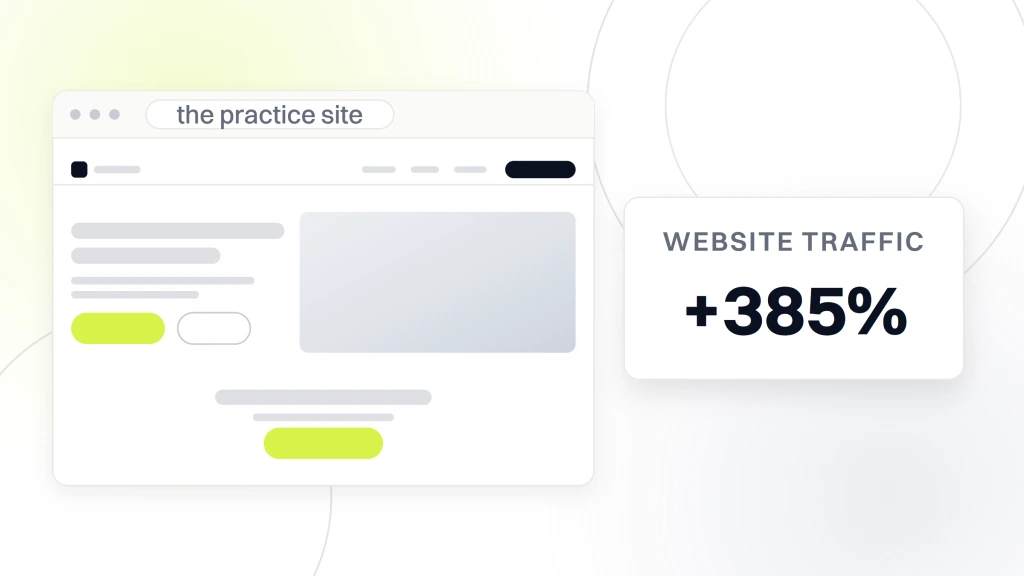
By 2024, North County Dental Care hit 12 to 16 new patients per month, +385% website traffic, and +500% marketing ROI. iSmile Dental Spa in Carmichael, California is the same story with a premium cosmetic angle. Same 1 to 2 baseline. Same insecure previous site. We rebuilt on HTTPS, added a real doctor photo to the hero, built a before-and-after gallery for smile makeovers, and rolled out 12 dedicated service pages with medically reviewed copy. Twelve months later, patient load hit 12 to 14 per month consistently. Multi-year, patient volume climbed 900%.
On Smile Design Dentistry, dental online marketing at the site and PPC level dropped cost per call 30% and lifted PPC conversion rate 20% across 50+ locations.
North County Dental Care numbers
+1,000% patient volume. +385% website traffic. +500% marketing ROI. Those three numbers landed on a site that had zero top-10 keywords and no HTTPS at the start. The site rebuild was the single largest lever. The paid ads amplified the site.
iSmile Dental Spa numbers
+900% patient load. +800% website traffic. +500% ROI. Premium cosmetic practices need the trust and proof elements more than any other vertical, and the cases run $6,000 to $18,000. The before-and-after gallery, doctor bio depth, and medically reviewed copy on the service pages carried most of the conversion gains. Nothing about the ad campaign was novel. The site did the work.
Launch cadence for a dental website marketing rebuild
A dental website marketing rebuild runs 6 to 10 weeks end to end. Week one is discovery and content audit. Weeks two to four are wireframes and design. Weeks five to eight are development and QA. Weeks nine and ten are launch, CRO pass, and analytics setup. That cadence assumes you provide content, photos, and offer approvals within 48 hours of every review round.
After launch, week two is the first analytics review. Week four is the first CRO pass. Week eight is the second CRO pass. Month three is the first traffic and ranking review. Month six is the first full ROI review. Every one of these gets a written report and a punch list of fixes. Dental website marketing done right is a continuous improvement cycle, not a one-and-done project. See our dental website management guide for the monthly maintenance stack.
Content approval delays as the timeline killer
The single largest dental website marketing timeline risk is the practice’s own content approval speed. Bio copy that sits with the office manager for 8 days. Headshot decisions that wait for the doctor’s next scheduled shoot. Insurance carrier list that lives in a spreadsheet no one wants to open. Every one of these delays the launch 2 to 4 weeks. Set a 2-day approval SLA on every review from day one.
Post-launch cadence as the compounding gain
After launch, the dental website marketing site gets better every 30 days. Week four CRO pass moves the booked-call rate 15 to 25 basis points. Week eight pass moves it another 10 to 15. Month six ROI review reveals which service pages drive the most exams and which pages need content depth. Every one of these passes is 4 to 8 hours of work and produces measurable revenue.
Dental website marketing tool stack
The dental website marketing tool stack breaks into 6 categories: CMS, forms, phone tracking, chat, booking, and analytics. Every practice runs a version of this stack. Every one is affordable at $300 to $700 per month for a solo GP practice and $1,200 to $2,400 for a multi-location group. The tools are commodities. The setup and integration are where the value sits.
- CMS. WordPress with a custom theme. Content edits under 60 seconds without a developer.
- Forms. Gravity Forms or WPForms with Zapier routing to CRM and front-desk inbox.
- Phone tracking. CallRail with dynamic number insertion by traffic source.
- Chat. LivePerson or Podium with SMS follow-up on missed conversations.
- Booking. NexHealth, Zocdoc, or LocalMed integrated to PMS.
- Analytics. GA4, Google Business Profile insights, and Microsoft Clarity for session recordings.
Test every phone number, form, and booking widget with a real submission on staging before launch. Skip the log and 4 or 5 broken integrations go live silently.
Set the whole stack up in week one of the rebuild. Test every integration in staging before launch. Every phone number, every form, every booking widget gets a real test submission on the staging URL. That single QA step catches the 4 or 5 broken integrations that would go live and cost the practice 20 to 40 booked exams in the first 30 days.
Test every tool live before launch
Test every tool with a real submission on the staging URL. Submit a form. Confirm the CRM record. Confirm the front-desk inbox. Call the tracked phone number. Confirm the CallRail recording. Fill the online booking widget. Confirm the PMS appointment. Every one of these gets a written test log with a timestamp and a screenshot. Skip the log and something breaks silently in production 2 weeks later.
GA4 configuration on day one
GA4 configured on day one saves a month of trying to reconstruct baseline traffic three months after launch. Set up GA4 with conversions on form submit, phone call, and online booking widget submit. Set up an audience for return visitors, an audience for GBP-referred traffic, and an audience for paid traffic. Every one of these audiences becomes a retargeting pool by month three. See our dental marketing attribution guide.
What to cut from most dental website marketing plans
Every dental website marketing plan has 3 to 5 items that eat time and produce zero booked patients. Cut them. The three biggest offenders on the plans we audit are Instagram feeds embedded in the footer, awards and badges from non-verified certifications, and blog posts from an outside content mill. Reallocate the time to the CRO pass.
The second cut list is design overload. Sliders with 5 rotating banners. Modal popups on scroll. Auto-play video backgrounds. Every one of these adds 800ms to 2s of load time and drops the conversion rate by 5% to 12%. Cut them. A dental website marketing site should load in under 1.8 seconds on mobile 4G and reach interactive under 3.5 seconds. Every design element that fights that budget gets cut before launch. See web.dev Core Web Vitals.
Cut hero sliders on day one
Hero sliders were the 2013 design pattern. Every conversion study since 2016 shows the first slide gets 90% of the attention and the remaining slides get near-zero interaction. Every rotating slider adds LCP time, cumulative layout shift, and JavaScript weight for zero conversion return. Every dental website marketing rebuild we run replaces sliders with a static hero.
Cut outside content mills
Blog posts written by an outside content mill that never talked to your doctor rank for nothing, convert for nothing, and add zero E-E-A-T signal. Google’s medical-content quality raters look for real practitioner byline, real credentials, real citations. A content mill post fails all three. Cut the mill contract. See our dental content marketing guide for the interview workflow.
Dental website marketing cost and timeline expectations
Dental website marketing costs run $6,000 to $18,000 for a solo GP rebuild, $15,000 to $35,000 for a multi-location group, and $40,000-plus for a DSO with 10 or more offices and a centralized brand. Timelines run 6 to 10 weeks for a solo GP, 10 to 16 weeks for a multi-location, and 16 to 24 weeks for a DSO with a location-page rollout. Every one of these budgets includes on-page CRO work, content buildout, and analytics setup.
The ongoing retainer runs $599 to $2,400 per month for dental website marketing site maintenance, minor content updates, and CRO passes. The paid media budget sits on top and runs $1,800 to $8,000 per month depending on service mix and city cost per click. See our dental marketing cost guide for the full budget breakdown by practice size and service focus.
Solo GP practice budget
Solo GP rebuild runs $6,000 to $10,000 at the low end and $10,000 to $18,000 for a full custom design and content buildout. Retainer sits at $599 to $999 per month. Media budget runs $1,800 to $3,500 per month for Google Ads plus a small local SEO retainer. Total year-one spend lands between $30,000 and $65,000 depending on aggressiveness. Return on the low end is 20 to 30 new patients per month by month six.
DSO group budget
DSO builds start at $40,000 and scale by location count and brand-tier complexity. The build is heavier, so location pages need templated SEO, per-office GBP integration, per-office reviews aggregation, and centralized reporting. Retainer sits at $2,400 to $8,000 per month depending on office count. Every DSO we work with treats the site as central infrastructure. See our dso dental marketing guide.
Where dental website marketing starts
Start with the 9 on-page elements checklist. Print it. Compare it to your live site. Every element you’re missing is a lever waiting to move the booked-call rate. Fix the top three misses first: hero H1 and sub-headline, above-the-fold form, and doctor photo. Watch the phone-to-form ratio, form completion rate, and scroll depth for four weeks and expect movement inside 30 days.
When you’re ready to run this stack across the whole practice, our dental marketing for dentists covers the full acquisition and retention stack. For the site-specific rebuild, see our custom dental website design packages. For related reading in this cluster, see our dental website optimization and dental website content guides.