
Optometrist Marketing
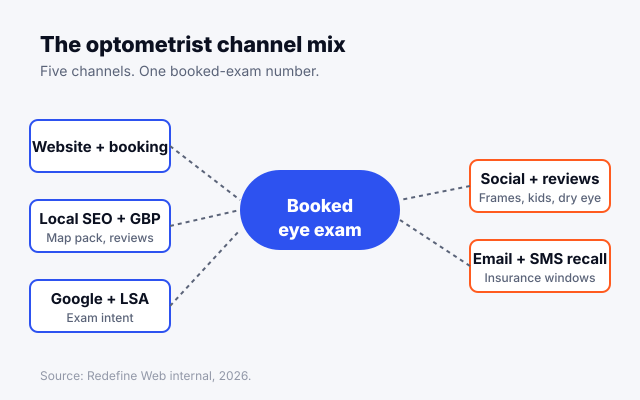
- Optometrist marketing that works is a small stack of five channels: booking-ready website, Google Business Profile plus local SEO, Google Ads for exam intent, recall or reactivation flows, and referrals.
- Independent practices we've worked with book 30 to 60 new exams a month at a blended cost per booked exam of $22 to $45.
- Google Ads books exams in week one, local SEO gains ground in 8 to 12 weeks, and organic SEO compounds over 4 to 9 months.
- The single highest-ROI channel is the automated recall program built into your EMR (RevolutionEHR, Crystal PM, Compulink, Officemate, or Eyefinity).
- Measure five numbers only: booked exams per month, cost per booked exam, show rate, frames capture rate, and annual patient value.
Optometrist marketing is the small stack of channels, offers, and follow-ups that turns a stranger with tired eyes into a booked exam and a paying frames customer. This guide walks the whole plan. Website, local SEO, Google Ads, social, email, SMS, referrals, and recall. Real numbers, real order of operations, and where each dollar shows up on the schedule.
The short version of optometrist marketing that actually works
The optometrist marketing plan that pays back is smaller than most owners think. A fast, mobile-friendly website with online booking. A Google Business Profile that ranks in the map pack for your city. Google Ads for high-intent searches like eye exam near me and kids eye doctor. A short email and SMS list you use for annual recall. One or two social channels where you post real patients (with consent) and real frames.
That’s the machine. Everything else is a garnish. If you skip the website and try to run ads, you burn cash. If you rank locally without a booking button, you lose the search-to-schedule handoff. Independent practices we’ve worked with book 30 to 60 new exams a month on this exact stack, at a cost per booked exam between $22 and $45 depending on market density. The full optometrist marketing cost guide breaks that number by tier, pricing model, and one-time build costs.
Start with the website, or the rest of your optometrist marketing wastes money
Your site is where every paid click, map pack tap, and referral card ends up. If it takes six seconds to load on 4G or hides the booking button under a hamburger menu, your marketing budget is training patients to bounce.
The version that works has five things above the fold. A clear promise (Comprehensive eye exams in [City]). The insurance you take, in plain language (VSP, EyeMed, Davis, Spectera, Medicare). A book-now button that opens your scheduler (RevolutionEHR, Weave, or a similar tool). Your Google review score. A phone number that dials on tap. That’s it. Save the “why choose us” section for row two.
Every service should have its own page. Comprehensive exams, contact lens fittings, dry eye clinic, myopia control, LASIK co-management, pediatric optometry, low vision. Each page ranks for its own keyword and gives Google Ads a place to send matching intent traffic. A single “services” grid with 200 words per item does neither.
For a deeper build spec, we wrote a full web design for optometrists playbook. It covers layout, page depth, and the CRO patterns that pushed one practice from 1.8% to 5.4% site-to-booking conversion.
Local SEO is the highest-ROI channel in optometrist marketing
Roughly half of all Google searches have local intent, and eye care is even more local than that. Patients want a practice they can drive to in fifteen minutes. Local SEO puts you in the three-result map pack that sits above the organic list. Rank there and you get the click before any competitor gets a chance.
Three moves matter most. Your Google Business Profile has to be complete: real hours, services checked, at least twenty geotagged photos of the practice and the exam lanes. Reviews need to arrive on a schedule, not in bursts. Aim for four to eight new reviews a month, asked at the counter after the frame handoff and confirmed by SMS. Your website needs pages for every neighborhood you serve if you’re in a metro area, each with unique copy about parking, transit, and insurance carriers accepted.
The compounding is real. When Vision Express, an independent practice, came to us, they were losing share to corporate chains. We rebuilt the service pages, tuned the Google Business Profile, and layered geo-targeted content. In six months, organic traffic grew 135.9% and booked appointments jumped 62%. Their full Vision Express case study covers the exact SEO, web, and PPC stack.
If you want the tactical checklist, our SEO services for optometrists page details the local, technical, and content pillars we run every month.
Google Ads for optometrists pays back fastest when it targets exam intent
Paid search is the fastest lever. SEO takes 4 to 9 months to compound. Google Ads books an exam this afternoon. The trick is spending only on searches that convert. For the whole cross-channel view, our post on digital marketing for optometrists shows how paid search plugs into local SEO, email, SMS, and social. And our breakdown of the nine optometrist marketing services covers each one individually.
Build three campaign types. First, high-intent search: eye exam near me, optometrist [city], kids eye doctor, contact lens fitting near me, dry eye specialist [city]. Second, insurance-modified terms if you’re in-network for the big plans: VSP optometrist near me, EyeMed provider [city]. Third, service-specific for higher-margin work: ortho-k [city], myopia control [city], scleral lenses [city]. Skip broad match. Stick with phrase and exact until you have three months of data.
For a practice in a mid-size metro, expect $6 to $14 per click on exam-intent terms, a 4-8% landing page conversion rate, and a cost per booked exam between $22 and $55. Google Local Services Ads (LSA) can beat that where they’re available for optometrists (the program has expanded to some healthcare categories in select markets). Pay-per-lead, not per click, and reviews carry double weight.
| Campaign type | Typical CPC | Booking rate | Cost per booked exam | Best for |
|---|---|---|---|---|
| Exam-intent search | $6 to $14 | 4-8% | $22 to $55 | Every practice |
| Insurance-modified | $4 to $9 | 6-11% | $18 to $40 | In-network practices |
| Specialty (myopia, dry eye) | $9 to $22 | 3-6% | $45 to $110 | Higher-margin services |
| Google Display remarketing | $0.60 to $2.20 | 1-3% | $40 to $90 | Reactivation, not cold |
| Meta lead ads (frames) | $0.90 to $3.20 | 2-5% | $25 to $65 | Eyewear promos, kids back-to-school |
For campaign structure and the exact keyword list, check our full PPC services for optometrists page. For the negative keyword lists and dayparting settings, see our post on tactical marketing for optometrists.
Recall and reactivation are the cheapest booked exams you’ll ever run
Most practices spend heavily to win a new patient and then lose them at month 14 when they forget their annual is due. A basic recall system built into your EMR (RevolutionEHR, Crystal PM, Compulink, Officemate, or Eyefinity) sends a reminder eleven months after the last exam, then again at twelve and thirteen months. Add an email version with a book-now link and an SMS version with a two-tap reply.
The math is stark. A cold Google click costs $8 and books an exam at maybe 6%. A recall SMS costs less than a penny and books at 22-38%. Every practice we’ve measured saves $1,800 to $4,200 a month in ad spend after month three of a real recall program, since they stop needing to buy the patients they already had. The same rebook-flow math applies across health verticals, including the SMS rebook idea in our med spa marketing playbook.
Layer a reactivation stream on top. Anyone who hasn’t been in for 24 months gets a three-email sequence with a soft offer (a free retinal photo add-on, a frame line new to your dispensary, or a benefits-are-expiring reminder in December). We’ve seen response rates of 8-14% on properly segmented reactivation lists.
Social media for optometrists is where trust builds, not where exams get booked
Set expectations right. Instagram and TikTok don’t book exams the way Google Ads does. What they do is give first-time patients a face to trust before they show up, and give existing patients a reason to refer.
Post three things on rotation. Real staff and real doctors (patients love a face). New frame arrivals with prices visible (the Luxottica, Marchon, and Safilo co-op lines almost always have brand-side promo assets you can adapt). Short educational clips: what a comprehensive exam actually checks, why your kid needs an eye exam before first grade, what dry eye is and what you can do about it. Two to four posts a week is the ceiling that stays sustainable for a two-doctor practice.
Meta (Facebook + Instagram) ads work best for eyewear promos and pediatric back-to-school campaigns. A $600 to $1,200 monthly ad budget with sharp targeting (parents 28-45, 10-mile radius, kids in household) can drive 20-40 pediatric bookings a month at $18-$32 each. Not exam-intent economics, but community-building economics.
Our dedicated optometrist marketing agency page walks the full multi-channel setup for practices that want it built and run for them.
Referrals compound faster than any paid channel
The best optometrist marketing budget line is $0. A patient who tells a friend to book with you converts at 40-60% and stays for years. The catch: most practices don’t ask.
Build a five-line referral system. First, ask at the counter after the frames are picked out (mood is highest). Second, send a two-question SMS 48 hours after the appointment (rate us, and if you loved it, here’s a link to share). Third, give existing patients a real reason to refer, not a coupon (a written thank-you card, a small credit toward their next contact-lens supply, or a donation to a local school). Fourth, build relationships with two adjacent providers: a pediatrician for kid exam referrals, a primary care doctor for diabetic retinal screenings. Fifth, run one community event a quarter (Little League team photos with a free vision screening, school health fair, senior center presentation).
Referral programs don’t scale linearly, they compound. Practices that stick with it for 18 months usually get to a 30-45% referral rate on new patients, which drops their blended cost per booked exam by 40% or more.
Measurement is what separates marketing from spending
The optometrist marketing dashboard has five numbers. Booked exams from each channel. Cost per booked exam by channel. Show rate (patients who book vs. patients who actually come in). Frames capture rate (exams that lead to eyewear purchases). Annual patient value.
Wire the tracking end to end. Google Ads to booking form to EMR appointment record. Meta ads to booking form. Recall SMS to booking form. Organic traffic to booking form. When Dr Parth Shah’s eye specialist centre went from no website to a full digital presence, that measurement chain (traffic to keyword to booking to revenue) was what let them prove 22 top-ten rankings, a 120% organic traffic surge, and a 35% revenue gain in six months. The full Dr Parth Shah case study shows the reporting cadence.
Without those five numbers, you can’t tell a great month from a lucky one. With them, you know which channel to double down on and which one to cut.
Frequently asked questions about optometrist marketing
How much should an optometrist spend on marketing?
Most independent optometrist practices spend 5-9% of gross revenue on marketing, which shakes out to $2,500 to $9,000 a month for a single-location clinic doing $500K to $1.2M in top-line revenue. New practices in their first two years should spend closer to 10-12% to build the patient base, then step down as recall and referrals take over. Multi-location groups and premium specialty practices (dry eye, myopia control, vision therapy) usually spend at the higher end, since their per-exam margin supports it.
The split we see work best: 45-55% on paid media (Google Ads plus Meta), 20-25% on SEO and content, 10-15% on the website itself, 10-15% on recall and reactivation infrastructure, and 5-10% on community and referral work. Bootstrap that ratio for the first six months, then rebalance to whatever’s returning the best cost per booked exam.
How long does optometrist marketing take to work?
Google Ads and Meta lead ads book exams in week one. Local SEO shows the map-pack gain in 8-12 weeks. Full organic SEO (ranking for city and service terms like dry eye [city] or kids eye doctor [city]) usually takes 4-9 months to compound. Recall and referral systems return meaningful gain starting month three, then keep compounding.
The realistic first-year arc: months 1-2 pay for themselves on ads only, month 3-6 add SEO gains, months 7-12 the recall and referral engine takes over and your paid cost per exam drops 30-50%. Practices that quit at month three miss the whole compounding curve. Practices that budget for a full 12-month runway usually hit 2-3x their starting new-patient volume.
What’s the best marketing for an optometrist practice?
The best marketing for an optometrist is the plan that stacks four channels in the right order: a booking-ready website first, Google Business Profile plus local SEO second, Google Ads for exam intent third, and recall plus referrals fourth. Skip any of the four and the rest works worse. Add social media once the four are producing (it’s a trust and reactivation channel, not an acquisition channel). Our full 12-month optometrist marketing strategy guide walks the quarterly phases in detail.
The single highest-ROI move for most practices is the recall system, since it converts patients you already paid to acquire. The single fastest lever is Google Ads, which books exams this week. Together, they cover both the short term and the long term.
Do optometrists need a marketing agency, or can they run it in-house?
An in-house lead can handle social, community events, and basic email if you carve out real weekly time (usually one part-time role at 15-20 hours). What tends to break in-house is paid media (Google Ads takes 8-15 hours a month of active tuning) and SEO (technical audits, content production, backlinks). Most independent practices get the best return by keeping community and social internal, and outsourcing the paid plus SEO stack to a specialist.
If you go with an agency, look for one that reports on booked exams, not clicks. Ask for the client roster and the case studies with real revenue and booking numbers. Anyone who can’t share those isn’t measuring the right thing. Our guide to marketing companies for optometrists walks the scorecard, pricing shapes, and red flags in more depth.
What KPIs matter most in optometrist marketing?
Five: booked exams per month, cost per booked exam by channel, show-up rate, frames capture rate, and annual patient value. Everything else (impressions, clicks, reach, followers) is a proxy at best and a vanity metric at worst.
Set a target for each: 40-80 new booked exams per month for a single-doctor practice, $22-$45 blended cost per booked exam, 82-90% show rate, 45-65% frames capture, and $380-$620 annual patient value. If four of the five are on target and one isn’t, you know exactly where to fix.
How do you market a new optometry practice?
Rank a fast, booking-ready website for your city and primary services first (weeks 1-4). Claim and complete your Google Business Profile with a full photo set, real hours, and every service ticked (week 1). Turn on Google Ads for exam-intent terms in a 10-15 mile radius (week 2). Ask every patient for a review at the counter, then confirm by SMS (from day one). Run a soft-open event for the neighborhood: local media, a school partnership, or a free vision screening at a community fair (month 1-2).
New practices should expect to spend closer to 10-12% of projected revenue on marketing for the first 18-24 months. The reward is a patient base that starts referring and re-booking on its own by year two, which is when the marketing math shifts from acquisition-heavy to retention-heavy.
See how our team runs the full plan for independent practices on our optometrist marketing agency page.
Book your free 30-minute strategy call.
No spam, no sales rep. We use your email to schedule your call with a senior strategist. That is it.
More from the blog
View all articles → Marketing Strategy
 How Dental DSOs Grow Through Marketing. Tactics That Scale
Read article Marketing Strategy
 Dental DSO Marketing Services. What to Expect From an Agency Partner
Read article Marketing Strategy